Kaedrin.com
You are here: Kaedrin > Weblog > Archives > Science Fiction

Science Fiction
Sunday, May 13, 2012

SF Book Review, Part 11: The Vorkosigan Saga Ends
The last time I wrote about the Vorkosigan Saga books, a commenter noted that the best books were ahead of me, and indeed, I think they were. In fact, the run of books starting with Mirror Dance and concluding with A Civil Campaign is as good as any series I've ever read, and the series as a whole represents quite a feat. It is not so bogged down with continuity that you have to read all of them - most of the novels are complete stories in and of themselves. But on the other hand, when you read them in order (as I have done), a lot of value is added. This makes some of these later books in the series difficult to judge. Memory might be my favorite novel in the series, but is that because of what happens in the novel by itself, or is it reliant on previous installments for that heft? And is that a bad thing? Personally, I don't think so... but it may make an interesting topic for another post.

Below are short reviews of the last five novels of the series (with a bonus short story thrown in for good measure). I've tried to avoid any real talk about the plots of each, but there might be some minor spoilers on a macro level. That being said, I knew a lot of this stuff was coming before I read it, and it did not diminish anything. Half the fun is Bujold's style, which is not ornate or flowery, not showy, but perhaps deceptively effective and downright compelling. These are page turners, but ones of unusual sophistication. While I have finished the series, I don't think this will be the last I blog of it. Indeed, I already have a few ideas for other posts, but they will have to wait for another day. In the meantime, here's some mixed thoughts on the last five books of the series:
  • Memory - I think this may be my favorite novel of the series. Unfortunately, I'm pretty sure it wouldn't have nearly the same impact if you started here. This book is a culmination, a real turning point for both the character of Miles and the series as a whole. Up until now, Miles has led a dual life, and for the most part, he's gotten away with it. But the chickens come home to roost in this novel, and Miles has to make some hard choices. Like all the best Vorkosigan novels, seemingly nothing goes right in the first portion of the story. I keep thinking to myself: This is wrong! Or No, you idiot! Fortunately, Bujold knows what she's doing. Miles falters in the beginning, but starts to pick himself back up, and watching him grow, watching him finally accept and acknowledge his identity, his true identity, makes for a wonderful story (this is primarily why new readers might not wholly get it). Oh sure, there's lots of intrigue and conspiracy and of course Miles is in the center of it all, but that's the norm for him. What's new is that he doesn't retreat to his normal crutches (er, not after the beginning anyway), and instead forges a new path for himself.

    Also notable here is the setting of Barrayar, which becomes more complex and real to me every time I see it. Sometimes it seems like every science fiction planet has their own monoculture (or monoclimate), but Barrayar is fully realized, with distinct differences between rural and city areas, and multiple political factions, etc... It helps that the planet is populated with a veritable plethora of familiar and likeable side characters (another reason the book probably wouldn't resonate with new readers). In particular, it's fun to see a different side of Illyan, who up until now has been something of an inscrutable spymaster (though we do see him when he's much younger too). There's even a callback to my other favorite Vorkosigan story, The Mountains of Morning - Miles visits Silvy Vale again, to find that things have changed there, in no small part because of his previous efforts. It's a turning point for Miles in this story, and thus a turning point for the whole series.
  • Komarr - In this book, Miles and one of the Emperor's other Imperial Auditors visits one of the other two planets in the Barrayaran Imperium to investigate an engineering disaster. It looks pretty straightforward at first, but seeing as though Miles is involved, things get hairy pretty quickly. There are a few things that really set this book apart, and one is that half the book is written from Ekaterin Vorsoisson's perspective. She's the niece of Miles' Imperial Auditor colleague, and she's married to a minor Vor lord and administrator on the planet. This is a relatively new direction for the series, which has often relied on Miles as detective, but this time, it's his official role. I won't say much about the mystery in question, except that it's pretty well plotted and interesting. The real strength of this book is Ekaterin, who's in a pretty rough situation, and things get worse for her as time goes on. Miles and Ekaterin actually develop an interesting relationship here, and there's a moment about halfway through the book where they have a minor adventure when shopping, and it forces Miles to have flashback to his Dendarii days - it's actually a callback to one of the novellas from Borders of Infinity, and it totally explains something that I never quite got when I was reading that story. It's one of those moments when all the pieces unexpectedly come together... for something you never even realized was an issue. It makes me wonder about the degree to which Bujold had planned out the series. In any case, this is an interesting book. I wouldn't say that it's better than Memory, but it's solid in its own right, and it's an interesting direction for the series. Miles is still growing into his new role, and finding that his Impsec habits die hard (and that's a good thing, too, as his many varied experiences serve him well in his new job).
  • A Civil Campaign - You wouldn't think a book whose centerpiece is a (disastrous) dinner party would have very high stakes, but, well, here we are. Oh, and the conclusion of the story hinges off of... a democratic vote. Yeah, from the outside, this doesn't seem like much, especially in a series that has previously centered on military action and espionage, but it's actually quite involving because it's a big character piece. The points of view in this book expand from Miles and Ekaterin to also include Mark Vorkosigan, Kareen Koudelka, and even Ivan Vorpatril. Like Memory, we're on Barrayar here, so there's a huge cast of well established side characters making appearances, along with a bevy of new ones, including even some folk of the Vorrutyer clan who have been villains in previous books, but this time around, there are a couple that are, uh, maybe not good guys, but certainly better than the alternatives! It's another change of pace for the series, and the Romantic angle which has been building since Memory seems to have picked up a lot of steam. The books starts a bit on the slow side, but once you get to that ill-fated dinner party, which is hysterically funny by the way, things pick up considerably, making this among my favorite of the books in the series. Actually, the grand majority of the book is funny, probably making this more of a comedy than previous books in the series. Where Memory was all about Miles, this book seems more about Ekaterin. Her character underwent a lot of changes in Komarr too, but she's really the one that is driving everything this time around. This book really does a lot, but Bujold manages to juggle all the various storylines well, and make it all seem natural and balanced. Excellent book.
  • Winterfair Gifts - This is a short story that depicts Miles' wedding on Barrayar. The Dendarii mercenaries (sans Elli Quinn, for obvious reasons) have arrived for the wedding, but Lady Ekaterin has mysteriously fallen ill... The story is told entirely from Armsman Roic's POV, which is a neat touch. We've seen him a bit in the previous novel, but he really gets a chance to shine here. Indeed, there's even something of a romantic subplot with him and Taura, the 8 foot tall, genetically modified Dendarii mercenary with fierce, catlike features. Roic, being a Barrayaran, has a prejudice against women soldiers and "mutants", of which Taura certainly qualifies. But he quickly reverses position. It's not really the focus of the story, and it was pretty clear that nothing much would come of this because of Taura's unnaturally short lifespan, but it was a nice touch. The mystery the two of them solve is pretty neato too. All in all, it's a really pleasant story, and it was really nice to get updates on the Dendarii folk, who had been pretty absent from the recent books. If you're reading the series, don't skip this one because it's "just" a short story. It's a lot of fun.
  • Diplomatic Immunity - As I tweeted when I was reading this, I tried really hard to resist the "urge to constantly scream the title like the South African guy from Lethal Weapon 2". Of course, I failed miserably, and yes, I just kinda screamed it right now. Anywho, after the previous four books in the series, which were all superb, I think this one probably represents a bit of step backwards. Not bad at all, just not quite at the level of the previous few books. It does take a little while to get started, but once the nature of the conflict starts to become clear, it becomes incredibly tense and thrilling. Unfortunately, a fair amount of the conclusion happens "off screen" as it were, and we find out that Ekaterin saves the day in Miles' stead (I'd like to have seem more from Ekaterin's perspective in this one). On the other hand, we do get to hang out with Bel Thorne again, which is awesome, and Bujold's writing is still wonderful and absurdly funny at times. I don't want to talk much about the plot here, as it is interesting (you'll probably have to have read Cetaganda before this one for the ending to really have a good impact) and despite not being my favorite Vorkosigan book, it's still better than average SF mystery! It's one of those weird things. Miles manages to foil a galaxy-wide conspiracy plot that could have potentially lead to war... yet it seems like there is less at stake here than in A Civil Campaign!
  • Cryoburn - Like Diplomatic Immunity, this one suffers a bit from reduced stakes. Bujold manages to work around this by adding the POV of Jin, an 11 year old kid at the heart of the conspiracy that Miles is uncovering. But the book takes place on Kibou-daini, a planet that we've never heard of before (most of the other planets in Bujold's universe are mentioned and foreshadowed in other books before a story gets set there), and the only familiar face we run into is Armsman Roic (who is indeed awesome!) A few others show up later in the story, and we see some communiques from Ekaterin and Gregor and the like, and we hear a little about Miles' kids, but for the most part, it's all new characters. Fortunately, the new folks are pretty great in their own right, and the story here is also rather interesting, which I think elevates this above Diplomatic Immunity, even if it doesn't quite reach the heights of some other installments. Ironically, despite being the latest novel published (and the latest in terms of the chronology), this might make a decent entry into the series, which is rather strange, and of course, everything you'd read after this would be prequel, so I wouldn't recommend it, but I suspect that's why this managed to garner a Hugo nomination... Anyway, I had a ton of fun with this, but there was something about it that felt strange. Not bad, but it's like Miles has become so powerful in his old age. He's done all the growth he's needed to do. It's like he's maxed out his levels in an RPG and so most enemies don't really represent a threat to him... so while I enjoyed the story, I never quite feared that he wouldn't manage to pull it all off in style, which, of course, he does. There's nothing really wrong with that, and again, I really had a lot of fun with the book, it's just another that isn't really top tier stuff (though Bujold's writing is tight as ever). The very end of Cryoburn, after the story proper has been resolved, seems a bit rushed for what it represents. There's a bit of a tragedy there, but not an unexpected one, and indeed, Bujold laid the hints on pretty thickly in the preceding chapters, though I didn't quite recognize that for what it was. It makes for a fitting end to the series, though I'm sure there are plenty other stories that could be told as well (and indeed, Bujold has written a tale centering around Ivan that will be out later this year).
Whew. There are only two books in the series that remain for me, one that takes place a couple hundred years in the past and is mostly unrelated (Falling Free) and one that is forthcoming (Captain Vorpatril's Alliance, which can't get here soon enough - I think withdrawal pains are starting to set in already).
Posted by Mark on May 13, 2012 at 04:28 PM .: Comments (0) | link :.


End of This Day's Posts

Sunday, April 15, 2012

Kickstarted
When the whole Kickstarter thing started, I went through a number of phases. First, it's a neat idea and it leverages some of the stuff that makes the internet great. Second, as my systems analyst brain started chewing on it, I had some reservations... but that was shortlived as, third, some really interesting stuff started getting funded. Here are some of the ones I'm looking forward to:
  • Singularity & Co. - Save the SciFi! - Yeah, so you'll be seeing a lot of my nerdy pursuits represented here, and this one is particularly interesting. This is a project dedicated to saving SF books that are out of print, out of circulation, and, ironically, unavailable in any sort of digital format. The Kickstarter is funding the technical solution for scanning the books as well as tracking down and securing copyright. Judging from the response (over $50,000), this is a venture that has found a huge base of support, and I'm really looking forward to discovering some of these books (some of which are from well known authors, like Arthur C. Clarke).
  • A Show With Ze Frank - One of the craziest things I've seen on the internet is Ze Frank's The Show. Not just the content, which is indeed crazy, but the sheer magnitude of what he did - a video produced every weekday for an entire year. Ze Frank grew quite a following at the time, and in fact, half the fun was his interactions with the fans. Here's to hoping that Sniff, hook, rub, power makes another appearance. And at $146 thousand, I have no idea what we're in for. I always wondered how he kept himself going during the original show, but now at least he'll be funded.
  • Oast House Hop Farm - And now we come to my newest obsession: beer. This is a New Jersey farm that's seeking to convert a (very) small portion of their land into a Hop Farm. Hops in the US generally come from the west coast (Washington's Yakima valley, in particular). In the past, that wasn't the case, but some bad luck (blights and infestations) brought east coast hops down, then Prohibition put a nail in the coffin. The farm hopes to supply NJ brewers as well as homebrewers, so mayhaps I'll be using some of their stuff in the future! So far, they've planted Cascade and Nugget hops, with Centennial and Newport coming next. I'm really curious to see how this turns out. My understanding is that it takes a few years for a hop farm to mature, and that each crop varies. I wonder how the East Coast environs will impact the hops...
  • American Beer Blogger - Despite the apparent failure of Discovery's Brewmasters, there's got to be room for some sort of beer television show, and famous beer blogger and author Lew Bryson wants to give it a shot. The Kickstarter is just for the pilot episode, but assuming things go well, there may be follow up efforts. I can only hope it turns out well. I enjoyed Brewmasters for what it was, but being centered on Dogfish Head limited it severely. Sam Calagione is a great, charismatic guy, but the show never really captured the amazing stuff going on in the US right now (which is amazing because it is so broad and local and a million other things Brewmasters couldn't really highlight given its structure).
Well, there you have it. I... probably should have been linking to these before they were funded, but whatever, I'm really happy to see that all of these things will be coming. I'm still curious to see if this whole Kickstarter thing will remain sustainable, but I guess time will tell, and for now, I'm pretty happy with the stuff being funded. There are definitely a ton of other campaigns that I think are interesting, especially surrounding beer and video games, but I'm a little tight on time here, so I'll leave it at that...
Posted by Mark on April 15, 2012 at 08:28 PM .: Comments (2) | link :.


End of This Day's Posts

Wednesday, March 28, 2012

Upcoming Books
Because my book queue is not long enough*, it seems some of my favorite SF authors are releasing new novels in 2012. Yay**. Here are the most exciting ones, in order of anticipated publication:
  • The Wind Through the Keyhole: A Dark Tower Novel by Stephen King (4/24/12)- I just found out about this one... Apparently Stephen King is returning to his Dark Tower series and doing another quasi-prequel... actually ,it's a sorta sequel to the oddly placed yet strangely compelling Wizard and Glass, a novel I now consider one of my favorites in the series. That book sorta told the origin story of Roland the Gunslinger, and this one sorta continues his early adventures. Stephen King has never been one of my favorite authors, but I'm on board for this one...
  • The Mongoliad: Book One (The Foreworld Saga) by Neal Stephenson, Greg Bear, and others (4/24/12) - I've written about this experiment before, and to be sure, most of this content is already available, as it was serialized via custom apps on various mobile devices, but they're now collecting the first completed story in a paperback... I played around with the iPhone app, but never purchased a "subscription" as the concept of serialized books does not really appeal to me (heck, I'm the guy that doesn't catch up with TV series until the season is over), but I'd like to check out a completed story.
  • Redshirts: A Novel with Three Codas by John Scalzi (6/5/12) - I have to admit that I find the title of this sorta kitschy, but I always find myself entertained by Scalzi, and it's not like this is an actual Star Trek novel or anything. I'm holding out hope that he'll be able to bring something unique to the tired old red-shirt cliche.
  • Some Remarks: Essays and Other Writing by Neal Stephenson (8/7/12) - I have no idea what these "Remarks" are going to be, but I'm guessing this will end up being a collection of previously published writing (like his awesome, long, rambling essays in Wired). I'm hoping that it will contain at least some new stuff though. Of course, I'd love another epic essay like In the Beginning...was the Command Line, but I'm not actually expecting that...
  • Captain Vorpatril's Alliance by Lois McMaster Bujold (11/6/12) - I've only got one book left in Bujold's Vorkosigan saga and was prepping for withdrawal pains, so this book will be perfectly timed to keep me addicted... Still, I'm very much looking forward to this novel, a spin-off featuring Ivan Vorpatril, one of the long-running side-characters of the series. I'm actually pretty excited about this book and I'm hoping Bujold will continue to play in the SF space in the future...
And that covers the big books I'm most excited about this year. Of course, there's bound to be others that I'm missing, and the queue is constantly growing, but the above will probably keep me busy for a while.

* Sarcasm!

** Not sarcasm!
Posted by Mark on March 28, 2012 at 09:34 PM .: Comments (0) | link :.


End of This Day's Posts

Sunday, March 18, 2012

SF Book Review, Part 10: The One That Includes Fantasy
While I've done my fair share of Science Fiction reading over the past few years, Fantasy has been relatively absent... I don't really have much against Fantasy or anything, I just tend to prefer Science Fiction, which tends to be more grounded. That being said, I've recently mixed a few fantasy books into my schedule, including some longtime residents of the queue, and I think you can expect to see a little more fantasy appearing soon as well...
  • Something Wicked This Way Comes, by Ray Bradbury - Hard to believe this is the first Bradbury I've ever read. I actually picked this up a while ago, reading it during Halloween season last year (after being reminded/shamed into it while posting about NPR's top 100 SF/F books). For the most part, I enjoyed this book, and there are some really tense sequences (I particularly loved the chase scene in the library), but I ultimately found the book a bit lacking. I can see why it's beloved, and there are certainly some great characters (the Illustrated Man is a wonderful villain) and eery overtones - carnivals are naturally scare places - but it didn't quite connect with me the way other classics of science fiction or fantasy have in the past. This is partly due to Bradbury's style, which I found a bit stilted, but it's probably more due to the fantastical nature of the plot. I wonder if I'd have liked this better if I read it when I was younger. I'm glad to have read it, and I enjoyed it well enough, but I was never blown away by it.
  • Perdido Street Station, by China Miéville - Ah, finally. This book has been on my book queue (and indeed, even on my shelf) for several years (I first mentioned it on the blog in 2009, but I'd already had it for at least a year at that point). So what's the deal with this thing? Miéville is one of the primary examples of The New Weird, a literary subgenre harkening back to the Weird fiction of yore, exemplified by the likes of H.P. Lovecraft. The notion of "Weird" being distinct from horror or fantasy is mostly due to the fact that a lot of that stuff was written before genre fiction achieved such a strict taxonomy. The "new" weird probably fits into that line too. There are elements of fantasy, horror, and even a little science fiction here, though I will say that the SF elements are little more than window dressing. Our main character, Isaac, is ostensibly a "scientist", but Miéville's conception of what a scientist does is... not very vigorous. For instance, Isaac's main breakthrough in the world of science? Crisis energy... a vague form of power derived by... placing things in danger? It's unclear, and it's ridiculous. Fortunately, Miéville's got a lot more going for him than against him. He's created a wonderfully detailed setting (though I will say he tends to go overboard in his verbose descriptions of such) and some evocative, fun characters. I was a particularly big fan of the Weaver, a sorta multi-dimensional being that takes the form of a spider, regards the universe as a work of art, and speaks in an unending stream of consciousness and free verse poetry. The villains of the piece, called slake-moths (which are huge, monstrous beasts with hypnotic powers and an appetite for consciousness), are also compelling. Lots of other interesting ideas populate the world, like the Construct Council and countless other races of beings. Again, I think Miéville gets a little carried away in his description of the world, and this wankery can get a bit tiresome at times, but it's a dense setting and I'd hope that future installments would perhaps be a little less exposition-heavy. Also, the main character of Isaac is a bit of a sad-sack, and while Miéville sets the stakes very high and manages to come up with a solid solution, there is a bit of an (intentional) downer ending. I'd call this a very good book, though it doesn't quite strike all of my chords. There are things I love about it, and things I don't particularly care for. Miéville has written a number of books set in this universe, and it may be something I return to at some point, but I can't say as though I'm rushing to do so at this point.
  • The Quantum Thief, by Hannu Rajaniemi - This debut novel from Finnish author (and string theorist) Hannu Rajaniemi has garnered a lot of praise, and it is indeed crammed with a lot of interesting ideas. I'm not entirely sure they all coalesce into a great narrative, but then, this is also apparently the first in a trilogy (*groan*). Unlike every other book in this post, and indeed, most of my SF book posts, this book is the hardest of hard SF. Not quite Greg Egan hard SF, but close. Rajaniemi thrusts you into this unfamiliar world with no real hand-holding, forcing you to infer a lot of the concepts and ideas from minimal exposure. Most of the characters are of the post-human sort, digital beings stuck in human body shaped shells, sometimes more machine than biological. Complex interrelationships and privacy controls, augmented reality, brain-machine interfaces and the like. If you've read other stories along these lines, you may be comfortable, but the casual reader of SF might be a bit overwhelmed. I came down somewhere in the middle of that mixture. I was never totally lost, but I wasn't particularly comfortable with everything either. The story itself is a little obtuse. Our main character is Jean le Flambeur (John the Gambler?), an infamous thief playing the traditional role of a trickster. He's reasonably likeable, though he isn't given a ton of space to shine. As the book opens, his mind is imprisoned in a weird state where it is forced to play endless variations of the prisoner's dilemma against copies of itself and millions of others. One copy of himself is freed by a woman named Mieli, who seeks his criminal expertise. Her motivations are vague, as is her plan. There is a bit of a heist involved here, but it is again rather obtuse and difficult to piece together exactly what Mieli (or rather, the person pulling her strings) is after. There's also a detective named Isidore Beautrelet, who is trying to piece it all together, and then there's the tzaddik, a sorta vigilante group that is nevertheless tolerated by the authorities. The story takes place on Mars, where society has attempted to limit the endless copying of minds by instituting radical control over your personal technology stack, including even your appearance. It's all very complicated and very interesting. Again, much of this is inferred during the course of events, and things can get a little dicey as you figure them out. Like I said, it never fully coalesced for me, but I still found it interesting enough, and I'd be curious how the sequels will read now that I'm familiar with the various concepts...
  • The Witch Watch, by Shamus Young - I've already mentioned this a few times on the blog, and I suppose it's impossible for me to be unbiased as I've been... internet friends?... with Shamus for a while now, but I had a ton of fun with this book. Oddly, it doesn't seem like it would be my kinda book. It's a fantasy set in the Victorian era of England, with a little steampunk thrown in for good measure. The main character of Gilbert is a sorta zombie who doesn't really remember how he died (though he still retains his wits). Most of these elements are not really in my wheelhouse, and yet Shamus is able to ground everything in enough reality that it all works much better than I would have expected (I will say that I bought the book without knowing anything about the plot or characters or anything). Shamus is a programmer, and so even the fantastical elements of his story operate with a certain logic and internal consistency. For instance, I often find the way magic is portrayed in fantasy as a major problem. It's often used and abused, with little or no limitations, leading to an improbable escalation of powers that quickly grates on me. But in this novel, magic is limited by both social and natural forces. First, magic is feared and abhorred by nearly everyone. It is controlled by two main forces: the "Church" and the titular "Witch Watch" (a sorta magic-specific British detective agency). The Church is absurdly ignorant in its treatment of the problem, simply killing those it suspects of magic, with no due process. The Witch Watch take a more balanced approach, preferring to actually study what makes magic work. These social limitations on magic make for a nice buffer, and they allow Shamus to avoid getting into too many details with how magic actually works. But when he does, it's still interesting and well considered. There are physical limitations on magic as well. There are some spells that can be cast without much preparation, but they take a great deal of energy out of the person casting the spell. So you can conjure up a big fireball, but after you do so, you'll be pretty tired (and unable to continue). Of course, limitations are a great literary tool, as there are always ways to get around them, and that sort of contortion is always entertaining. Now, the book isn't perfect. In particular, I found the flashbacks and epistolary sections a little distracting. Some of them serve a good purpose, though I'm not sure they required quite as prominent a placement as they received... But that is a minor problem in an otherwise entertaining and tight story. The characters are quite likeable and have a nice chemistry together. Shamus' dry wit is in evidence here, especially when Gilbert and Alice get to trading barbs, and the book is quite easy to read. Give it a shot, if it sounds like your thing...
  • The Tale of the Wicked, by John Scalzi - Ok, so this is a bit of a cheat, as this is a short story I read in a single (short) sitting, but it was a fun space opera tale and a nice precursor to Scalzi's forthcoming Redshirts novel. The story has to do with an AI unit stretching beyond it's normal capabilities and is a little reminiscent of those great, paranoid old SF movies like Colossus: The Forbin Project or Demon Seed (though things never quite run as amok in Scalzi's tale). Still, it's a fun little story. Only available online in kindle format, it's still just 99 cents, and was one of those impulse purchases Amazon makes so easy...
So there you have it. Next up on the reviewing front will probably be finishing off the Vorkosigan saga... I'm trying to delay that as long as possible (only 1.5 books left!), so it may be a bit, but I'm sure I won't be able to resist (also, apparently a new one is coming in November)...
Posted by Mark on March 18, 2012 at 07:23 PM .: Comments (0) | link :.


End of This Day's Posts

Sunday, January 29, 2012

SF Book Review, Part 9: Mistressworks Edition
So last year, someone noticed that the SF Masterworks, a series of books highlighting the classic science fiction novels, was somewhat lacking in female author representation. I'm not a big fan of identity politics and I don't want to take this post in that direction, but one of the good things that came out of the whole meme was a site highlighting people's favorite SF books by female authors called SF Mistressworks. I'm always on the lookout for interesting SF, so I picked a few books from their list and added a few of my own, and so here are the last five female-authored books I've read:
  • A Matter of Oaths, by Helen S. Wright - In the distant future, humans have spread out into space, establishing two major empires and a Guild of Webbers that run the spaceships and thus control travel and trade between the two empires. Rafe is a talented Webber (basically someone who can interface with the computers who run spaceships) who is suffering from amnesia... but this isn't just a cliche, it's actually an indication that Rafe is an "oath-breaker", basically someone who has betreayed his respective empire and had their memory wiped as punishment. But, as it turns out, Rafe is more important than anyone realizes, and the two empires fight to retain him. His new crew gets caught in the middle of the fight. Wright has crafted a surprisingly dense universe here and populated it with traditional SF competent men and women that are generally a likable bunch. The worldbuilding is done mostly in the background - you pick things up as you go, rather than wading through long chapters of exposition. Sure, there are some info-dumps, but you have to put a lot of things together for yourself as well, and Wright strikes a good balance. The story itself isn't really exceptional, but it's a well executed space opera and well worth reading (unless you're a homophobe, in which case you'll be freaked out by some of the relationships in the book). The ending does feature a deus ex machina, but it fits well enough with the story, and Wright manages to wring enough suspense out of the finale. It's not really in print anymore, but you can pick up a used copy on Amazon for a penny (alas, no kindle version either). As far as I can tell, this was Wright's only fiction novel, which is a shame, as I'd certainly be interested in more from her...
  • Polar City Blues, by Katharine Kerr - Basically a traditional murder/mystery thriller story with a science fictional setting. Some of this setting doesn't really work for me. Kerr's characters all speak in a weirdly constructed version of English (for instance, a character will say something like "I no get it" instead of "I don't get it") that only really serves to be distracting without providing any real depth or flavor to the story. Fortunately, Kerr has crafted a complex, twisty little mystery for us, so I can give the linguistic stuff a pass. Polar City Police Chief Al Bates has a nasty problem brewing, with a psyionic killer on the loose and a trail of dead bodies in his wake. He teams up with connected smuggler Bobbie Lacey to investigate and quickly becomes enmeshed in a complicated tale of assassination, mysterious alien artifacts, and a new, unknown disease spreading throughout the city. Solidly constructed mystery with some added flavor from the science fictional elements and some neat role reversal in the book's romantic subplot. It took a bit to get going for me, but I ended up enjoying this enough to recommend it. Unfortunately, this is another book that's currently out of print, but again, Amazon has lots of cheap used copies. Kerr is probably more known for her Fantasy works, but this was an interesting effort.
  • Foreigner, by C. J. Cherryh - My least favorite book in this post, I found this one a bit of a slog. It starts off promisingly enough. Twice, even. But the two thrilling prologues prove to be a tease. After those exciting false starts, the story proper almost immediately bogs down. Lots of repetitive whining and miscommunication for the sake of plot (which isn't very complicated, but it's played that way due to the fact that everyone only says cryptic things). A user on Goodreads hit the nail on the head with his "brief fantasia that illustrates" Cherryh's style in this book:
    Bren was extremely worried about the assassination attempt and was quite annoyed that his freedom of movement had been compromised. A worrisome Bren couldn't believe he had to suffer an escort everywhere! "I really am awfully worried that I can't phone home", said Bren, as he huffily realized that his ability to buy canned meat alone was no longer possible. "This really bothers me, I can't even leave my apartment without an escort!" notes Bren, as he paces his apartment in frustration. It was driving him crazy with annoyance and worry that not only had an assassin tried to kill him, now he couldn't travel alone anymore. He could not leave his apartment alone. After all, an assassin had just attempted to murder him. An actual assassin! Trying to murder him! It was all so worrisome. And as if the assassination attempt wasn't enough, now he couldn't even leave his apartment unaccompanied. "This is really very annoying and I feel awfully compromised, so much so that I am genuinely worried," reflected Bren.
    Which is all well and good, but the book goes on like this for a solid 200-300 pages of nothing but Bren's whining incompetence. Things pick up towards the end of the novel, and Cherryh can craft some exciting sequences when she wants to, but she seems more interested in detailing the confusion of alien communication or politics. Which, again, would be fine, except that it's astoundingly repetitive and boring. And I'm a guy that's normally fascinated by this sort of thing, but Cherryh seems determined to stamp out anything interesting in the premise. Perhaps if any of her characters were likable or interesting in any way? Maybe if they didn't spend all their time petulantly whining about their lot in life? Which is all rather weird, since Cherryh certainly has a way with words. Unfortunately, she doesn't seem to have directed them towards any real purpose. A most frustrating novel. This is apparently the first in a long series of popular novels, and from what I gather, they're better than this book, which does set up the setting which is actually rather well thought out. Unfortunately, Cherryh explores this by way of long sequences of exposition and info-dumps that don't ever really seem relevant and are always interspersed with whining. I guess I just hate books where people whine a lot. It's fine to whine for a while - Lois Bujold's Miles Vorkosigan frequently gets depressed or whiny - but you can't make that the entire focus of the book. Miles always parlays his whining into action and usually success, which makes for a good story arc. The characters in Cherryh's book just whine and whine, interesting things happen to them, then the story ends. Most disappointing.
  • The Hunger Games, Suzanne Collins - I got a Kindle for Christmas and wanted to read something, and this book was free to download, so I figured I'd check out what all the fuss is about. I have to admit that the premise held little interest for me. Not only is it quite derivative (see Battle Royale, The Running Man, and a few other stories with similar premises), but it's also set in something of a dystopia, which never excites me (and for the record, that's my least favorite part of the other stories of this nature as well). Indeed, the worldbuilding here is distinctly lackluster. The whole purpose of "The Hunger Games" themselves makes no real sense to me, nor does the structure of the setting. On the other hand, the plot is reasonably well executed and rockets along at a fast pace. Once you get into the actual battle, the setting ceases to matter all that much, and you get a thrilling tale of survival and cat-and-mouse stalking. The action is well staged and executed, and I found myself reading at a rather fast pace. There's a sorta romantic subplot, though it's never really clear if it was just a ploy or not (I predict Katniss will develop a nasty case of trust issues in the sequels). It's ultimately a fun book, though I didn't find much depth here. I was kinda "meh" about this book in the end, and while I don't really have any desire to read the sequels, I'll probably watch the movies. I will say that I read it in 3 sittings, so it's certainly not a difficult book to get through, I just had a lot of nagging questions that bothered me about the book.
  • Mirror Dance, by Lois McMaster Bujold - Of course, there has to be some Bujold on the list, and this one is the ninth book in the long running Vorkosigan Saga. This installment is notable in that it's the longest of the books I've read yet (clocking in at a solid 560 pages) and it's told mostly from the perspective of a character other than Miles Vorkosigan. I won't say who, as it's a bit of a spoiler for the series as a whole, but this new character starts off the book as a pretty unlikeable guy. He's even whiny. And he screws lots of things up towards the beginning of the book. But his heart's in the right place, and unlike the characters in Foreigner, our protagonist here actually has an arc in this book, eventually even redeeming himself (reading Mirror Dance and Foreigner back-to-back really puts the latter's issues in specific relief). I have to admit that I was surprised by a number of plot twists throughout the novel, and while the absence of Miles was a bit grating at first, I quickly became intrigued by the story as it progressed. Bujold seems to do this in a lot of her books. I often find myself thinking This can't be right!? The story shouldn't be going this way!, only to be consumed by what follows. I don't know how she does it, but Bujold sure can craft a wonderful story. As the series progresses, she's managed to make excellent use of her universe and supporting cast, which is large and diverse. You're always happy to see certain characters pop up, and after 8 books, Bujold has a lot of background to draw from. The story of this book has to do with a botched rescue of clones, though things quickly escalate (into spoiler territory). It's a great book, maybe in the top tier of the series, though I'd worry about reading this without the background from the previous books. At the very least, you'd have to read Brothers in Arms before this one (a lot of the books in this series have a sorta companion book, making it a series of pairs - a subject for another post, perhaps). I've already read the next few books in the series and with only two or so books left, I'm dreading the hole it will leave in my reading schedule...
And there you have it. I'll probably need to do some non-SF book reviews coming up, but the SF always returns. I may end up finishing off the Vorkosigan Saga in the near future anyway...
Posted by Mark on January 29, 2012 at 06:25 PM .: Comments (0) | link :.


End of This Day's Posts

Wednesday, January 11, 2012

The Book Queue, 2012 Edition
The last list I posted, back in July 2011, had 15 books on it. I've made some excellent process, clearing out almost all of the "Holdovers" from previous lists, including some books that have been sitting on my shelf for literally years. The one remainder from that list is Godel, Escher, Bach, which I chose not to read due to its length (not sure if I'll tackle it this year either, but it will remain in the queue until I do!) I've actually read several books that weren't even in the queue, but I think it's time to regroup and look ahead to what I'll be reading in 2012. The first few books here are holdovers from the previous list, which I didn't read for various reasons.
  • Godel, Escher, Bach: An Eternal Golden Braid by Douglas R. Hofstadter: Again, not sure I want to tackle this one right away, as it's quite the lengthy tome. And it's not super easy reading either - it's dense, complex stuff. I've actually read the first chapter or so before, and I'm virtually certain I'll enjoy the book a great deal, but I've got a ton of other stuff I'd like to get through first.
  • Komarr, A Civil Campaign, Diplomatic Immunity, and Cryoburn by Lois McMaster Bujuld - These are the last 4 books in Bujold's long running Vorkosigan Saga, a series I cracked open last year, plowing through the first 10 installments. I'm told that these next few books are some of the most fun in the series, so I'm already looking forward to them (and dreading that I won't be able to fall back on reading Vorkosigan novels)
  • The Children of the Sky by Vernor Vinge: I still want to read this (a continuation of Vinge's loosely linked Zones of Thought books), but initial reviews of this book seem to indicate that it ends on a cliffhanger and that another novel is forthcoming. I thus won't be reading this until I know more about when the presumed conclusion to the story will be available...
  • The Quantum Thief by Hannu Rajaniemi: I actually ordered this last year, but for some strange reason, Amazon could not fulfill the order (it had something to do with my ordering of the paperback version, which is apparently nonstandard or something). I do still want to read it though (it's appaently a SF heist story, which seems right up my alley), and now that I have a Kindle, I can probably get to this whenever I want...
  • Savage Season by Joe R. Lansdale: The first in a series of crime novels by Lansdale, whom you may know from his work on Bubba Ho-Tep (a book/movie where a black JFK and an old Elvis fight a mummy in a modern-day Texas retirement home). I just never got to this last year, but I don't see myself delaying anytime soon.
  • Where Good Ideas Come From: The Natural History of Innovation by Steven Johnson: I really enjoyed Johnson's Everything Bad is Good for You: How Today's Popular Culture is Actually Making Us Smarter, but I've never read any of his other stuff... until now. Or until I read this one, which is already sitting on my shelf.
  • Theodore Rex by Edmund Morris - I gave this biography of Theodore Roosevelt to my uncle as a gift a while ago, and he though I'd like it too, so now it's in the queue. The biography apparently begins with Roosevelt's taking office (i.e. no getting bogged down with his childhood and upraising, it just goes straight to the action). It is a long book with small type and everything, but it's probably something I'll get through this year.
  • Foreigner by C. J. Cherryh - I've actually started reading this one already, so you can see that this book queue works in mysterious ways and that I certainly won't be reading this stuff in order. In any case, this is apparently the first in another long-running series about humans first encounter with aliens. So far, it's quite good, though I'm a little discombobulated by how the narrative keeps jumping ahead. From what I can tell, the series gets much better as it goes...
So there's 11 books I want to read this year. My goal is to do just as good as the 30 I read last year, if not improve on that a little. I also got a Kindle for Christmas, which means I could maybe do more reading on the go. Or not. We'll see. I'm going to be keeping track of progress on GoodReads, so feel free to follow along or friend me or whatever.
Posted by Mark on January 11, 2012 at 06:26 PM .: Comments (0) | link :.


End of This Day's Posts

Wednesday, December 28, 2011

The Year in Reading
As of this moment (and depending on how you count omnibus editions), I have read 30 books in 2011. There's a pretty good chance that I'll finish my current book by the end of the year as well. If you'll permit some navel gazing, here are some stats about what I've read this year:
  • 30 books in 2011 is a big improvement over the 20 books I read in 2010 (which was itself a pretty big year for me). This might be the most I've read in a single year since high school... and it's worth noting that at least 4 of the books from 2010 were read in December of that year (i.e. this has been a pretty well sustained pace for the past year and half or so).
  • According to goodreads, these 30 books translate to 10,964 pages of reading in 2011 (and if you count my current progress, I'm over the 11,000 mark...) This number is perhaps a little suspect, as it depends on print size and spacing and book format and so on, but as an approximation it feels... well, actually, I have no real frame of reference for this. I'll have to enter in dates for my 2010 reading to see what Goodreads comes up with there.
  • 9 of the books were non-fiction, which might also be a record for me (unless you count textbooks or something).
  • Most of the 21 fiction books were science fiction or fantasy novels, and my progress this year was definitely fueled by shortish novels (i.e. around 300 page novels)
  • The longest novel I read this year was Reamde, clocking in at 1044 pages. The second longest novel was Perdido Street Station, which ran 623 pages.
  • 13 of the 30 books were written by women, which is probably another record for me (for a point of comparison, in 2010, I only read 2 books written by women). I should note that this is mostly fueled by Lois McMaster Bujold's Vorkosigan Saga - I've read 9 books in the series so far, and may finish the 10th by the end of the year.
  • Goodreads also provides a neato graph of when you read stuff and when that stuff was published (unfortunately, it's a little too big to feature here). As it turns out, I read only 2 books that were initially published before 1986, though one of those 2 was published in the late 19th century, so there's that.
All in all, a pretty great year of reading. For reference, my top 4 books of the year: Oh hell, can we just make the Vorkosigan Saga (as a whole) the honorary 5th best book of the year? Ok then.

Things have slowed down in the latter part of this year, though I think a large part of that is that I've been focusing on longer novels and non-fiction, which obviously take more time. Indeed, if I manage to tackle Godel, Escher, Bach: An Eternal Golden Braid next year, I expect that will drag down my numbers a bit. Of course, I could hold off on that and slot in 4 short novels in its place, but I should really read GEB, as it's been on my shelf for quite a while... Looking ahead to next year, I'll definitely be finishing off Bujold's Vorkosigan novels, and I was given a Kindle for Christmas, so I'm sure I'll find plenty of things to read there. Perhaps an updated book queue is in order!
Posted by Mark on December 28, 2011 at 07:26 PM .: Comments (2) | link :.


End of This Day's Posts

Sunday, December 11, 2011

Nerding Out on Star Trek
Star Trek has been in the news lately, as J.J. Abrams preps the new movie. It seems that Khan will be the villain again (originally thought to be played by Benicio Del Toro, but that has apparently not happened), though there is also apparently a secondary villain who plays an older mentor to Khan. Or something. It was the obvious choice and I'm interested in seeing what Abrams does with the new movie, but in a lot of ways, it's also a disappointing and lazy choice. Not just because Khan was the villain in the original second Star Trek film either. As Devin Faraci also notes, I think one of the things people forget about is that one of the reasons that film worked so well was that Khan wasn't the obvious choice:
Khan wasn't an obvious choice for the original Star Trek II. Basically Harve Bennett watched every single episode of the original series because he thought Star Trek: The Motion Picture lacked a good villain, and took a shine to Space Seed; while it was always regarded as one of the better episodes of the series, Khan wasn't quite the iconic villain he is today.

What made Khan iconic was the fact that his quest for vengeance led to the death of Spock. It seems unlikely that Star Trek 2 will be a remake of Star Trek II, so it's probably a riff on Space Seed - except made more EXTREME for 3D movie purposes. I bet they get Chris Pine to yell 'KHAAAAAAAAN!,' though.
I think I would have rather seen Abrams go in a completely different direction. Either mining the original series for other obscure characters to update for the big screen, or maybe even - and I know this is crazy talk - creating a new character from scratch. The Star Trek reboot was extremely popular, so they've got a built in audience for this next installment. As long as you can make a trailer with a bunch of lens flares, swish pans, and explosions, people are going to go see the sequel. Why not take a chance? Khan is an iconic villain because of his context - none of which has been built up in this new reboot universe.

Anyway, I got to thinking about the existing movies and just for shits and giggles, I ranked them from favorite to least favorite below. Mostly because this post just wasn't nerdy enough. Here goes:
  • Star Trek II: The Wrath of Khan - The obvious choice, and the film most frequently cited as the best of the Trek movies. I actually haven't seen it in a while, but there are lots of memorable things about it, and of course, Khan was probably the most memorable of the villains in the films...
  • Star Trek (2009 Reboot) - Oh sure, it's not a very rigorous movie and I would totally prefer more science in this film's fiction (and what's there is just breathtakingly stupid), but this film is just so much damn fun that it really does catapult up towards the top of the list. I'd actually say it ties with the next few films, but for now, this is where I have it.
  • Star Trek IV: The Voyage Home - Who among us hasn't picked up our mouse and talked to it, saying "Computer? Commmputerrr?" like Scottie does in this movie? It's an unusual movie in that it's a sorta fish out of water comedy rather than a sci-fi action film (and quite frankly, those who complain about the reboot's science should take a look at how time travel is portrayed in this film). Fortunately, it's still a boatload of fun.
  • Star Trek VI: The Undiscovered Country - Returning to the series more adventurous roots, this film also wound up being really well done. I feel like I'm saying this for all the movies so far, but it's a lot of fun.
  • Star Trek: The Motion Picture - I know, it's slow and plodding and filled with lame glory shots of the Enterprise leaving stardock or something, but I actually enjoyed this one overall. It was a little nebulous and intellectual, but that's what I like about it.
  • Star Trek: First Contact - Certainly the best of The Next Generation movies, this one is pretty fun, but it's also much more of a lame action movie than the series or even the other movies. I think this movie also demonstrates that while the Borg were once awesome villains, their continual evolution into ineffectual dweebs was disappointing. They're better than this movie gives them credit for. This movie works, but there's lots of dumb things going on here.
  • Star Trek III: The Search for Spock - I'm actually surprised this one fell this far on the list. It's not a horrible movie and I don't hate it, but quite frankly, I don't remember much about it (which isn't a good sign).
  • Star Trek: Insurrection - Meh. It's an ok film, and Worf has a space bazooka and everything, but it plays out like a third rate TNG episode. I remember having an ok time with the movie when it came out, but it's ultimately a pretty forgettable experience...
  • Star Trek: Generations - And now we get to the part of the list where the movies are legitimately bad. This movie was just so unnecessary and got the TNG crew off to a horrible start. It's one thing to honor the old crew. It's another to try to cater to everyone, and thus make a movie that works for no one. A horrible movie.
  • Star Trek: Nemesis - Another terrible movie. Hard to believe that's the same Tom Hardy that was in Bronson and Inception, but yep, that's him. I've always thought that the Romulans would be a good villain for the movies, but it never seems to work out...
  • Star Trek V: The Final Frontier - A total abomination, the less said about this the better.
I think my biggest problem with the Star Trek movies is that I consider a lot of The Next Generation episodes better than most of the movies, even including the ones at the top of the list. And even a lot of TNG episodes haven't aged that well, but many are still really well done and interesting. Much moreso than the movies, at least. Speaking of TNG, check out this twitter feed which is throwing out humorous plot summaries from a proposed 8th season of TNG. My favorite episode:
A sentient nebula chases the ship, which has nowhere to hide, because usually it would be in a nebula. Data adopts a dog, snake, and parrot.
Heh, great stuff. Speaking of great stuff, RedLetterMedia has reviews of all the Next Generation movies (in the same style as their brilliant Star Wars prequel reviews) that are certainly worth checking out. Well, I think that covers all the Star Trek nerdery I have right now, so there. I hope you enjoyed it.
Posted by Mark on December 11, 2011 at 07:40 PM .: Comments (3) | link :.


End of This Day's Posts

Sunday, September 18, 2011

NPR's Top 100 Science-Fiction, Fantasy Books
I've been meaning to comment on this for a while, but haven't gotten around to it until now. A couple months ago, NPR put out the call for fans to nominate the best science-fiction and fantasy books. Out of several thousand nominations, NPR narrowed the list down to a few hundred, then had another voting period, finally ending up with the top 100 books (or series).

Like most lists, especially crowd-sourced lists like this, there are many quibbles to be had, but it's a pretty decent list. Below, I'll bold the ones I've read and add annotations where I can, then follow up with some comments.
  1. The Lord Of The Rings Trilogy, by J.R.R. Tolkien - An unsurprising choice for the top slot, and while it may not be my "favorite" series, it's hard to argue with it being the most influential of the books in this list (indeed, many of the fantasy novels below are deeply indebted to LotR).
  2. The Hitchhiker's Guide To The Galaxy, by Douglas Adams - Another unsurprising pick, though my shocking nerd confession is that I don't seem to like this as much as most other nerds. Go figure.
  3. Ender's Game, by Orson Scott Card - Given Card's reputation with the NPR crowd, I'm surprised this book made it this high. Of course, he doesn't espouse any despicable views in the book, and it is very good, so it's well worth reading.
  4. The Dune Chronicles, by Frank Herbert - I've only read the first book, which is fantastic. I never got around to the sequels though, and from what I've heard, I'm not missing out on much.
  5. A Song Of Ice And Fire Series, by George R. R. Martin - I've not read any, though I've seen the first season of the TV show, which is excellent. Probably more likely to keep following the show than read the books. I have to wonder, given some of the heavyweights that fell below this book, if the TV series gave this entry a bit of a boost in the voting...
  6. 1984, by George Orwell - A classic, probably deserves to be higher on the list, but it's hard to argue with a top 10 slot.
  7. Fahrenheit 451, by Ray Bradbury - Another shocking nerd confession - I haven't read any of Ray Bradbury's books. Consider this book on the list of shame.
  8. The Foundation Trilogy, by Isaac Asimov - This one always seems to come out near the top of lists like this, but I've always preferred his robot books.
  9. Brave New World, by Aldous Huxley - I should read this someday, but I just can't muster the enthusiasm to read dystopic stuff these days.
  10. American Gods, by Neil Gaiman - I like this book a lot, but 10th best SF/F book of all time? I don't think so. I wonder how this one got to be so high...
  11. The Princess Bride, by William Goldman - I've never read this, but I get the impression that the movie is better than the book and that the book is getting a bump due to the sheer awesomeness of the movie (which is brilliant).
  12. The Wheel Of Time Series, by Robert Jordan - Never read any of it. It may surprise you to learn that I don't actually read much in the way of fantasy novels (though obviously I've read some of the ones on this list).
  13. Animal Farm, by George Orwell - Another classic, and one that I now like despite being forced to read it in school (seriously, being able to climb out of that cellar is a big feat in itself).
  14. Neuromancer, by William Gibson - Probably the best of the Cyberpunk novels, which isn't say that much since it was really the first of the Cyberpunk novels. Still, it's a good one, deserving of a lot of the praise it gets. Wouldn't be as high on my list, but I can see why it's here.
  15. Watchmen, by Alan Moore - It is probably the best comic book series of all time, well worth the placement on this list.
  16. I, Robot, by Isaac Asimov - Well here's the weird thing. They grouped the Foundation novels together (along with lots of other series on the list), but not the Robot novels? I really like I, Robot, but I like the way the series goes as a whole (I guess people aren't as big a fan of Asimov's latter work where he tied Robots and Foundation together).
  17. Stranger In A Strange Land, by Robert Heinlein - Heinlein makes his first appearance with... one of my least favorites of his work. I suppose it does represent more of a cultural touchstone than his other work, and I know this novel was one of the driving forces behind the 60s counter-culture, so I guess it's not a surprise that the NPR folks like it, but still. Luckily, more Heinlein shows up on this list.
  18. The Kingkiller Chronicles, by Patrick Rothfuss - I've not read this fantasy series, though lots of folks really seem to love the first novel. I've heard mixed reviews of the second book, and like a lot of fantasy series, who knows how long this will go (I believe it's planned at 3, but so were a few other long-running series, so again, who knows). I also can't think of this book without thinking of Scalzi's story of "hearty stew" fantasy.
  19. Slaughterhouse-Five, by Kurt Vonnegut - Another one that goes on the list of shame (at least I've read some Vonnegut before).
  20. Frankenstein, by Mary Shelley - Is this the first female author on the list? Damn. Well, it's a justified classic novel, probably belonging higher on the list.
  21. Do Androids Dream Of Electric Sheep?, by Philip K. Dick - I've never read this, but I have to wonder if the fact that everyone knows Blade Runner was based on this story has anything to do with its performance.
  22. The Handmaid's Tale, by Margaret Atwood - Never read it and I'm not a big fan of dystopias either, but at least there's another female author in the top 25...
  23. The Dark Tower Series, by Stephen King - A series filled with high highes and very low lows. Difficult to describe, but there was a time when I loved these books. But the series kinda finished with a wimper. I had kinda steeled myself against the ending, knowing that it could not possibly live up to what was being built up in the earlier novels, so I didn't hate the ending, but it was still an unsatisfying conclusion. I might, however, make a case for Wizard and Glass, it being an interesting and tragic tale that is, perhaps more importantly, mostly self-contained. (As an aside, both the Dark Tower series and the previous book on this list, The Handmaid's Tale, feature a city-state known as Gilead - a biblical reference, but interesting that these two were ranked next to each other.)
  24. 2001: A Space Odyssey, by Arthur C. Clarke - An interesting choice for the first Clarke novel on the list. Once again, i wonder if it gets a bump from its incredible movie adaptation. Still, it is a very good book that I did enjoy (even having seen the movie).
  25. The Stand, by Stephen King - I do really love this book. There are some issues with the ending, but something like "the hand of God came down and saved them" works infinitely better on the page than it does on the screen (not that I'd hold up the TV mini-series as something particularly good). Well worth a read, probably my second-favorite Stephen King novel (with the first being The Shining, which probably doesn't qualify for this list).
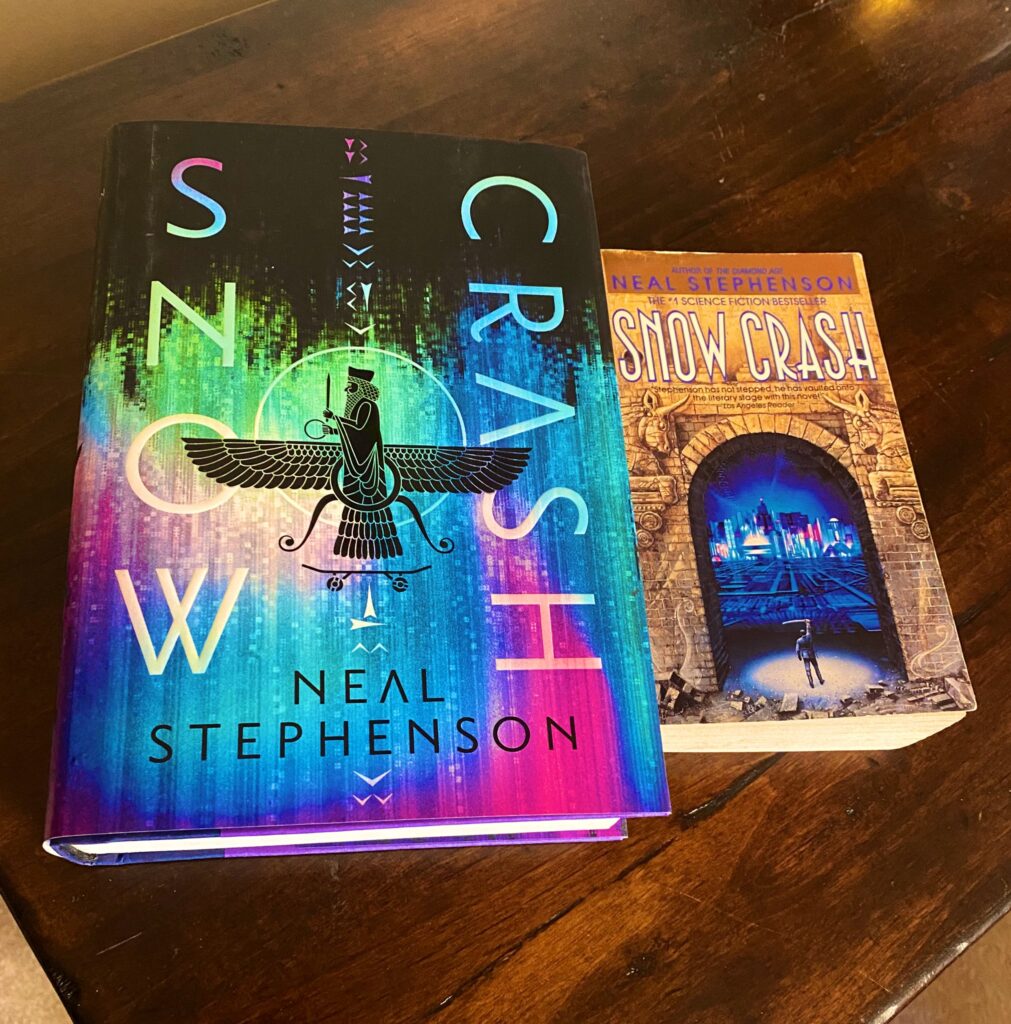
  26. Snow Crash, by Neal Stephenson - If the aforementioned Neuromancer popularized Cyberpunk, Stephenson put the final nail in the coffin with this satirical, action-packed romp through cyber-space. It's a surprisingly prescient novel, though it doesn't get everything quite right. Stephenson is my favorite author, but I would have ranked Cryptonomicon higher (more on that below).
  27. The Martian Chronicles, by Ray Bradbury - On the list of shame.
  28. Cat's Cradle, by Kurt Vonnegut - On the list of shame.
  29. The Sandman Series, by Neil Gaiman - I was always under the impression that Gaiman's Sandman stuff didn't hold up as well as some of his other work, but I guess people still love it. I've never read it, and probably won't...
  30. A Clockwork Orange, by Anthony Burgess - Never read it. If the rest of the list is any indication, there seems to be an inflation of rank for films with great movie adaptations...
  31. Starship Troopers, by Robert Heinlein - An interesting thought experiment from Heinlein, who basically originated the modern military SF genre with this novel, but there's not much of a story here. An important book, but one that would probably chafe a lot of readers with its ideas and the bald way Heinlein presents them.
  32. Watership Down, by Richard Adams - Saw the movie, probably won't read it, makes sense to be on the list though.
  33. Dragonflight, by Anne McCaffrey - Eh, fantasy. Only the third female author so far.
  34. The Moon Is A Harsh Mistress, by Robert Heinlein - My favorite of Heinlein's novels, its libertarian themes and strange sexual politics could probably turn off readers, but there's a well paced story that accompanies things this time, and I really enjoyed the novel.
  35. A Canticle For Leibowitz, by Walter M. Miller - Never read it, but it's in the queue somewhere.
  36. The Time Machine, by H.G. Wells - On the list of shame, though of course I know the general idea of the story (which says something about its importance, I guess).
  37. 20,000 Leagues Under The Sea, by Jules Verne - See previous entry.
  38. Flowers For Algernon, by Daniel Keys - I'd heard of this, but never knew what it was about until now, and I kinda want to read it now.
  39. The War Of The Worlds, by H.G. Wells - See The Time Machine above.
  40. The Chronicles Of Amber, by Roger Zelazny - It's in the queue somewhere.
  41. The Belgariad, by David Eddings - Another fantasy series. Good to know if I want to read some fantasy, but I doubt I'll get to this anytime soon.
  42. The Mists Of Avalon, by Marion Zimmer Bradley - The fourth female author.
  43. The Mistborn Series, by Brandon Sanderson - More fantasy I'm unlikely to ever read.
  44. Ringworld, by Larry Niven - In the queue somewhere, I think my brother might even have a copy somewhere, but I just haven't gotten to it yet.
  45. The Left Hand Of Darkness, by Ursula K. LeGuin - Wonderful SF novel probably deserving a higher spot on this list. And the fifth female author so far.
  46. The Silmarillion, by J.R.R. Tolkien - A little bit of a cheat, as I haven't read the whole thing, but still. Why isn't this considered part of the LotR series?
  47. The Once And Future King, by T.H. White - I think I read this for school? King Arthur and stuff? Must not have made much of an impression.
  48. Neverwhere, by Neil Gaiman - In terms of pure enjoyment, I think this is Gaiman's best. Real page-turning stuff here, and a more satisfying narrative than American Gods or Stardust.
  49. Childhood's End, by Arthur C. Clarke - A solid choice and a good novel, but I've never been as in-love with it as everyone else. There are a couple other Clarke books I'd put ahead of this one.
  50. Contact, by Carl Sagan - Adaptation bump? Whatever the case, I've heard that the movie kinda stops short, while this one make a bolder statement. I've always really loved the movie, but if it really does betray the book, I'd find that disappointing.
  51. The Hyperion Cantos, by Dan Simmons - The first book is certainly on my list to read, but I've heard the rest of the series is kinda meh, and then there's the fact that I've never actually read a good book by Simmons (I read one of his weird vampire books a while back and hated it so much that I drilled a screw through the book so that no one else would read it).
  52. Stardust, by Neil Gaiman - I know I read this, and I'm pretty sure I liked it, but I don't remember anything about it and it's been sorta overridden by the movie adaptation in my mind (rightly or wrongly, I did enjoy the movie, which I understand diverges pretty significantly from the book)
  53. Cryptonomicon, by Neal Stephenson - My favorite book of all time? Perhaps! Would definitely be higher on my list.
  54. World War Z, by Max Brooks - I can only imagine that this is on the list because people love zombies right now. I hate zombie stories.
  55. The Last Unicorn, by Peter S. Beagle - Fantasy. Fleh.
  56. The Forever War, by Joe Haldeman - Considered by many to be Haldeman's response to Heinlein's Starship Troopers, this is first rate SF and it actually features some semblance of a story. There are some flaws (in particular, the way he treats sexuality), but it's still a great book.
  57. Small Gods, by Terry Pratchett - The only Pratchett I've read is Good Omens (co-written with Neal Gaiman), but I was underwhelmed by it and have never really sought out more Pratchett. I should probably do so at some point, but I guess we'll see.
  58. The Chronicles Of Thomas Covenant, The Unbeliever, by Stephen R. Donaldson - Fantasy series. Fleh.
  59. The Vorkosigan Saga, by Lois McMaster Bujold - Love that this made it on the list. I really enjoy these novels and am looking forward to reading more of the series. Would be higher on my list.
  60. Going Postal, by Terry Pratchett - See Small Gods above.
  61. The Mote In God's Eye, by Larry Niven & Jerry Pournelle - I keep hearing about this novel, but I've never read it. It's in the queue.
  62. The Sword Of Truth, by Terry Goodkind - More fantasy. Fleh.
  63. The Road, by Cormac McCarthy - More dystopia. Fleh.
  64. Jonathan Strange & Mr Norrell, by Susanna Clarke - I've wanted to read this for a while, I've just never gotten around to reading it.
  65. I Am Legend, by Richard Matheson - A study of isolation and grim irony. Does this get a bump from the movie adaptation? The movie kinda stinks. The book is far more disturbing, and it's definitely influential in many of the horror writers who followed.
  66. The Riftwar Saga, by Raymond E. Feist - More fantasy. Fleh.
  67. The Shannara Trilogy, by Terry Brooks - More fantasy. Fleh.
  68. The Conan The Barbarian Series, by R.E. Howard - I enjoy the movies, but I doubt I'll ever get to the books...
  69. The Farseer Trilogy, by Robin Hobb - More fantasy. Fleh. But the blurb on NPR sounds nice, I guess. But then, zombies. Fleh.
  70. The Time Traveler's Wife, by Audrey Niffenegger - Doesn't seem like it would be my thing, but I'd be open to reading it, I guess.
  71. The Way Of Kings, by Brandon Sanderson - More fantasy. Fleh.
  72. A Journey To The Center Of The Earth, by Jules Verne - Familiar with the story, but never actually read the book.
  73. The Legend Of Drizzt Series, by R.A. Salvatore - More fantasy. Fleh.
  74. Old Man's War, by John Scalzi - Fantastic modern entry in the military SF canon. Scalzi's tightest novel, though he's got some other good ones.
  75. The Diamond Age, by Neil Stephenson - I'm surprised this made the list, as I'm convinced that Stephenson's reputation for bad/rushed endings comes from this book. Still, it is a really good book, and you can see the transition he was making between Snow Crash and Cryptonomicon. I would probably put Anathem higher than this, but I can't argue with putting it on the list.
  76. Rendezvous With Rama, by Arthur C. Clarke - This might actually be my favorite of Clarke's novels.
  77. The Kushiel's Legacy Series, by Jacqueline Carey - More fantasy. Fleh.
  78. The Dispossessed, by Ursula K. LeGuin - I was less impressed with this novel and it probably wouldn't make my list, but I can see why so many people love it.
  79. Something Wicked This Way Comes, by Ray Bradbury - On the list of shame.
  80. Wicked, by Gregory Maguire - Eh, really?
  81. The Malazan Book Of The Fallen Series, by Steven Erikson - More fantasy. Fleh.
  82. The Eyre Affair, by Jasper Fforde - Never heard of it, but it sounds interesting.
  83. The Culture Series, by Iain M. Banks - In the queue somewhere.
  84. The Crystal Cave, by Mary Stewart - Yet another Arthurian tale (I think this is the third on the list so far). Not much interest here.
  85. Anathem, by Neal Stephenson - Very nice to see this one on the list despite it's relatively recent release. A fantastic novel, his best since Cryptonomicon.
  86. The Codex Alera Series, by Jim Butcher - More fantasy. Fleh.
  87. The Book Of The New Sun, by Gene Wolfe - On my list of shame.
  88. The Thrawn Trilogy, by Timothy Zahn - I'm surprised this Star Wars series made the list. I loved this as a teenager, but when I revisited it a few years later, it wasn't quite as riveting. Still a thousand times better than the prequels! And Grand Admiral Thrawn was indeed quite a great villain for the series. I'm glad Zahn got a place on the list. He's a workhorse, but I tend to enjoy those authors.
  89. The Outlander Series, by Diana Gabaldan - Not familiar with this, may have to add it to the queue!
  90. The Elric Saga, by Michael Moorcock - More fantasy. Fleh.
  91. The Illustrated Man, by Ray Bradbury - *sigh* List of shame.
  92. Sunshine, by Robin McKinley - More fantasy. Vampire fantasy. Fleh.
  93. A Fire Upon The Deep, by Vernor Vinge - One of the best portrayals of a truly alien species in all of SF. The ending is a bit... strange, but I really love the book (A Deepness in the Sky is pretty good as well and I'm really looking forward to The Children of the Sky, which comes out in October I think)
  94. The Caves Of Steel, by Isaac Asimov - As previously mentioned, I'm a big fan of the Robot series. Again, these are books I read as a teenager, and some of them don't hold up as well, but the ideas are great.
  95. The Mars Trilogy, by Kim Stanley Robinson - On my list of shame.
  96. Lucifer's Hammer, by Larry Niven & Jerry Pournelle - In the queue somewhere.
  97. Doomsday Book, by Connie Willis - It's a really good book, but I'm not sure I'm as taken with it as some others.
  98. Perdido Street Station, by China Mieville - It's been sitting on my shelf for, like, 4 years at this point. I have promised myself that I'd read it by the end of this year!
  99. The Xanth Series, by Piers Anthony - Fantasy, but Piers Anthony rings a bell for me. I may check something of his out, maybe not Xanth though.
  100. The Space Trilogy, by C.S. Lewis - I didn't even know these existed!
I did some quick counting of the list:
  • I've read 38 of the books on the list
  • The breakdown between Fantasy and SF is arguable, but a quick count got me 37 fantasy, 63 SF.
  • Only 15 of the books on the list are written by women (and there's at least one woman who comes up twice)
  • Of those 15 books by women, 7 are fantasy (again, the line between SF and Fantasy can be blurry for some of these)
I should note that despite my frequent "fleh" comments above, I don't really have anything against fantasy, I just don't read much of it and thus don't have much to say about it. There are at least a couple series/books above that I'd probably check out at some point. I thought I'd have read more than 38 on the list, but when you consider that only 63 are SF, that does change things a bit, as my focus tends to be on SF.

I'm not sure what to make of the disparity between male and female authors on the list. Is it that there are less female authors of SF/F? Or is it that there are less female readers voting? I can think of one glaring omission on the list - The Sparrow by Mary Doria Russel is superb, and would certainly be on my list (I'm pretty sure it was on the shortlist, but got culled when NPR cut down to 100). Thanks to my incessant Bujold reading, 10 of the 23 books I've read so far this year have been written by a woman (though again, most of that is Bujold). I could probably improve that to 50/50 by the end of the year, which would be nice.

And that about covers it. How many have you read?

Update: Forgot to bold one of the books I read, so my count at the end was off. Updated!
Posted by Mark on September 18, 2011 at 08:32 PM .: Comments (16) | link :.


End of This Day's Posts

Sunday, September 11, 2011

SF Book Review, Part 8: Vorkosigan Edition
I've read the first few books in Lois McMaster Bujold's long-running Vorkosigan Saga and reviewed them in the the last couple SF Book reviews. In short, I've really enjoyed them, and now I've read five more books in the series.

At this point, it's hard to talk about the series without giving a little background info to start with. This, by necessity, means some spoilers, which I'll try to keep at a minimum (if you're sold on the series and want to get started, just skip to the last paragraph of this post). Here goes: In Shards of Honor, Cordelia Naismith of Beta Colony meets Aral Vorkosigan of Barrayar, and they get married around the time Aral becomes the Regent of Barrayar (the planet is ruled by a military class called the Vor, which consists of an Emperor and a bunch of Counts. A Regent is appointed when the current Emperor is not yet old enough to take the throne). Barrayar is a largely feudal society, so there's lots of Machiavellian scheming going on, and thus Aral's Regency was not unchallenged. An assassination attempt exposed the pregnant Cordelia to a teratogenic gas. All survived, including the fetus, but the baby was born with several birth defects, including most notably brittle bones.

That covers the first two books in the series (in a really frighteningly abrupt manner that leaves a ton of important stuff out!), and in The Warrior's Apprentice we are introduced to Miles Vorkosigan, who has grown up in a world that hates and fears "mutants" like himself. Unable to depend on physical prowess, Miles instead relies on his powers of observation and quick-thinking wit. He doesn't give in to the urge for self-pity, but he isn't one-dimensional caricature of a man driven by demons either. Bujold tends to write his stories from his perspective, so we get lots of visibility to what's going on in his head, and he's always thinking ten steps ahead (as is required of him). In The Warrior's Apprentice, he fails to get into the Barrayaran Military Academy due to his physical infirmities, after which he stumbles into a military conflict involving mercenaries, eventually improvising a mercenary fleet of his own (called the Dendarii Free Mercenaries) and foiling a political plot against his father. His mercenary fleet only knows him as Miles Naismith and does not know of his connections to Barrayar, which is a good thing, because Miles and his father propose making them Barrayar's secret army. Impressed, but given few options, the young Emperor pulls strings to get Miles accepted into the Barrayaran Military academy. Whew. That took longer and was probably more spoilery than I intended, but it gives you the appropriate background (I assure you, Bujold is much better at explaining all this! Read the first three books!)
  • The Vor Game - The novel opens with Miles Vorkosigan graduation, followed by his assignment to the Barrayaran equivalent of an arctic outpost (i.e. not a very desirable position). It turns out that the commander there (General Metzov) is rather insane, and a confrontation leads to a career wrecking scandal for Miles. His only option at that point is to work for Barrayaran intelligence, but of course, his first mission there goes belly up as well, forcing him to take command of the Dendarii Mercenaries (again) in order to help save his Emperor. Oh, and there's a Cetagandan invasion fleet on its way to Barrayar too. Yes, it's difficult to describe this plot, but it's an excellent novel, and Bujold deftly maneuvers around various pitfalls and tropes.

    Bujold does a particularly good job with the initial confrontation with the mad General Metzov. Miles has been ordered to participate in a massacre that is most probably illegal. However, disobeying orders isn't exactly a good option either. Miles isn't just a newly minted soldier. He's a Vor Lord, a member of the military caste, son of the Prime Minister (and former Regent) and cousin of the current Emperor. And he's faced with an impossible choice here. Participate in an atrocity, or potentially ruin his life, maybe even taking his father with him and soiling the family name. What do you do when all the available options are bad? It's a recurring theme in these books - and Miles can't just make decisions for himself, he has to constantly consider the political, social and cultural ramifications of his actions.

    Later in the book, he runs across the errant Emperor, where Bujold has steadfastly declined to give in to cliche. Emperor Gregor has been in the series since he was a little boy, protected by Miles' parents during an attempted coup. Miles and Gregor grew up as playmates (inasmuch as the Emperor-to-be could have playmates) and in the hands of a lesser writer, Gregor would have grown into a tyrant that would be the flip-side of Miles's honor. Or something. But Bujold avoids that temptation without going too far in the opposite direction. Gregor is, in himself, a most interesting character. He's got his flaws and some major problems, which we see in this novel, but he's not a tyrant either.

    In the end, it's easy to see why this got the Hugo award for best novel. I don't think it's Bujold's best, but it's definitely a great novel and well worth a read.
  • Cetaganda - One of the great things about this series of novels is that Bujuld doesn't stick to one type of story for all the books. The series is primarily comprised of Space Opera stories, but there are a number of books that stray from the path, and this is one of them. Miles and his cousin Ivan (who is Miles's cousin and something of a foil, usually referred to by Miles as "That idiot Ivan.") are sent to represent Barrayar at the Imperial funeral of the dowager Empress, mother of the current Cetagandan Emperor. The Cetagandans are generally the villains of the Vorkosigan universe, so you can imagine that when Miles gets into trouble (which happens almost immediately upon arrival), things get hairy pretty quickly. In essence, this novel takes the form of a murder mystery, with some espionage and political wrangling thrown in for effect. The Cetagandan empire has a multi-tiered aristocracy, along with numerous castes and an almost inconceivable list of customs, traditions, and ceremonies. Like the best SF, Bujold keeps the info-dumps to a minimum, letting us infer the details of all this from the context of the story. Of course, Miles is in-over-his-head almost immediately, yet he manages to pull it out (that's not really a spoiler, right?). Indeed, given his earlier career (as discussed above, along with the fact that his exploits with the Dendarii Mercenaries can't be trumpeted), his success on Cetaganda proves almost politically embarrassing! This is actually the most recently written book of the ones listed in this post, though it is placed rather early in the actual chronology. I guess this is getting a bit repetitive, but it's a good, fun read, handled with wit and care, like all of Bujold's work.
  • Ethan of Athos - Perhaps the most unusual of the novels in the series in that it does not feature Miles (or anyone from his family) at all, instead focusing on Dr. Ethan Urquhart, from the planet Athos - a planet entirely populated by men. It's an isolated and reclusive planet that does not seek any real outside contact. They reproduce using uterine replicators (something mentioned often in the series, actually), basically technological wombs where children can be grown. However, they do require certain genetic materials, which means that someone has to go out into the big bad galaxy and secure some new biological samples. Ethan is their man, but he's quickly embroiled in a galactic conspiracy. He is helped in his task by Commander Elli Quinn of the Dendarii Free Mercenaries (which is one of the ways in which this book connects with the rest of the series). When we last saw Quinn, she had her face blown off during a battle in The Warrior's Apprentice, but she has since had reconstructive surgery, and is now quite the beauty. Given that Ethan has never had contact with women, this makes for a somewhat interesting dynamic. The bulk of the action takes place on a space station and it takes the form of an espionage thriller. This was actually among the first books of the series to be published, and I think you can see that, but once again, it's a really good story, and provides you with some background information on an important character (Elli Quinn) and obliquely connects with a couple other books in the series. Another good read.
  • Borders of Infinity - Ah, this is the book that causes a great deal of confusion for those of us seeking to read the series in chronological order. It's basically a collection of three 100 page (or so) novellas, with some connective tissue provided in the form of an interview conducted by Simon Illyan, who is the head of the dreaded Barrayaran Imperial Security Service (basically an intelligence organization). However, the confusion comes in because each story takes place between other books in the series. I tried to read them in the appropriate order, but kinda messed up because the connective tissue takes place after Brothers in Arms (which is the next book below). No matter, because these are three of the best stories in the series.

    The first story, entitled "The Mountains of Mourning" is particularly effective, and it even earned Bujold a (well-earned) Hugo award for best novella. It's another of the murder/mysteries, but it takes place in the backwoods of Barrayar, allowing Bujold to explore certain Barrayaran prejudices - especially for their intolerance to birth defects or "mutants". This is particularly impactful because Miles is, himself, something of a mutant, and he has a lot of political considerations to make during this investigation.

    In "Labyrinth", Bujold tells a somewhat less plausible tale, but it is one which connects with Ethan of Athos and Cetaganda a bit, and it is quite an enjoyable read. I'm kinda curious as to whether or not the character Taura will make another appearance in the series (it would certainly be a welcome development!) The third and final story, "The Borders of Infinity" starts a little strangely, but it quickly escalates, and Bujold manages a few interesting twists in what basically amounts to a prison-break story. It ends on a bit of a tragic note, but I still enjoyed it quite a bit.

    Like a lot of short story collections, this one doesn't quite work as a whole as much as a single novel would, but that's to be expected, and each individual story is truly excellent. Indeed, I would put "The Mountains of Mourning" up as one of the best stories in the series, and the other two aren't too shabby either. If you're looking at reading the series and think it's ok to skip these because they're "only novellas", think again - these are really fantastic and should not be skipped. I believe they're better integrated into the omnibus editions that are now in print, but that's probably a topic for another post someday.
  • Brothers in Arms - One of the things I've always found somewhat improbably about this series was that Miles would be able to lead an entire fleet of mercenaries without anyone noticing that he was one of the most famous Barrayaran noblemen in the galaxy. In this book, Bujold solves that problem rather handily. If I tell you how she did so, well, it will sound ridiculous. And it kinda is. In the hands of a lesser writer, it might have fallen flat, but Bujold does an excellent job executing her solution here. It's almost comedic, though she never quite goes that far (if you just accept the premise and go with it, you'll find yourself laughing). However, by the time of the time you reach this novel, she's laid all the groundwork, and it actually fits rather well. The story itself is more of a political espionage tale, and quite a good one at that. Elli Quinn makes another appearance here, and the story ends at a point that leads into the whole connective tissue parts of Borders of Infinity. I expect to see more of a few of these characters in later books as well.
Yes, I'm completely hooked by this series. The only reason I haven't devoured the 8 remaining books is that I'm deliberately trying to prolong the experience, as I will no doubt experience a bit of withdrawal when I finish the series. Of course, the most recent installment was just published last year, so more books are not out of the question.

I heartily recommend the series. If you're interested, I would start with Shards of Honor (or the omnibus edition called Cordelia's Honor, which features Shards of Honor and the hugo-award winning Barrayar) which primarily deals with Miles's parents, or The Warrior's Apprentice (which is probably easier found as part of the omnibus called Young Miles, which features The Warrior's Apprentice, "The Mountains of Mourning" from Borders of Infinity (another Hugo winner), and The Vor Game (yet another Hugo award winner)). Actually, I think those two omnibus editions are an excellent deal, and will give you a significant amount of the series with just two purchases... Well worth it, if you ask me.
Posted by Mark on September 11, 2011 at 08:42 PM .: Comments (4) | link :.


End of This Day's Posts

Wednesday, July 20, 2011

First Contact
As it turns out, Aliens from other planets do exist. On the other hand, whether intelligent life exists is apparently still open for debate:

It's not nearly as good as Terry Bisson's classic short story They're Made of Meat, but it shares some similarities.
Posted by Mark on July 20, 2011 at 06:06 PM .: Comments (0) | link :.


End of This Day's Posts

Sunday, July 17, 2011

The Book Queue
So the last book queue I posted at the beginning of this year had 12 books on it, and I've made great strides against that list. Only 4 remain, and I'm halfway through one of those. I've also read at least 7 other books that weren't on that list (mostly Bujold's Vorkosigan Saga books, of which only the first was on the original list). With only 3 books remaining, I'm looking to fill up the immediate queue again.

Holdovers
The four remaining books from my last queue...
  • Guns, Germs, and Steel: The Fates of Human Societies by Jared Diamond: It's been a bit of a slog. Two weeks of reading, and I'm still only about halfway through it. However, it's gotten better as I've read. It still hasn't quite overcome the bad first impression, but there is at least some interesting stuff going on now. I plan to nail it down this week.
  • Perdido Street Station, by China Miéville: I admit, this is getting ridiculous. This has been in the queue, even sitting on my shelf, for years. I will definitely get to this one this year.
  • Godel, Escher, Bach: An Eternal Golden Braid by Douglas R. Hofstadter: I'm making such good progress this year, but I have a feeling that if I start this, even if I'm reading every day, it will take me a long time to finish it off. It's a 900+ page book, with small type and dense material that I'm sure I'll really enjoy, but which will totally break the momentum I've built up this year. Definitely in 2012 though!
  • Inherent Vice by Thomas Pynchon: Trashy noir novel by Pynchon? Sounds awesome (also apparently being adapted by Paul Thomas Anderson for the screen, so I want to read this before that movie comes out). This one hasn't even been on the list that long though, so it's not a big deal that it's a holdover. Will definitely get to it this year.
Vorkosigan Saga
I started Lois McMaster Bujold's long-running series of science fiction novels mostly (but not solely) chronicling the adventures of the physically diminutive but mentally gifted Miles Vorkosigan. So far this year, I've read 7 novels in the (loosely connected) series. I've got a whole stack of other books just waiting on my shelf now too... and Bujold just released a new one last year, so there's always the chance of more books in the future! I don't know if these are the nerdiest books I've ever read, but referring to them as the Vorkosigan Saga certainly makes it seem so... In any case, this is what I've got left in the series. I'm trying not to read too many of these in a row - I can already sense that I'll be a bit bummed when I finish the series because I very much enjoy spending time with these characters: New Stuff
Pretty self explanatory:
  • Readme by Neal Stephenson: I've already posted about this several times. Stephenson is probably my favorite author, so of course a new novel will immediately jump to the top of the queue (even though it's a 900+ page behemoth). Comes out in September.
  • The Children of the Sky by Vernor Vinge: I've also posted about how much I'm looking forward to this one, another book in Vinge's Zones of Thought universe (not really a series, though maybe, kinda, sorta). This one comes out in October and will probably jump to the top of the queue after I finish Reamde.
  • The Quantum Thief by Hannu Rajaniemi: A science fiction heist story. I am so there.
  • Savage Season by Joe R. Lansdale: The first in a series of crime novels by Lansdale, whom you may know from his work on Bubba Ho-Tep (a book/movie where a black JFK and an old Elvis fight a mummy in a modern-day Texas retirement home). I'm not anticipating a book that's quite that crazy, but this series seems to get some good reviews, so I'll check it out...
So that's 15 books right there, which should keep me busy through the end of the year. Of course, new books will undoubtedly be added (especially since I've just noticed that there's no new non-fiction on the list) and so on, but that is the way of the book queue.
Posted by Mark on July 17, 2011 at 01:55 PM .: Comments (0) | link :.


End of This Day's Posts

Sunday, June 26, 2011

Tasting Notes - Part 4
Another edition of Tasting Notes, a series of quick hits on a variety of topics that don't really warrant a full post. So here's what I've been watching/playing/reading/drinking lately:

Television
  • Game of Thrones - The season finale aired last week, and I have to say, I'm impressed. My usual approach to stuff like this is to let it run for a couple of seasons to make sure it's both good and that it's actually heading somewhere. At this point, the book series isn't even finished, but friends who've read it think it's great and they say the books get better, so I gave the series a shot - and I'm really glad I did. It's a fantastic series, much more along the lines of swords-and-sandals (a la Spartacus or Gladiator) than outright fantasy (a la Lord of the Rings). People talk about magic and dragons and whatnot, but most of that seems to be in the distant past (though there are hints of a return to that sort of thing throughout the series and especially in the last minutes of the season). Most of the season consists of dialogue, politics, Machiavellian scheming, and action. Oh, and sex. And incest. Yeah, it's a fun show. The last episode of the season doesn't do much to resolve the various plotlines, and hints at an even more epic scale. Interestingly, though, I don't find this sort of open-endedness that frustrating. Unlike a show like Lost, the open threads don't seem like red-herrings or even mysteries at all. It's just good, old fashioned storytelling. The worst thing about it is that I'm all caught up and will have to wait for the next season! Prediction: Geoffrey will die horribly, and I will love it. But not too quickly. He's such a fantastic, sniveling little bastard. I want to keep hating him for a while before someone takes him down.
  • Netflix Watch Instantly Pick of the Week: Doctor Who - Most of the semi-recently rebooted series is available on watch instantly, and I've only just begun to pick my way through the series again. I vaguely remember watching a few of Christopher Eccleston's Ninth Doctor episodes, but I never finished that first season. I'm not very far in right now - just saw the first appearance of the Daleks, which should be interesting.
Movies
  • 13 Assassins - Takashi Miike tends to be a hit-or-miss filmmaker for me. Fortunately for him, he is ridiculously prolific. His most recent effort is a pretty straightforward Samurai tale about a suicide mission to assassinate a cruel and ruthless evil lord. Seven Samurai, it is not, but it is still quite engaging and entertaining to watch. It starts a bit slow, but it finishes with an amazing 45 minute setpiece as our 13 heroes spring their trap on 200 enemies. Along the way, we get some insight into Japanese culture as the days of the Samurai and Shogunate faded, though I don't think I'd call this a rigorously accurate film or anything. Still, there's more going on here than just bloody action, of which there is a lot. An excellent film, among the top films I've seen so far this year.
  • HBO has a pretty great lineup right now. In the past couple weeks, I've revisited Inception, Scott Pilgrim vs. the World, and How to Train Your Dragon. All of these films have improved upon rewatching them, a subject I've always found interesting. Scott Pilgrim, in particular, has improved it's standing in my mind. I still think it's got some problems in the final act, but I also think it's a dreadfully underappreciated film.
  • Netflix Watch Instantly Pick of the Week: Transcendent Man - I mentioned this a couple weeks ago, but it's an interesting profile of Ray Kurtzweil, a futurist and singularity proponent. I don't really buy into his schtick, but he's an interesting guy and the documentary is worth a watch for that.
Video Games
  • I'm still playing Mass Effect 2, but I have not progressed all that far in the game. I've found this is common with RPGs lately - it takes a long time to get anything accomplished in an RPG, so I sometimes find it hard to get started. Still, I have liked what I've seen of this game so far. It's far from perfect, but it's got some interesting elements.
  • Since I had to hook up my Wii to get Netflix working during the great PSN outage of '11, I actually did start playing Goldeneye again. I even got a Wii classic controller, and that made the game approximately 10 times more fun (but I have to say, plugging the Wiimote into the classic controller to get it to work? That's just stupidly obtuse, though I guess it keeps the cost down). Since I could play it in short 30 minute chunks, I actually did manage to finish this one off in pretty short order. It's a pretty simple FPS game, which I always enjoy, but there's nothing particularly special about it, except for some muted nostalgia from the original.
Music
  • The Black Keys - Brothers - This is a pretty great album. Lots of crunchy blues guitars and catchy rhythms. I'm greatly enjoying it.
  • Deerhoof - Deerhoof vs. Evil - Another hipster rock album, but I rather like it, especially the song Secret Mobilization. Good stuff.
Books
  • I've been cranking my way through Lois McMaster Bujold's Vorkosigan Saga novels, of which there are many (and I'm actually quite glad, as they're all great fun). I've covered the first few novels in SF Book Reviews, and will probably have finished enough other books to do a Bujold-only edition in the near future. I'm currently reading Ethan of Athos, which seems to me to be a kinda spinoff/standalone novel, but an interesting one nonetheless (and we get to catch up with a character from one of the other books).
  • I also started Guns, Germs, and Steel by Jared Diamond, but have found myself quickly bogging down (it doesn't help that I have, like, 10 Bujold novels sitting around, begging me to read them) almost from the start. It's not bad, per say, but there's something about the style and scope of the book that bothers me. There are some interesting ideas, and Diamond admits that his methods are, by necessity, not that rigorous, but it's still seems extremely speculative to me. I would normally be fine with that sorta approach, but I'm finding something about this grating and I haven't figured it out just yet...
  • If you count the aforementioned Guns, Germs, and Steel, I'm down to just 4 unread books from my last Book Queue, which is pretty good! And I've only really added the Bujold books and Fuzzy Nation since then. I'm actually at a point where I should start seeking out new stuff. Of course, it probably won't take long to fill the queue back up, but still. Progress!
The Finer Things...
  • I've managed to have some pretty exceptional beers of late. First up is Ola Dubh Special Reserve 40, an imperial porter aged in 40 year old Highland Park casks. It's an amazing beer, though also outrageously priced. Still, if you can get your hands on some and don't mind paying the premium, it's great.
  • Another exceptional beer, the legendary Pliny the Elder (currently ranked #3 on Beer Advocates Best Beers on Planet Earth list). It's a fantastic double IPA. Not sure if it's really #3 beer in the world fantastic, but fantastic nonetheless.
  • One more great beer, and a total surprise, was Sierra Nevada Boot Camp ExPortation. Basically, Sierra Nevada has this event every year where fans get to go to "Beer Camp" and collaborate on new beers with Sierra Nevada brewers and whatnot. My understanding is that the batches are extremely limited. Indeed, I never expected to see these, but apparently there were a few on tap at a local bar, sorta leftover from Philly Beer Week. The beer is basically a porter with Brettanomyces added and aged in Pinot Noir barrels. This is all beer-nerd-talk for a sour (in a good way) beer. I'm not normally big into the style or Brett, but I'll be damned if this isn't a fantastic beer. I loved it and unfortunately, I'll probably never see it again. If you see it, try it. At the very least, it will be an interesting experience!
And that's all for now.
Posted by Mark on June 26, 2011 at 06:22 PM .: Comments (2) | link :.


End of This Day's Posts

Sunday, June 12, 2011

Fuzzy Nation
In recent years, Hollywood has been remaking or rebooting nearly every property it could get its hands on - including franchises that are only a few years old. Some have speculated an unhealthy obsession with branding and marketing, others just call it a result of Hollywood's creative bankruptcy. This sort of thing happens frequently in other forms of art as well. Indeed, it's a hallmark of Theater - every night, a new remake! You don't hear people complaining about yet another production of Macbeth, do you? And covering songs is quite common as well. In both of those realms, the remakes are outnumbered by original works (well, maybe not in theater), though, which is probably a good thing.

One area that doesn't seem to see too much in the way of remakes is literature. Enter John Scalzi's Fuzzy Nation. He calls this novel a "reimagining of the story and events in Little Fuzzy, the 1962 Hugo-nominated novel by H. Beam Piper." Not having read the original, I can't speak to the fidelity or necessity of the remake, but I am confident in calling it a fun, entertaining take on several common SF tropes.

Our tale begins with Jack Holloway, an independent contractor working for ZaraCorp, prospecting and surveying the planet Zara XXIII. ZaraCorp is apparently a company that basically strips down planets for all of their useful materials - metal ores, oil, and a rare mineral called sunstones. Not much time is spent mentioning how planets are discovered, but once they are, a team of specialists attempts to determine if there's any sentient life on those planets, and if there isn't, then ZaraCorp (and/or its competitors) are given a license to "exploit" the planet. Holloway, a former lawyer, has just found a huge cache of valuable sunstones. It will take years to exploit and even Holloway's measly 0.25% share will garner him millions, if not billions of credits.

Not long after that, Holloway goes home and discovers that a small, catlike creature has snuck into his house. These ridiculously cute creatures begin to act suspiciously intelligent (incidentally, while I like the cover art, I have to say that the Fuzzy pictured there does not seem as cute as they do in the book). And from here, I'm guessing you can figure out several of the central conflicts in the book.

I burned through the book in about two sittings, and probably could have read it in one big session if I timed it right. I'm not sure if that's simply to do with the length of the book (it's about 300 pages with relatively large type and spacing) or if it's Scalzi's knack for page-turning storytelling (something I've talked about before). As previously hinted at, there are several common SF tropes at work here (Big mean corporations! Planetary exploitation! Is it sentient?!), and while Scalzi isn't often breaking new ground or even exploring various ideas very deeply, I think there's something to be said for a very well executed trope. There are several times when you can easily predict what will happen next, though Scalzi does manage some genuine twists and turns later in the story. It's clear he's working in pure storytelling mode here, which is perhaps why the pages seemed to turn themselves so quickly.

I do want to single out one aspect of the story that I think is particularly well done, and that's the character of Jack Holloway. The story is told mostly from his perspective, and he's got a certain charisma that makes him a good protagonist, but he's also kind of a selfish prick. I don't want to give anything away, nor do I want to give the wrong impression - he's certainly not an anti-hero or anything, he's just a fully fleshed out character who makes mistakes with the best of us. Flawed characters can be difficult and often present stumbling blocks to otherwise good stories, but I think Scalzi manages to pull this one off well.

Again, I have not read the original Little Fuzzy novel, but I suspect that Scalzi has done it proud. I'm not particularly looking forward to other reimaginings of classic SF, but I think in this case, it worked well, and I actually think that Scalzi's choice, while not totally obscure, was old enough that he may be introducing lots of folks to Piper's original works (I believe there are a few other Fuzzy novels as well). Among Scalzi's novels that I've read, this one is towards the top of the list, though I don't think it's his best work. I do think that most of his novels would make good introductions to the SF genre though, and would recommend them. While Scalzi may be best known for taping bacon to his cat, I would argue that he should be better known for his novels! Fuzzy Nation would be a good place to start.
Posted by Mark on June 12, 2011 at 06:03 PM .: Comments (0) | link :.


End of This Day's Posts

Sunday, May 08, 2011

SF Book Review, Part 7
Continuing to make some progress through my book queue... and, of course, adding new books to the queue as I go along. This time, it's Lois McMaster Bujold's fault, as I enjoyed Shards of Honor so much that I went out and read the next two books in the (apparently long running and loosely connected) series. I've now got about 10 more of her books in the queue. If the first three are any indication, I'll probably move through them pretty quickly... but I'm getting ahead of myself.

I'm going to start with one from the actual queue though: Timothy Zahn's Cobra Trilogy. I've been listing it as one book, but it's technically an omnibus edition of Zahn's first three Cobra novels, and I'll review each separately below. As a side note, Zahn is currently in the process of writing another trilogy set in the same universe (the second novel was published this year, with a third tentatively planned for January 2012) and plans a third trilogy at some point in the unspecified future.
  • Cobra by Timothy Zahn - Though this is not Zahn's first novel, it is among his first, and it shows. It is certainly not bad and you can see flashes of what he would grow into, but it is quite unusual. The pace of the novel, in particular, is rather strange. It starts off in rather standard military SF fashion, with a youth signing up for a war against an invading alien race. Of course, young Jonny Moreau gets assigned to a new, elite force of guerilla super-soldiers, packed to the gills with concealed weaponry. You get the standard training section, then you're off to war. But the war lasts approximately one chapter, and we're back in civilian life, but Jonny's powers (which cannot be removed) are causing problems. He's having trouble fitting back into civilian life, an interesting perspective, to be sure, though something that's been covered a lot, even in military SF. But then, even that section of the novel doesn't last, and Jonny is sent off on other adventures. The conflicts that arise are reasonably well done, but the solutions often leave a poor taste in your mouth... but then, that seems to be the point of a lot of it. This is an interesting approach, but Zahn hadn't quite reached the height of his storytelling powers just yet, so it reads a bit stilted. I think if Zahn had attempted something similar later in his career, it may have been a bigger success. It's a fine read, but nothing particularly special, except insofar as it gets you to the later books in the series.
  • Cobra Strike by Timothy Zahn - This book picks up about 20 years after the first, and follows the next generation of Moreaus (though Jonny also plays a big supporting role) as they attempt to cope with living in an isolated trio of worlds. A new threat appears, and the Cobras are sent to investigate. I won't go into too much detail here, as this book is a little more cohesive, telling one story from start to finish. I'm not entirely convinced about the conflict or the ultimate solution, but it's definitely an easier read, and you definitely see more commonality with Zahn's later works. A worthy sequel and indeed, an improvement on the original.
  • Cobra Bargain by Timothy Zahn - The last book in the series, and probably the book that most resembles Zahn's later success. It's not quite as accomplished as his later work, but it's up there, and it's the one book in the series that really had me turning the pages. This one jumps us forward another 20 years. Jonny has passed away, but his sons have established themselves in planetary politics and the third generation of Moreaus are becoming Cobras. This time around, we follow Jasmine "Jin" Moreau, the first female Cobra, and one of the more engaging protagonists in the series. Of course, things never go as planned and Jin is quickly caught alone in enemy territory. Things have changed there over the last 20 years, but it's still a dangerous place, and she finds herself in an uneasy alliance with certain members of the enemy. Quite entertaining, and the pages turned themselves more in this final novel than in either of the previous two. Indeed, I read the last 150-200 pages in one sitting. Is it worth reading the first two novels to get to this point? Maybe for fans of Zahn, but it's certainly not something I'd recommend folks start with. I enjoyed it, but I wouldn't count it as one of my favorites, even amongst Zahn's other work.
  • Barrayar by Lois McMaster Bujold - This book picks up right after the end of Shards of Honor, with Cordelia Naismith marrying Lord Aral Vorkosigan. And as it turns out, Aral has taken up a rather important position in the Barrayaran government - one that involves lots of behind-the-scenes politics and intrigue, betrayals and conspiracies. The book starts out a bit on the slow side, establishing all the players in the coming civil war. Things come to a head in the second act, and our protagonists take the initiative in the final act. The mixture of high technology with old-school Machiavellian duplicity is an intriguing one, and Bujold masterfully weaves a web of cunning and deception throughout the plot. Cordelia is a wonderful protagonist, and her outsider's perspective provides the perfect lens through which the readers can get a look at Barrayar and it's odd mish-mash of traditions and ceremony. Near as I can tell, this is the last book in which Cordelia is the main character, and if you're interested in reading these, I recommend starting with the omnibus edition, called Cordelia's Honor (which contains Shards of Honor and Barrayar). Highly recommended.
  • The Warrior's Apprentice by Lois McMaster Bujold - With this novel, Bujold shifts the protagonist from Cordelia to her son, Miles Vorkosigan. Without getting into too much detail about the previous books, Miles was born with various physical impairments - in particular, his bones don't develop normally. So physically, he's somewhat frail (and very diminutive), but he more than makes up for that with his mental acuity and cunning. This book starts with Miles' failure to gain entrance into the Barrayaran military academy (he couldn't pass the obstacle course without breaking his leg), after which he must find something to do with himself. The rest of the novel plays out like an old "Adventure on the High Seas" type of story (but in space!) Indeed, Bujold has mentioned that her series is modeled after the Horatio Hornblower novels, which partially explains the mixture of past and future present in the books. Miles makes for a great protagonist, and I love the way his predicament escalates so quickly... and how he somehow manages to hold things together. I read most of this book on my way to (and returning from) Las Vegas, and very much enjoyed it. I was a little hesitant at first, and at first I was a little worried that Bujold was taking too obvious a path, but she manages several twists on the formula later in the novel that really turned things around for me. Indeed, the novel ends very much on a political bent along the lines of Barrayar. Very entertaining novel, and I can see why this is a popular starting place for the series (apparently most of the novels in the series are about Miles). I'm very much looking forward to exploring more of this series (and I have about 10 new books on my shelf now).
Well that just about covers it. I've got some non-fiction to catch up on right now, and while I'm at it, I might as well finish off a couple other non-SF novels that have been sitting around for a while as well, so it may be a while before the next SF book review. Unless I get hooked into the Vorkosigan saga again. Which is probably likely.
Posted by Mark on May 08, 2011 at 06:52 PM .: Comments (0) | link :.


End of This Day's Posts

Sunday, April 24, 2011

Tasting Notes - Part 3
Another edition of Tasting Notes, a series of quick hits on a variety of topics that don't really warrant a full post. So here's what I've been watching/playing/reading/drinking lately:

Television
  • Community is actually a pretty fun show. In a lot of ways, it's standard sitcom fodder, but the inclusion of the character of Abed redeems most of the potentially overused cliches. Abed is a pop-culture obsessed film student who appears to be aware that he's a part of a sitcom, and thus his self-referential observations are often quite prescient. The cast is actually pretty fantastic and there are lots of traditionally funny jokes along the way. Honestly, I think my favorite part of the episode are the post-credits sequences in which Abed and Troy are typically engaging in something silly in a hysterically funny way. I've only seen the first season, but I'm greatly looking forward to the second season (which is almost complete now, and probably available in some form, but I haven't looked into it too closely).
  • Netflix Watch Instantly Pick of the Week: The X-Files - It looks like the entire series is available. I watched the series frequently when it was on, but I never realized just how many episodes I missed. I was never a fan of the alien conspiracy episodes (in part because it was difficult to watch them in the right order and I never knew what was going on), but I've always loved the "freak of the week" style episode, and now that all of them are at my fingertips, I'm seeing a bunch that I never knew even existed. The show holds up reasonably well, though it's a little too on-the-nose at times (especially in the early seasons). In the context in which the shows were being produced, though, it's fantastic. From a production quality perspective, it's more cinematic than what was on TV at the time (and a lot of what's on today), and it was one of the early attempts at multi-season plot arcs and continuity (technology at the time wasn't quite right, so I don't think it flourished quite as much as it could have if it had started 10 years later).
Video Games
  • Ratchet & Clank Future: Tools of Destruction is a lot of fun, though you can sorta tell that it was a near launch game. I actually mentioned this a while back, and because it was my first Ratchet & Clank game, I didn't suffer from most of the repetitive and derivative elements (which I gather is what disappointed old fans). Some minor usability issues (constantly changing weapons/tools is a pain), but otherwise great fun. I particularly enjoyed the Pirate themed enemies, who were very funny. I enjoyed this enough that I'll probably check out the more recent A Crack in Time, which I hear is pretty good.
  • Call of Duty: Black Ops - It's another CoD game, so I got pretty much exactly what I expected. The single player game actually has a semi-interesting story, though the animators fell in love with the overly-hyper cutting and shaky-cam style that is already overused in film, and which is mostly unnecessary in video games. Don't get me wrong, the story is kinda hokey, but it's entertaining in its own way. And, of course, the combat is very well balanced and fun (as every game I've played in the series is...) The game ends with one of the most gleefully manic sequences I've ever played (much better than, for example, the airline thing at the end of CoD4). The multi-player is not particularly noob-friendly, but I got a few hours out of it and even managed to win a round one time. The kills come so quickly that it's pretty rare that you'll escape anyone once they start shooting (the way you can in some other games). This is both good and bad though. All in all, it's a good FPS for console.
  • I've started playing Mass Effect 2 for the PS3. I have no idea what's going on with the story (I thought there was supposed to be some sort of PS3 intro thingy, but I didn't see it when I started the game), but I'm having fun so far. It's not something I've been playing a lot though, perhaps because I don't have a ton of time to dedicate to it...
  • Remember when i said I would play more Goldeneye for the Wii? Yeah, I still haven't unpacked the Wii from that trip, which is a pretty good expression of how I generally feel about the Wii these days. I guess it's a good thing Nintendo is announcing their next console soon (though I have to admit, the rumors I'm hearing aren't particularly encouraging).
Movies
  • James Gunn's comic book spoof Super continues the trend towards deconstruction of superheroes that's been going on recently in comic book cinema (though things look like they're about to revert a bit this summer). As such, it's semi-derivative at times, but it sticks to its guns (or should I say, Gunns!) and never flinches at its target. It's also not afraid to embrace the weird (such as, for instance, tentacle rape). It's extremely graphic and violent, and some of it is played for laughs, but there's at least one unforgivable moment in the film. One thing I have to note is that there's going to be a lot of teenage nerds falling in love with Ellen Page because of her enthusiastic performance in this movie. She's awesome. The critical reception seems mixed, but I think I enjoyed it more than most. I wouldn't call it one of the year's best, but it's worth watching for superhero fans who can stomach gore.
  • Hobo with a Shotgun does not fare quite as well as Super, though fans of Grindhouse and ultra-violence will probably get a kick out of it. If Super represents a bit of a depraved outlook on life, Hobo makes it look like the Muppets. A few years ago, when Grindhouse was coming out, there was a contest for folks to create fake grindhouse-style trailers, and one of the winners was this fantastically titled Hobo With a Shotgun. Unfortunately what works in the short form of a fake trailer doesn't really extend well to a full-length feature. There are some interesting things about the film. Rutger Hauer is great as the hobo (look for an awesome monologue about a bear), the atmosphere is genuinely retro, it actually feels like a grindhouse movie (as opposed to Tarantino and Rodriguez's efforts, which are great, but you can also kinda tell they have a decent budget, whereas Hobo clearly has a low budget), and the armored villains known as the Plague are entertaining, if a bit out of place. Ultimately the film doesn't really earn its bullshit. Like last year's Machete (another film built off of the popularity of a "fake" trailer), I'm not convinced that this film really should have been made. Again, devotees to the weird and disgusting might enjoy this, but it's a hard film to recommend.
  • Netflix Watch Instantly Pick of the Week: The Good, the Bad, the Weird - Kim Jee-woon's take on the spaghetti western is actually quite entertaining, if a bit too long and maybe even a bit too derivative. Still, there are some fantastic sequences in the film, and it's a lot of fun. Jee-woon is one of the more interesting filmmakers that's making a name for Korean cinema on an international scale. I'm greatly looking forward to his latest effort, I Saw the Devil.
Books
  • In my last SF book post, I mentioned Lois McMaster Bujold's Shards of Honor. I really enjoyed that book, which was apparently the first in a long series of books, of which I've recently finished two: Barrayar and The Warrior's Apprentice. I'll save the details for the next SF book review post, but let's just say that I'm fully onboard the Bujold train to awesome. I put in an order for the next several books in the series, which seems to be quite long and varied.
  • Timothy Zahn's Cobra Trilogy is what I'm reading right now. I'm enjoying them, but it's clear that Zahn was still growing as a storyteller when writing these. Interestingly, you can see a lot of ideas that he would feature in later works (and he would do so more seamlessly too). I'm about halfway through the trilogy, and should be finishing it off in the next couple weeks, after which, you can expect another SF book review post...
  • I've also started Fred Brooks' The Design of Design, though I haven't gotten very far just yet. I was traveling for a while, and I find that trashy SF like Zahn and Bujold makes for much better plane material than non-fiction. Still, I'm finding Brooks' latest work interesting, though perhaps not as much as his classic Mythical Man Month.
The Finer Things...
  • The best beer I've had in the past few months has been the BrewDog/Mikkeller collaboration Devine Rebel. It's pricey as hell, but if you can find a bottle of the 2009 version and if you like English Barleywines (i.e. really strong and sweet beer), it's worth every penny. I got a bottle of the 2010 version (which is apparently about 2% ABV stronger than the already strong 2009 batch) recently, but I haven't popped it open just yet.
  • My next homebrew kit, a Bavarian Hefeweizen from Northern Brewer, just came in the mail, so expect a brew-day post soon - probably next week, if all goes well. I was hoping to get that batch going a little earlier, but travel plans got in the way. Still, if this goes as planned, the beer should be hitting maturity right in the dead of summer, which is perfect for a wheat beer like this...
  • With the nice weather this weekend, I found myself craving a cigar. Not something I do very often and I really have no idea what makes for a good cigar, but I'll probably end up purchasing a few for Springtime consumption... Recommendations welcome!
That's all for now. Sorry about all the link dumps and general posting of late, but things have been busy around chez Kaedrin, so time has been pretty short. Hopefully some more substantial posting to come in the next few weeks...
Posted by Mark on April 24, 2011 at 06:36 PM .: Comments (0) | link :.


End of This Day's Posts

Sunday, April 10, 2011

Upcoming SF
Because my book queue is not long enough*, it seems some of my favorite SF authors are releasing new novels in 2011. Yay**. Here are the three most exciting ones, in order of anticipated publication:
  • Fuzzy Nation by John Scalzi - It's actually been a few years since Scalzi wrote a full SF novel (and that book, Zoe's Tale, was a sorta rehash of an earlier book), so I'm greatly looking forward to this. I have not read any of the original Fuzzy series by H. Beam Piper, but apparently this novel is Scalzi's attempt at rebooting or reimagining the series. At some point, I considered going back to read the originals, but I'm confident that Scalzi's novel will be good as a standalone story, and I've really enjoyed all his SF novels. This one is set to be released on May 10, so I'll probably be picking it up soon...
  • Readme by Neal Stephenson - This should be unsurprising to readers of this blog, as this has long been an anticipated novel here at Kaedrin, even back when it was known as Reamde (still no explanation of that - I don't really buy that it was a typo...) Details about the novel are still scarce (not even a cover yet, and the publication date seems to have moved back a week), but seeing as though Stephenson is my favorite author and all, I don't really need much to get in line for this one. Currently set to be released on September 20th, I'm very much looking forward to this one.
  • The Children of the Sky by Vernor Vinge - The long-anticipated third novel in Vinge's loosely connected Zones of Thought series. I really loved the first two books in the series (A Fire Upon the Deep and A Deepness in the Sky) and both of them have won major SF awards like the Hugo and Nebula. As such, expectations are high. Again, I've been avoiding details about the plot here, but my assumption is that it will only have a passing reference to the previous two novels (both of which only share one character and take place thousands of years apart). This one is set for October 11, so it looks like I'll have a busy fall, once again.
That covers the major releases that I'm looking forward to. There are, of course, some other books coming out that I might be interested in, but for now, I think the queue is full enough!

Also, just a quick administrative note, I'll be traveling this week, so probably no entry on Wednesday. I shall return next Sunday. Have a good week!

* Sarcasm!

** Not sarcasm!
Posted by Mark on April 10, 2011 at 08:35 AM .: Comments (0) | link :.


End of This Day's Posts

Sunday, March 20, 2011

SF Book Review, Part 6
It's been a while since I followed up on my book queues (and some of the books on here weren't even on the queue, they just jumped to the top of the queue - which is probably why the queue is so long).
  • Doomsday Book by Connie Willis - This is one of a notable few SF novels to have won both the Hugo and Nebula awards for best novel (technically this book tied with another Kaedrin favorite, Vernor Vinge's A Fire Upon the Deep, for the Hugo). Indeed, Willis has apparently written a few other novels in the same universe, and they seem to have racked up the awards as well. This particular installment is about time-traveling historians. Young Kivrin is travelling back to the 14th century to observe daily life. Her mentor and father-figure, Dunworthy, is against the trip from the start, as it's a dangerous era and the further back in time you travel, the less precise the technology becomes. The novel proceeds on two main timelines - One at a futuristic Oxford University, the other at a small 14th century town. This is clearly not a predictive novel - the future Oxford is quite absurd at times (in particular, the lack of communication infrastructure is ridiculous - they don't even have much in the way of telephones, let alone cell phones or the internets). I don't know enough about history to say whether or not the 14th century bits are more realistic, but they seem more appropriate. Of course, it doesn't really matter. The story is effective on its own merits, and it operates according to its own internal logic, which is quite sound. One thing I found refreshing for a time-travel story is that there is no real consideration or recursive examination of paradoxes and the like. There are some off-hand references to the fact that the time travel mechanism won't let you change the past, but there isn't much in the way of circular causality events or anything resembling that sort of time-travel pyrotechnics that you see so frequently. Indeed, Kivrin might as well have been traveling to a dangerous alien planet. That being said, the historical section plays out in an interesting fashion. I won't get into too much detail here, but I will say that diseases are involved (in both timelines) and that Willis is brutally unforgiving. Her style is prosaic, more like classical hard SF, which kinda gave me a false sense of security. But Willis managed to pull the rug out from underneath me - several times. It might not seem like it at the beginning of the novel, but this isn't a book for the faint of heart. That being said, there is a hint of redemption and hope at the very end of the novel. I enjoyed this and may someday get around to the others in the series, but I'm not exactly in a hurry to do so.
  • The Space Merchants by Frederik Pohl and C. M. Kornbluth - Widely considered to be the best SF novel produced by the Futurians - a group of SF fans who eventually turned into editors and authors themselves, often focusing less on hard science and more on sociology and politics. This book is basically a satirical look at advertising and consumerism, and as such, it's actually still pretty relevant today (even if the specifics of technology are a bit odd at this point). The story follows an advertising copywriter, Mitch Courtenay, who gets ahold of a big new account (Venus!), and all the inter-office intrigue that he has to deal with. It goes some cliched places, but this book probably helped shape some cliches in itself. Stylistically, there's nothing special going on here, though the pages seem to turn themselves pretty quickly. It's a short book and a very easy, fun read.
  • Shards of Honor by Lois McMaster Bujold - Bujold is one of the authors that seemed to pick up the pieces after the whole Cyberpunk thing happened, returning SF to its Cambellian origins. This is a pretty straightforward space opera, though a very well executed one that I probably enjoyed more than any of the other books in this post. The story concerns a Betan scientist named Cordelia and her encounter with Lord Vorkosigan, of the Barrayarans. At first, they are enemies, but they quickly develop into more. And of course, they are surrounded by war and conflict between their two peoples, and during the course of the story, we're treated to all sorts of deceptions and treachery. This probably makes it sound trashy, and maybe it is, but it's still great fun. This book is apparently part of a large, wide-ranging series of books. Opinions differ as to which way to read them - in order of publication, or in order of internal chronology. Either way, Shards of Honor is the start of the series (i.e. it's the first published and the first in the chronology). I've already purchased the next two internal chronology books though, and am greatly looking forward to reading them.
  • Time's Eye - A Christmas gift from my brother, and apparently also the first in a series of novels, this particular book starts out with a premise similar to Clarke's 2001. One day, a bunch of Spherical objects (i.e. objects similar in concept to the Monolith) appear on the planet, and suddenly, the planet is a jumble of times. It seems that each region of the planet (the size of the regions appear to be small, though no definites are given) has been replaced with an earlier version of itself, sometimes stretching back millions of years. As such, most of the planet is now devoid of humanity. This story concerns itself with 5 main groups of people. Two are modern (a 3-person UN Peacekeeping team and a 3-person crew of Astronauts who were orbiting the planet at the time of the event), one relatively contemporary contingent (a British regiment, circa late 19th century, stationed in India), and two ancient powers (Alexander the Great's Macedonian army, and Ghengis Khan's Mongolian hoards). If you like the concept of modern folks mixing with historical folks (i.e. what would happen if modern astronauts met up with some Mongolians? And so on...), this would be a lot of fun, and I managed to have a pretty good time with it. Ultimately, there isn't much in the way of answers here, and I've read enough Arthur C. Clarke series to know that it probably won't be completely satisfying by the end of the series, but it was an enjoyable enough read, and there is an internal struggle between the Macedonians and the Mongols that is pretty compelling. It just doesn't seem that interested in resolving the various mysteries it set up. Perhaps the future books will delve into that a bit, but I have to admit that I'm unlikely to pursue this any further.
  • The Picture of Dorian Gray - I've always known that Oscar Wilde was famous for his wit, but I do believe this is the first thing of his that I've read (I suppose he's more notable as a playwright, and you can see that sort of talent in this novel), and I was surprised at the density of witty remarks within the book. It seems like you can't go a page without getting some wondrous monologue, usually spoken by Lord Henry (a quasi-villain? The book certainly doesn't have a traditional conflict). You also get a long series of fantastic one-liners, such as "Nowadays people know the price of everything, and the value of nothing." and "Dorian is far to wise not to do foolish things now and then," and "There is a luxury in self-reproach. When we blame ourselves we feel that no one else has a right to blame us." and "Nothing can cure the soul but the senses, just as nothing can cure the senses but the soul." Much of this is oxymoronic or nonsensical in nature, but oddly compelling nonetheless. The story is a bit on the thin side, and is really just an excuse for Wilde to run, well, wild, with his witty imagination. I suppose you could say that this isn't science fiction - it's pretty firmly in the realm of fantasy - but I'll make an exception here. It's not a particularly heartwarming tale, but there's a lot of thematic depth and as I've already mentioned, lots of witty repartee that keeps the pages turning. I wouldn't call it a favorite, but I'm really glad I read it.
And there you have it! Coming up in the queue are some more Bujold novels, perhaps some Timothy Zahn, and even though it's probably not SF, some Thomas Pynchon for good measure. I may also need to do a Non-Fiction book review soon, as I've been reading a lot of that lately too...
Posted by Mark on March 20, 2011 at 07:58 PM .: Comments (0) | link :.


End of This Day's Posts

Wednesday, September 01, 2010

More SF Pet Peeves
Sunday's post on the Unquestioned Assumptions of SF was a little strange as the post I was referencing was really more about pet peeves than unquestioned assumptions, so I figured that I should rename this post to add my own pet peeves to Matt Johnsons's list. So without further ado:
  • Aliens That Aren't Really Alien: Most alien species you see in SF are basically humans with weird ears or bumps on their forehead. In other words, they're just humans with superficial differences. Sure many of them will have strange customs or psychological ticks, but most of the time, such differences aren't even as severe as cultural differences here on earth. The most egregious violator of this is Star Trek. Klingons, Vulcans, Romulans... they're all just humans with various traits magnified (impatient aggression, steadfast logic, and passionate cunning, respectively). One notable exception in the world of film is Alien (though sequels tend to diminish the more alien qualities). In the world of literature, the big exception is Vernor Vinge's Zones of Thought books, A Fire Upon The Deep (reviewed on this blog a while back) and A Deepness in the Sky (which I also wrote about once). Fire's wolflike aliens, in particular, were great examples of what is possible, but rarely even attempted in SF. Regardless, examples of human-like alien races far outweigh the truly alien aliens in SF, and that's always bothered me. To be sure, this does present something of a challenge to authors, as it requires them to think in ways unaccustomed to humans.
  • Monolithic Planet Ecologies: Star Wars is particularly bad in this respect - the ice moon of Hoth, the desert planet of Tatooine, the forest moon Endor, etc... The thought of an entire planet with only one type of climate almost boggles the mind. I'm sure there are some planets like this, but if Star Wars was any indication, every planet has one and only one dominant climate. Sometimes this sort of conceit can be used to good effect, as in Ursula K. Le Guin's excellent The Left Hand of Darkness, but it's still a pet peeve of mine.
  • Language: Rarely is language used as anything more than simple flavor in a story with alien species. Most of the time there is some sort of unexplained technology, typically called the "Universal Translator" or something, that will automatically translate alien languages. Rarely does the translation aspect receive any scrutiny. At best, we get some sort of throwaway reference to the universal translator, then the story moves on to other things. If you think of the way all the various human languages interact with one another and the inadequacies of translations, it seems really unlikely that alien species would even come close to being easily understood. For instance, human translators working to convert a text from one human language to another aren't working in a vacuum - they bring their own cultural and historical context into the picture when translating that text. Take a Greek word like pathos; there isn't really a single English word that corresponds with what Pathos represents. You rarely get that sort of depth in SF. One notable exception to this is Mary Doria Russell's exceptional novel, The Sparrow. The novel has many themes, but the way it uses language to precipitate a tragic outcome is unsurpassed. Interestingly, Neal Stephenson's novel Snow Crash has a more thorough exploration of the nature of language than most stories with alien species (and Snow Crash doesn't even feature any aliens!)
  • Artificial Gravity: Another concept often relegated to a throwaway reference, there exists a lot of potential here that goes untapped. It's not so much that it's impossible to control gravity as that if we had that ability, the applications would extend far beyond being able to stand on the floor of a spaceship. Implications for weaponry are enormous, and energy manipulation in general seems ripe for this sort of technology. But no, we'll just use it to simulate earth level gravity, thanks. I guess tractor beams could be explained in such a way, and a lot of SF does at least attempt to account for this by explaining that the spaceship is spinning in such a way as to simulate earth gravity, but it's still a bothersome trope.
I think that's all for now. I was going to write one for manned interstellar travel, but that topic is just too large (for example, it encompasses FTL travel, which is, in itself, a rather large subject) for a quick paragraph (Nevertheless, the way interstellar travel is depicted in SF is often tiresome and thoroughly unrealistic - one notable exception, Greg Egan's Diaspora). One interesting thing about writing this post that I didn't really expect were the number of exceptions to each of the above pet peeves. It turns out that there are a lot of books that really do address these issues (perhaps another reason why the phrase "Unquestioned Assumptions" is not appropriate for this discussion).
Posted by Mark on September 01, 2010 at 09:27 PM .: Comments (2) | link :.


End of This Day's Posts

Sunday, August 29, 2010

Unquestioned Assumptions
Matthew Johnson lists out several Unquestioned Assumptions of Science Fiction. It's an interesting list, though it suffers from the same problems all lists suffer from: I don't agree with some of them, and I think there are some rather notable omissions. So let's get started:
  • Bionics: Johnson is basically saying that we have seen no evidence that a superhuman bionic man/woman could be created. He mentions the increasingly sophisticated use of prosthetics, but is correct in noting that there are weak spots in that chain, and thus someone with a bionic arm won't really be guaranteed any advantage unless they become one of them full-replacement cyborgs from Ghost in the Shell. I'll admit that SF has probably gotten a lot of this wrong, but there's much more to bionics than just superhuman beings. In a more general sense, bionics is about applying natural biological systems and methods to the engineering of electronic or mechanical technology. And in general, this is something we've already done a lot of (for instance, velcro and lots of flight related innovations derived from birds). Even in terms of medicine, stuff like cochlear implants are rapidly approaching the point where the deaf can hear better than unmodified humans (there are, of course, other drawbacks to this). I know nanotechnology is used as a form of magic in some movies, but there is a ton of potential there. And something like a Respirocyte could theoretically result in "superhuman" powers simply by increasing the amount of oxygen stored in red blood cells. So no, I don't see the bionic man or woman anytime soon, but I don't think it's an unreasonable topic for SF.
  • Uploading, or cloning for that matter: Johnson notes that this isn't impossible, just that they're also not "any kind of ticket to immortality for the simple reason that neither an uploaded version of your mind nor a clone with all your memories is you: they are both copies of you". This is an excellent point, and I do believe he's very right. While I'm willing to go along with the ride in a book like John Scalzi's Old Man's War, I seriously doubt the subjective experience would be anything like what Scalzi describes (he handwaves the whole thing by explaining that consciousness is transferred, so it's like a cut-and-paste, as oposed to a copy-and-paste - there's nothing left in the old body. I can see how that sort of thing would be appealing to people though.) Interestingly, Scalzi proposes something completely different in The Android's Dream, where the artificial consciousness is most definitely a copy (and we're never entirely sure how good that copy really is). Anyway, Johnson does wonder why anyone would even want to do such a thing, and I do take a bit of an issue with that. I'll expand on this later in the post, but interstellar space travel seems much more hospitable to some sort of electronic being than it does to biological lifeforms (again, more on this later). Another reason, assuming that the artificial construct can sustain creative thought, it might be nice to keep some folks around after they are gone. Maybe that would be a disaster - maybe Einstein would be a tremendous douchebag if he were still alive in mechanical form today, but it's probably something worth trying. In the end, I certainly wouldn't call this an unquestioned assumption. There exist lots of counter-examples, including the recently reviewd Diaspora, where artificial consciousness seems to have lots of advantages over biology (more on this in a bit).
  • Sensors: I completely agree with Johnson here. The non-trivial challenges to sensors are numerous and I don't see them ever working the way they're portrayed on tv or in movies (books tend to be better, but still).
  • Space Combat: Another one I mostly agree with, especially given the way it's portrayed in most SF. This is a topic already covered on this blog (and others mentioned my post) years ago, so I'll leave it at that. I do think there's a fantastic movie to be made in the mold of The Enemy Below, but in space and with realistic physics (with some handwaving around the energy and motivational aspects of the whole thing - it could be entertaining, but it probably couldn't be wholly accurate).
  • Sol III: Quite frankly, I don't think I've ever seen this one before. The convention of naming the star, and then each planet around the star getting a number (i.e. the eighth planet orbiting the star Omicron Persei is referred to as Omicron Persei 8) does seem common, though I don't find it all that troubling. I can see how it would be a pet peeve of someone though.
So that covers Johnson's list. There are, of course, lots of omissions here. Perhaps I'll cover those in a later post.
Posted by Mark on August 29, 2010 at 07:56 PM .: Comments (5) | link :.


End of This Day's Posts

Sunday, August 22, 2010

SF Book Review, Part 5
Still working my way through the book queue, here are a few SF books I've read recently. [See also: Part 1 | Part 2 | Part 3 | Part 4]
  • Diaspora by Greg Egan: One way to divvy up the various scientific disciplines is to make a distinction between hard science (natural sciences like physics) and soft science (social sciences like psychology). Given this popular notion, it thus follows that science fiction is also divided in such a way, with hard science fiction focusing on the nuts-and-bolts details of technology and science (and stories that progress in a logical fashion), and soft science fiction focusing much less on science (if there's any science at all) and more human behavior. Of course, given a specific SF story, it will probably fall somewhere around inbetween these two arbitrary poles. However, Greg Egan's Diaspora veers strongly in the direction of hard SF and rarely looks back. This is most certainly not a book for beginners, but if you don't mind lengthy discussions of mathematics, geometry, particle physics, and even more complicated notions, then this is the book for you.

    The story begins about a thousand years from now. Humanity has fragmented considerably. Some, called statics, exist mostly in the same way we do today. Others are still made of flesh and bone, but have been genetically augmented, sometimes in quite thorough ways. There are Gleisner robots, which are individual AI beings that nevertheless choose to mostly operate in the physical world via mechanical bodies. And finally, there are polises, which are basically networks of distinct artificial consciousnesses. Most citizens of a polis were uploaded from a human, but there are occasionally "orphans", which are citizens that are created without any ancestor. The main character of the book is Yatima, an orphan, and most of the action is told from the point of view of polis citizens, which is interesting because said citizens can't quite be categorized as human. Indeed, Egan uses gender-neutral pronouns (Ve, Vis, Ver) to refer to most citizens (there are some recent converts that cling to their original gender).

    The setting alone provides a rich space for speculation and exploration, but once the basics of the universe are settled, Egan starts to throw various crises at our characters, and that's when things start to get really interesting. I won't go into detail here, but Egan has crafted an exceptionally ambitious tale here. The scope and scale of the story grows exponentially, with Egan casually skipping past hundreds or thousands of years at a time and by the end, time pretty much ceases to have much meaning. This is audacious stuff, and probably the "hardest" SF I've ever read (again, this is not "hard" in a sense of difficulty, just in the way science is treated). It's not all "hard" stuff, of course. It still exists on that continuum, it's just way more hard than it is soft. There's a lot of depth to this book, and a short blog post like this isn't even beginning to scratch the surface of the ideas and issues that arise out of the paradigm that Egan has set up (I've already written a bit of a deeper exploration of some ideas, but there are lots of other things that could be fleshed out). For the purposes of this post, I'll just say that this is among the most ambitious and audacious SF novels I've ever read, and if you're not scared away by a little (ok, a lot of) math, it is definitely worth a read.
  • The City and the Stars by Arthur C. Clarke: Since The Matrix came out in 1999, I've often found myself recognizing bits and pieces of other media as being part of the formula that created The Matrix. Indeed, one of the big reasons the movie is so great is that it pulls on a large number of diverse sources and mashes them together into something seemingly new and exciting. Of course, it's not, and that's why I keep seeing pieces of it, even in 60 year old novels like The City and the Stars. The story takes place about a billion years in the future, in an insular city named Diaspar. No one has left or come into the city for as long as anyone can remember, and most citizens have lived many lives within the city. It's a sort of utopia, and most of its residents are perfectly content. However, there is one man, a "unique" in that he has had no past lives, who doesn't fear the universe outside the city. He makes plans to exit the city to see what he can find, but it seems that no one even really knows how to leave. To accomplish his task, he enlists the help of "the Jester", and this is where the Matrix series really takes from.
    Long ago it had been discovered that without some crime or disorder, Utopia soon became unbearably dull. Crime, however, from the nature of things, could not be guaranteed to remain at the optimum level which the social equation demanded. If it was licensed and regulated, it ceased to be crime.

    The office of Jester was the solution - at first sight naive, yet actually profoundly subtle - which the city had evolved. ... On rare and unforeseeable occasions, the Jester would turn the city upside-down by some prank which might be no more than an elaborate practical joke, or which might be a calculated assault on some currently cherished belief or way of life. All things considered, the name "Jester" was a highly appropriate one. There had once been med with very similar duties, operating with the same license, in the days when there were courts and kings.
    (Sound familiar? On the other hand, Clarke himself was clearly drawing on longstanding traditions himself.) Then we find out that this "unique" is actually part of a long line of "uniques", only this time, things are different. He opts to go further and do more than any other unique, and he essentially breaks down the walls of the city (sorry, I guess that's a spoiler, but it's necessary to keep up the comparison to The Matrix, and in specific Neo). It's a really wonderful SF book and it's aged pretty well. There are some inconsistencies and Clarke's prose might strike some modern readers as being a bit sparse, but that's characteristic of the era in which he was writing. The ideas are great and thought provoking, and that's what a good SF book needs.
  • Conquerors' Pride by Timothy Zahn: Zahn has been the workhorse of my SF reading over the past few years. I can always count on Zahn to turn the pages and trot out some interesting ideas along the way, which is more than you can say for a lot of supposedly better written novels. I actually read this series about 15 years ago when they came out, but I wanted to re-read them, as I remember enjoying the books a lot, but some of the things I liked back then aren't as great as I remember. I'm happy to report that this series is about as good as I remember. This book is the first in the series, and it begins as a first contact story. Things don't go well, as the alien ships immediately attack, quickly obliterating an entire human fleet (in a ruthless move, they even attack escape pods). So now humans are at war with a new and deadly species, and the Cavanagh family is caught in the middle. When Commander Pheylan Cavanagh is captured by the aliens, his family leaps into action to mount a rescue mission. What follows is another compelling Space Opera from Zahn, whose storytelling skills have never been better. I have some minor complaints about some of the plot details, but it's otherwise an above average page-turner. Being the first in a series can sometimes be a challenge, but Zahn finds a way to end this one in a satisfying fashion.
  • Conquerors' Heritage by Timothy Zahn: The second book in the series is interesting in that it is told entirely from the perspective of the "Conquerors" (i.e. that aliens). This does tend to slow things down a bit, but that's common in the middle book of a series, and at least Zahn does keep things moving forward by continuing where we left off in the last book (i.e. he doesn't retell the first book from another perspective, he keeps progressing the story.) Switching perspectives makes for an interesting plot device, though I guess you could call it gimmicky, and like a lot of alien species in SF, it seems like these are just humans with slightly different faces and sharp tongues. There is one social component that is unique though, which is that Conquerors have something called a Fsss organ. After a Conqueror's body dies, they live on in an incorporeal form that is tied to the fsss organ. If you split the organ in two, the spirit can move between the two cuttings nearly instantaneously, which gives the Conquerors FTL communication capabilities. This is an interesting idea, and Zahn plays a bit with the social and psychological consequences of such a system. Since there's a whole book dedicated to their perspective, I guess it's not a spoiler to say that we're meant to have a sympathetic relationship with even the Conquerors (who, ironically, refer to the humans as Conquerors as well), though saying how Zahn pulls it off would most certainly be a spoiler. In the end, it's a solid middle entry and it moves the story forward, albeit not as quickly as the first book (I still managed to read it in only a couple of days, so it's still a page turner).
  • Conquerors' Legacy by Timothy Zahn: The final book in the series is told from mixture of perspectives, and now that Zahn has all the pieces in place, he drives the plot forward quickly and relentlessly. I don't want to give anything away here, but it's got a satisfying ending and most of what I said about the first two books apply to this one as well. It's a fast-paced, page-turning conclusing to a solid Space Opera series. This isn't deep or overly hard SF, but it's an above-average SF tale and well worth reading if you like this sort of thing.
I'm currently reading Doomsday Book by Connie Willis, and have a few others to finish up from my current book queue. My next book post will probably be about non-fiction books though, as there are a few I've read and some others on the queue that I'd like to finish off.
Posted by Mark on August 22, 2010 at 08:12 PM .: Comments (0) | link :.


End of This Day's Posts

Sunday, June 27, 2010

The Clockwork Orange Fallacy
I've been reading a science fiction novel called Diaspora, by Greg Egan. The novel is initially set about a thousand years in the future, which is enough time to allow Egan to postulate all sorts of things without really having to explicitly delve into the morality of gene-splicing or consciousness transferral, etc... However, those sorts of questions emerge anyway because we, the readers, are still living our contemporary lives, where these issues are as relevant as ever.

The novel begins in a "Polis", which is basically a network of artificial consciousnesses. Some of these are humans who have uploaded themselves, others are entirely artificial. Alternatively, there were apparently a lot of people who transferred themselves into human-shaped robots called Gleisners. Regular human beings are still around, and they're referred to as "Fleshers" (for obvious reasons). At this point, there are tons of genetically altered humans, to the point where many of the variants can no longer communicate with one another (another class of humans, calling themselves "Bridgers" have been bred specifically to solve the problem of communication). Humans without any sort of genetic tampering are referred to as "Statics", and don't seem to be doing well.

In the story, the industrious but apparently suspicious gleisners have discovered an odd astrophysical event which could prove disasterous to Earth (at least, to its fleshers). Two of the characters go down to the planet to warn the fleshers, but they're met with paranoia and disbelief. One of the characters, Yatima, is a completely random mutation from a polis (he has no "parents", even artificial ones), and he (or, I should say "ve" as they seem to be quasi-asexual, though even the artificial pronouns sometimes seem to have a gender connotation, but that's a different discussion) is having some trouble understanding the objections to his suggestion that anyone who wants to can upload themselves to his Polis. In the scene below, he's speaking with a static human and Francesca, who is a human bridger.
He gazed down at them with a fascinated loathing. ‘Why can’t you stay inside your citadels of infinite blandness, and leave us in peace? We humans are fallen creatures; we’ll never come crawling on our bellies into your ersatz Garden of Eden. I tell you this: there will always be flesh, there will always be sin, there will always be dreams and madness, war and famine, torture and slavery.’

Even with the language graft, Yatima could make little sense of this, and the translation into Modern Roman was equally opaque. Ve dredged the library for clarification; half the speech seemed to consist of references to a virulent family of Palestinian theistic replicators.

Ve whispered to Francesca, dismayed, ‘I thought religion was long gone, even among the statics.’

‘God is dead, but the platitudes linger.’ Yatima couldn’t bring verself to ask whether torture and slavery also lingered, but Francesca seemed to read vis face, and added, ‘Including a lot of confused rhetoric about free will. Most statics aren’t violent, but they view the possibility of atrocities as essential for virtue - what philosophers call “the Clockwork Orange fallacy”. So in their eyes, autonomy makes the polises a kind of amoral hell, masquerading as Eden.’ (page 119 in my edition)
The reference to A Clockwork Orange was interesting, as this isn't a novel that's been filled with pop culture references, but the concept itself is a common theme in SF (and, for that matter, philosophy). It's not hard to see why, especially when it comes to something like a Polis. What does morality mean in a Polis? A consciousness living in a Polis is essentially living in an entirely virtual environment - there are minimal physical limits, property doesn't really exist as a concept, and so on. The inhabitants of any given Polis are modeled after humans, in a fashion, and yet many of our limitations are not applicable. Some polises have a profound respect for the physical world around them. Others have retreated into their virtual reality, some going as far as abandoning the laws of physics altogether in an effort to better understand the elegance of mathematics. Would it be moral to upload yourself into a Polis? Or would that be the cowards way out and represent the evasion of responsibility that free will provides? Would one still have a free will if their consciousness was run by a computer? Once in a Polis, is it necessary to respect the external, natural world? Could anything be gained from retreating into pure mathematics? Egan doesn't quite address these issues directly, but this sort of indirect exploration of technological advancement is one of the things that the genre excels at.

Strangely, one of the things that seems to take on a more dangerous tone in the world of Diaspora is the concept of a meme (for more on this, check out this post by sd). The way ideas are transmitted and replicated among humans isn't especially well understood, but it can certainly be dangerous. Egan is pretty clearly coming down against the humans who don't want to escape to the Polis (to avoid disaster), and he seems to blame their attitude on "a virulent family of Palestinian theistic replicators". This sort of thing seems even more dangerous to an artificial consciousness though, and Egan even gives an example. These AI consciousnesses can run a non-sentient program called an "outlook" which will monitor the consciousness and adjust it to maintain a certain set of values (in essence, it's Clockwork Orange software). In the story, one character shows Yatima what's happened to their outlook:
It was an old outlook, buried in the Ashton-Laval library, copied nine centuries before from one of the ancient memetic replicators replicators that had infested the fleshers. It imposed a hermetically sealed package of beliefs about the nature of the self, and the futility of striving ... including explicit renunciations of every mode of reasoning able to illuminate the core belief’s failings.

Analysis with a standard tool confirmed that the outlook was universally self-affirming. Once you ran it, you could not change your mind. Once you ran it, you could not be talked out of it.
I find this sort of thing terrifying. It's almost the AI equivalent to being a zombie. If you take on this outlook, why even bother existing in the first place? I guess ignorance is bliss...

In case you can't tell, I'm very much enjoying Diaspora. I'm still not finished, but I only have a little more than a hundred pages left. It's not much of a page turner, but that's more because I have to stop every now and again to consider various questions that have arisen than lack of quality (though I will note that Egan is probably not a gateway SF author - he certainly doesn't shy away from the technical, even in extremes). I'll probably be posting more when I finish the book...
Posted by Mark on June 27, 2010 at 07:52 PM .: Comments (2) | link :.


End of This Day's Posts

Where am I?
This page contains entries posted to the Kaedrin Weblog in the Science Fiction Category.

Inside Weblog
Archives
Best Entries
Fake Webcam
email me
Kaedrin Beer Blog

Archives
May 2012
April 2012
March 2012
February 2012
January 2012
December 2011
November 2011
October 2011
September 2011
August 2011
July 2011
June 2011
May 2011
April 2011
March 2011
February 2011
January 2011
December 2010
November 2010
October 2010
September 2010
August 2010
July 2010
June 2010
May 2010
April 2010
March 2010
February 2010
January 2010
December 2009
November 2009
October 2009
September 2009
August 2009
July 2009
June 2009
May 2009
April 2009
March 2009
February 2009
January 2009
December 2008
November 2008
October 2008
September 2008
August 2008
July 2008
June 2008
May 2008
April 2008
March 2008
February 2008
January 2008
December 2007
November 2007
October 2007
September 2007
August 2007
July 2007
June 2007
May 2007
April 2007
March 2007
February 2007
January 2007
December 2006
November 2006
October 2006
September 2006
August 2006
July 2006
June 2006
May 2006
April 2006
March 2006
February 2006
January 2006
December 2005
November 2005
October 2005
September 2005
August 2005
July 2005
June 2005
May 2005
April 2005
March 2005
February 2005
January 2005
December 2004
November 2004
October 2004
September 2004
August 2004
July 2004
June 2004
May 2004
April 2004
March 2004
February 2004
January 2004
December 2003
November 2003
October 2003
September 2003
August 2003
July 2003
June 2003
May 2003
April 2003
March 2003
February 2003
January 2003
December 2002
November 2002
October 2002
September 2002
August 2002
July 2002
May 2002
April 2002
March 2002
February 2002
January 2002
December 2001
November 2001
October 2001
September 2001
August 2001
July 2001
June 2001
May 2001
April 2001
March 2001
February 2001
January 2001
December 2000
November 2000
October 2000
September 2000
August 2000
July 2000

Categories
12 Days of Christmas
2006 Movie Awards
2007 Movie Awards
2008 Movie Awards
2009 Movie Awards
2010 Movie Awards
2011 Fantastic Fest
2011 Movie Awards
6 Weeks of Halloween
Administration
Anime
Arts & Letters
Atari 2600
Beer
Best Entries
Commodore 64
Computers & Internet
Culture
Disgruntled, Freakish Reflections
Harry Potter
Hitchcock
Humor
Link Dump
Lists
Military
Movies
Music
Neal Stephenson
NES
Philadelphia Film Festival 2006
Philadelphia Film Festival 2008
Philadelphia Film Festival 2009
Philadelphia Film Festival 2010
Politics
Science & Technology
Science Fiction
Security & Intelligence
The Dark Tower
Uncategorized
Video Games
Weblogs
Green Flag


Copyright © 1999 - 2010 by Mark Ciocco.