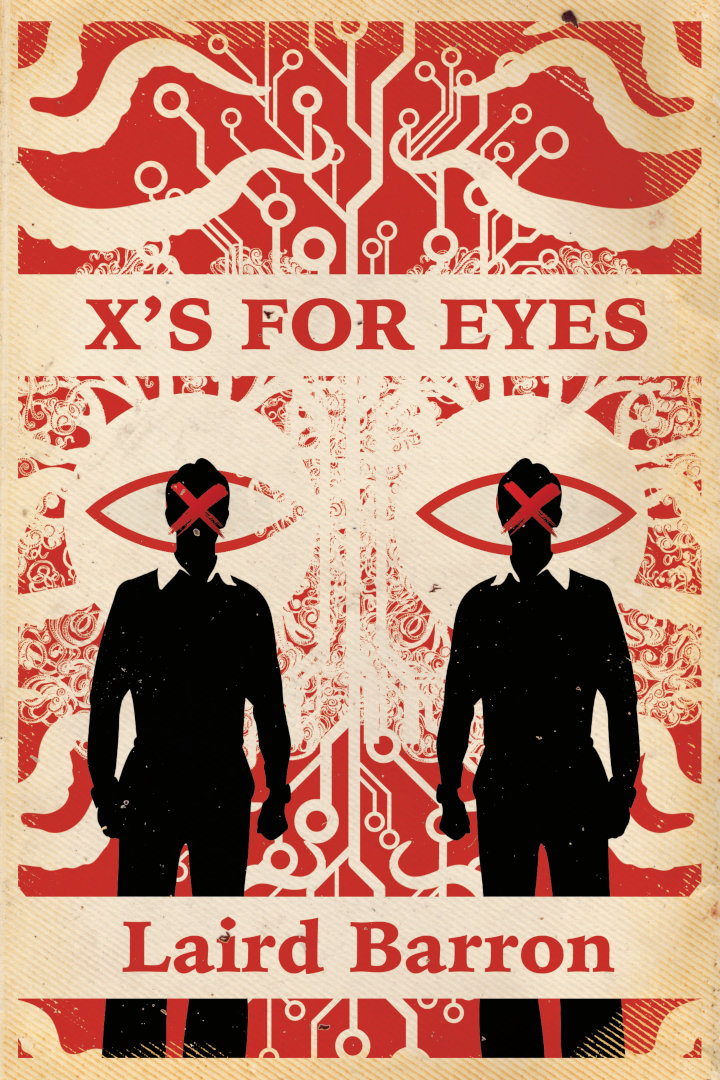
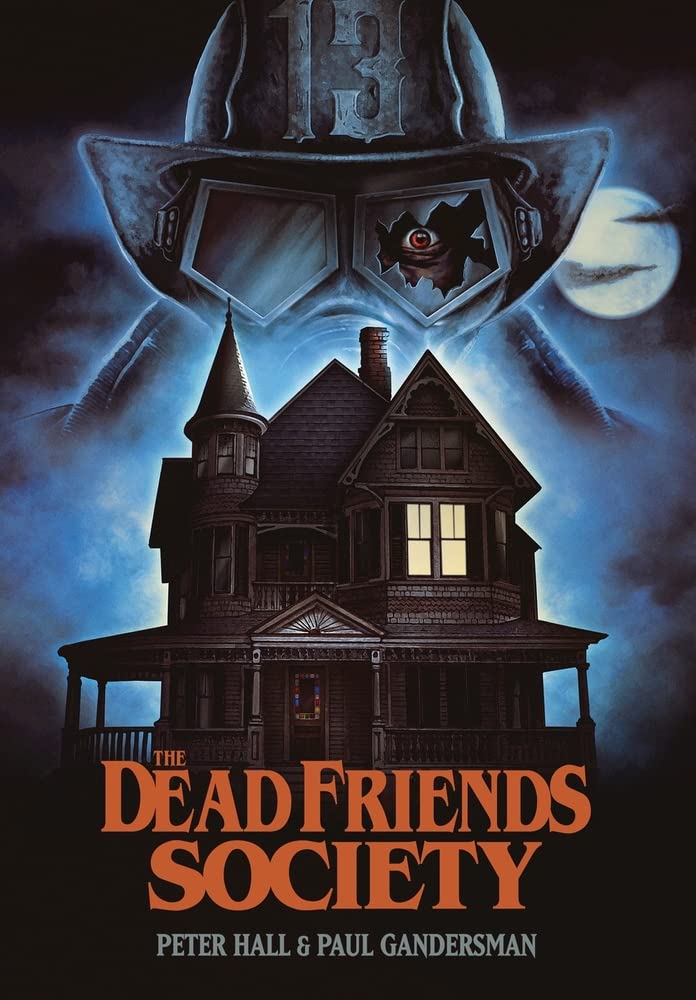
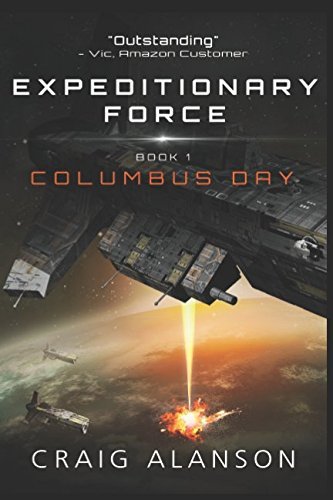
Kaedrin.com
You are here: Kaedrin > Weblog > Archives > Arts & Letters

Arts & Letters
Wednesday, January 11, 2012

The Book Queue, 2012 Edition
The last list I posted, back in July 2011, had 15 books on it. I've made some excellent process, clearing out almost all of the "Holdovers" from previous lists, including some books that have been sitting on my shelf for literally years. The one remainder from that list is Godel, Escher, Bach, which I chose not to read due to its length (not sure if I'll tackle it this year either, but it will remain in the queue until I do!) I've actually read several books that weren't even in the queue, but I think it's time to regroup and look ahead to what I'll be reading in 2012. The first few books here are holdovers from the previous list, which I didn't read for various reasons.
  • Godel, Escher, Bach: An Eternal Golden Braid by Douglas R. Hofstadter: Again, not sure I want to tackle this one right away, as it's quite the lengthy tome. And it's not super easy reading either - it's dense, complex stuff. I've actually read the first chapter or so before, and I'm virtually certain I'll enjoy the book a great deal, but I've got a ton of other stuff I'd like to get through first.
  • Komarr, A Civil Campaign, Diplomatic Immunity, and Cryoburn by Lois McMaster Bujuld - These are the last 4 books in Bujold's long running Vorkosigan Saga, a series I cracked open last year, plowing through the first 10 installments. I'm told that these next few books are some of the most fun in the series, so I'm already looking forward to them (and dreading that I won't be able to fall back on reading Vorkosigan novels)
  • The Children of the Sky by Vernor Vinge: I still want to read this (a continuation of Vinge's loosely linked Zones of Thought books), but initial reviews of this book seem to indicate that it ends on a cliffhanger and that another novel is forthcoming. I thus won't be reading this until I know more about when the presumed conclusion to the story will be available...
  • The Quantum Thief by Hannu Rajaniemi: I actually ordered this last year, but for some strange reason, Amazon could not fulfill the order (it had something to do with my ordering of the paperback version, which is apparently nonstandard or something). I do still want to read it though (it's appaently a SF heist story, which seems right up my alley), and now that I have a Kindle, I can probably get to this whenever I want...
  • Savage Season by Joe R. Lansdale: The first in a series of crime novels by Lansdale, whom you may know from his work on Bubba Ho-Tep (a book/movie where a black JFK and an old Elvis fight a mummy in a modern-day Texas retirement home). I just never got to this last year, but I don't see myself delaying anytime soon.
  • Where Good Ideas Come From: The Natural History of Innovation by Steven Johnson: I really enjoyed Johnson's Everything Bad is Good for You: How Today's Popular Culture is Actually Making Us Smarter, but I've never read any of his other stuff... until now. Or until I read this one, which is already sitting on my shelf.
  • Theodore Rex by Edmund Morris - I gave this biography of Theodore Roosevelt to my uncle as a gift a while ago, and he though I'd like it too, so now it's in the queue. The biography apparently begins with Roosevelt's taking office (i.e. no getting bogged down with his childhood and upraising, it just goes straight to the action). It is a long book with small type and everything, but it's probably something I'll get through this year.
  • Foreigner by C. J. Cherryh - I've actually started reading this one already, so you can see that this book queue works in mysterious ways and that I certainly won't be reading this stuff in order. In any case, this is apparently the first in another long-running series about humans first encounter with aliens. So far, it's quite good, though I'm a little discombobulated by how the narrative keeps jumping ahead. From what I can tell, the series gets much better as it goes...
So there's 11 books I want to read this year. My goal is to do just as good as the 30 I read last year, if not improve on that a little. I also got a Kindle for Christmas, which means I could maybe do more reading on the go. Or not. We'll see. I'm going to be keeping track of progress on GoodReads, so feel free to follow along or friend me or whatever.
Posted by Mark on January 11, 2012 at 06:26 PM .: Comments (0) | link :.


End of This Day's Posts

Wednesday, December 28, 2011

The Year in Reading
As of this moment (and depending on how you count omnibus editions), I have read 30 books in 2011. There's a pretty good chance that I'll finish my current book by the end of the year as well. If you'll permit some navel gazing, here are some stats about what I've read this year:
  • 30 books in 2011 is a big improvement over the 20 books I read in 2010 (which was itself a pretty big year for me). This might be the most I've read in a single year since high school... and it's worth noting that at least 4 of the books from 2010 were read in December of that year (i.e. this has been a pretty well sustained pace for the past year and half or so).
  • According to goodreads, these 30 books translate to 10,964 pages of reading in 2011 (and if you count my current progress, I'm over the 11,000 mark...) This number is perhaps a little suspect, as it depends on print size and spacing and book format and so on, but as an approximation it feels... well, actually, I have no real frame of reference for this. I'll have to enter in dates for my 2010 reading to see what Goodreads comes up with there.
  • 9 of the books were non-fiction, which might also be a record for me (unless you count textbooks or something).
  • Most of the 21 fiction books were science fiction or fantasy novels, and my progress this year was definitely fueled by shortish novels (i.e. around 300 page novels)
  • The longest novel I read this year was Reamde, clocking in at 1044 pages. The second longest novel was Perdido Street Station, which ran 623 pages.
  • 13 of the 30 books were written by women, which is probably another record for me (for a point of comparison, in 2010, I only read 2 books written by women). I should note that this is mostly fueled by Lois McMaster Bujold's Vorkosigan Saga - I've read 9 books in the series so far, and may finish the 10th by the end of the year.
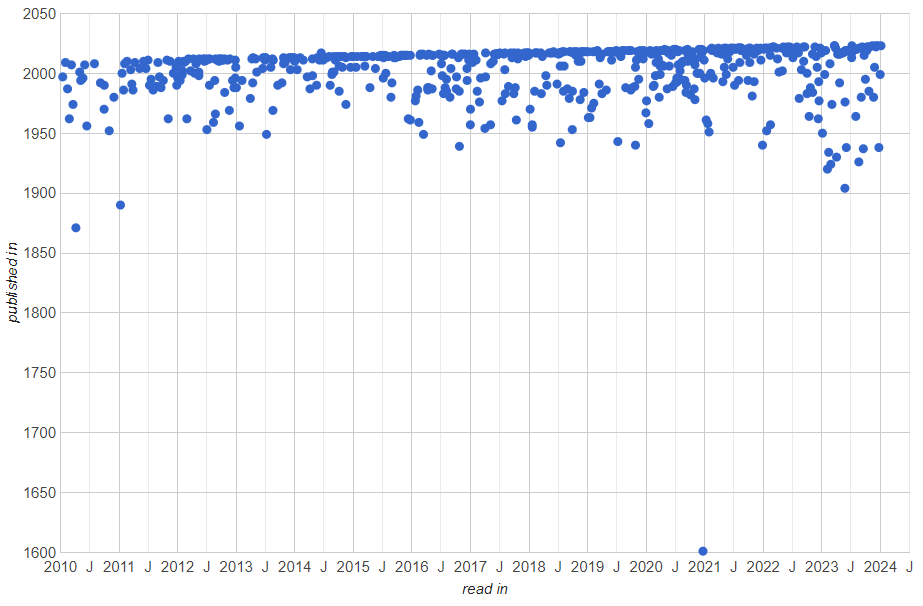
  • Goodreads also provides a neato graph of when you read stuff and when that stuff was published (unfortunately, it's a little too big to feature here). As it turns out, I read only 2 books that were initially published before 1986, though one of those 2 was published in the late 19th century, so there's that.
All in all, a pretty great year of reading. For reference, my top 4 books of the year: Oh hell, can we just make the Vorkosigan Saga (as a whole) the honorary 5th best book of the year? Ok then.

Things have slowed down in the latter part of this year, though I think a large part of that is that I've been focusing on longer novels and non-fiction, which obviously take more time. Indeed, if I manage to tackle Godel, Escher, Bach: An Eternal Golden Braid next year, I expect that will drag down my numbers a bit. Of course, I could hold off on that and slot in 4 short novels in its place, but I should really read GEB, as it's been on my shelf for quite a while... Looking ahead to next year, I'll definitely be finishing off Bujold's Vorkosigan novels, and I was given a Kindle for Christmas, so I'm sure I'll find plenty of things to read there. Perhaps an updated book queue is in order!
Posted by Mark on December 28, 2011 at 07:26 PM .: Comments (2) | link :.


End of This Day's Posts

Sunday, November 27, 2011

Reading Snapshot
It's a meme! About books! Here goes:
  1. The book I’m currently reading: Perdido Street Station, by China Miéville. This has been in the book queue, and indeed sitting on my shelf, for years. Not sure why I never picked it up until now, but I've finally done so. I'm only a couple hundred pages in, but so far, so good. Miéville is a little too verbose in his descriptions of the world, but at least it's an interesting setting worthy of description. It's a little slow to start and the story so far is somewhat undefined, though I think I can see where it's going (and things will hopefully pick up a bit once it gets there). So yeah, mixed feelings so far, but I've got a long ways to go.
  2. The last book I finished: Packing For Mars, by Mary Roach. A nice pop science book that does indeed get into some of the hairy details about space travel... Roach is able to make the whole thing entertaining, though she does seem to spend an inordinate amount of time focusing on the raunchy aspects of space travel. Lots of talk about farting, peeing/pooping, and sex in zero gravity. On the other hand, those activities are actually much more difficult than it would seem, so those details actually turn out to be rather interesting. I'm glad the book is written well and that Roach is able to make dry subjects interesting, but perhaps a 4 page digression into whether or not Astrochimp Enos masturbated during his flights (he apparently didn't) is a bit too much. Still, it's a fun book and well worth a read.
  3. The next book I want to read: It's a toss up between Lois McMaster Bujold's Memory or Katherine Kerr's Polar City Blues. Both are relatively short SF novels of the space opera variety (at least, I think so), which I'm sure I'll be ready for after the density of Perdido Street Station. I'm probably leaning towards Bujold right now, as that book is a sure thing in my mind...
  4. The last book I bought: Foreigner, by C. J. Cherryh. Another space opera series by a female author. I'm hoping it will be able to fill the void once I burn through all of Bujold's Vorkosigan novels.
  5. The last book I was given: Theodore Rex, by Edmund Morris. I actually gave this to my uncle for Christmas last year, and he has since returned it to me, as he thinks I'd enjoy it, which I probably will. When I get to it. Which might be a while.
Well, there you have it. What's your reading snapshot?
Posted by Mark on November 27, 2011 at 01:35 PM .: Comments (0) | link :.


End of This Day's Posts

Sunday, September 18, 2011

NPR's Top 100 Science-Fiction, Fantasy Books
I've been meaning to comment on this for a while, but haven't gotten around to it until now. A couple months ago, NPR put out the call for fans to nominate the best science-fiction and fantasy books. Out of several thousand nominations, NPR narrowed the list down to a few hundred, then had another voting period, finally ending up with the top 100 books (or series).

Like most lists, especially crowd-sourced lists like this, there are many quibbles to be had, but it's a pretty decent list. Below, I'll bold the ones I've read and add annotations where I can, then follow up with some comments.
  1. The Lord Of The Rings Trilogy, by J.R.R. Tolkien - An unsurprising choice for the top slot, and while it may not be my "favorite" series, it's hard to argue with it being the most influential of the books in this list (indeed, many of the fantasy novels below are deeply indebted to LotR).
  2. The Hitchhiker's Guide To The Galaxy, by Douglas Adams - Another unsurprising pick, though my shocking nerd confession is that I don't seem to like this as much as most other nerds. Go figure.
  3. Ender's Game, by Orson Scott Card - Given Card's reputation with the NPR crowd, I'm surprised this book made it this high. Of course, he doesn't espouse any despicable views in the book, and it is very good, so it's well worth reading.
  4. The Dune Chronicles, by Frank Herbert - I've only read the first book, which is fantastic. I never got around to the sequels though, and from what I've heard, I'm not missing out on much.
  5. A Song Of Ice And Fire Series, by George R. R. Martin - I've not read any, though I've seen the first season of the TV show, which is excellent. Probably more likely to keep following the show than read the books. I have to wonder, given some of the heavyweights that fell below this book, if the TV series gave this entry a bit of a boost in the voting...
  6. 1984, by George Orwell - A classic, probably deserves to be higher on the list, but it's hard to argue with a top 10 slot.
  7. Fahrenheit 451, by Ray Bradbury - Another shocking nerd confession - I haven't read any of Ray Bradbury's books. Consider this book on the list of shame.
  8. The Foundation Trilogy, by Isaac Asimov - This one always seems to come out near the top of lists like this, but I've always preferred his robot books.
  9. Brave New World, by Aldous Huxley - I should read this someday, but I just can't muster the enthusiasm to read dystopic stuff these days.
  10. American Gods, by Neil Gaiman - I like this book a lot, but 10th best SF/F book of all time? I don't think so. I wonder how this one got to be so high...
  11. The Princess Bride, by William Goldman - I've never read this, but I get the impression that the movie is better than the book and that the book is getting a bump due to the sheer awesomeness of the movie (which is brilliant).
  12. The Wheel Of Time Series, by Robert Jordan - Never read any of it. It may surprise you to learn that I don't actually read much in the way of fantasy novels (though obviously I've read some of the ones on this list).
  13. Animal Farm, by George Orwell - Another classic, and one that I now like despite being forced to read it in school (seriously, being able to climb out of that cellar is a big feat in itself).
  14. Neuromancer, by William Gibson - Probably the best of the Cyberpunk novels, which isn't say that much since it was really the first of the Cyberpunk novels. Still, it's a good one, deserving of a lot of the praise it gets. Wouldn't be as high on my list, but I can see why it's here.
  15. Watchmen, by Alan Moore - It is probably the best comic book series of all time, well worth the placement on this list.
  16. I, Robot, by Isaac Asimov - Well here's the weird thing. They grouped the Foundation novels together (along with lots of other series on the list), but not the Robot novels? I really like I, Robot, but I like the way the series goes as a whole (I guess people aren't as big a fan of Asimov's latter work where he tied Robots and Foundation together).
  17. Stranger In A Strange Land, by Robert Heinlein - Heinlein makes his first appearance with... one of my least favorites of his work. I suppose it does represent more of a cultural touchstone than his other work, and I know this novel was one of the driving forces behind the 60s counter-culture, so I guess it's not a surprise that the NPR folks like it, but still. Luckily, more Heinlein shows up on this list.
  18. The Kingkiller Chronicles, by Patrick Rothfuss - I've not read this fantasy series, though lots of folks really seem to love the first novel. I've heard mixed reviews of the second book, and like a lot of fantasy series, who knows how long this will go (I believe it's planned at 3, but so were a few other long-running series, so again, who knows). I also can't think of this book without thinking of Scalzi's story of "hearty stew" fantasy.
  19. Slaughterhouse-Five, by Kurt Vonnegut - Another one that goes on the list of shame (at least I've read some Vonnegut before).
  20. Frankenstein, by Mary Shelley - Is this the first female author on the list? Damn. Well, it's a justified classic novel, probably belonging higher on the list.
  21. Do Androids Dream Of Electric Sheep?, by Philip K. Dick - I've never read this, but I have to wonder if the fact that everyone knows Blade Runner was based on this story has anything to do with its performance.
  22. The Handmaid's Tale, by Margaret Atwood - Never read it and I'm not a big fan of dystopias either, but at least there's another female author in the top 25...
  23. The Dark Tower Series, by Stephen King - A series filled with high highes and very low lows. Difficult to describe, but there was a time when I loved these books. But the series kinda finished with a wimper. I had kinda steeled myself against the ending, knowing that it could not possibly live up to what was being built up in the earlier novels, so I didn't hate the ending, but it was still an unsatisfying conclusion. I might, however, make a case for Wizard and Glass, it being an interesting and tragic tale that is, perhaps more importantly, mostly self-contained. (As an aside, both the Dark Tower series and the previous book on this list, The Handmaid's Tale, feature a city-state known as Gilead - a biblical reference, but interesting that these two were ranked next to each other.)
  24. 2001: A Space Odyssey, by Arthur C. Clarke - An interesting choice for the first Clarke novel on the list. Once again, i wonder if it gets a bump from its incredible movie adaptation. Still, it is a very good book that I did enjoy (even having seen the movie).
  25. The Stand, by Stephen King - I do really love this book. There are some issues with the ending, but something like "the hand of God came down and saved them" works infinitely better on the page than it does on the screen (not that I'd hold up the TV mini-series as something particularly good). Well worth a read, probably my second-favorite Stephen King novel (with the first being The Shining, which probably doesn't qualify for this list).
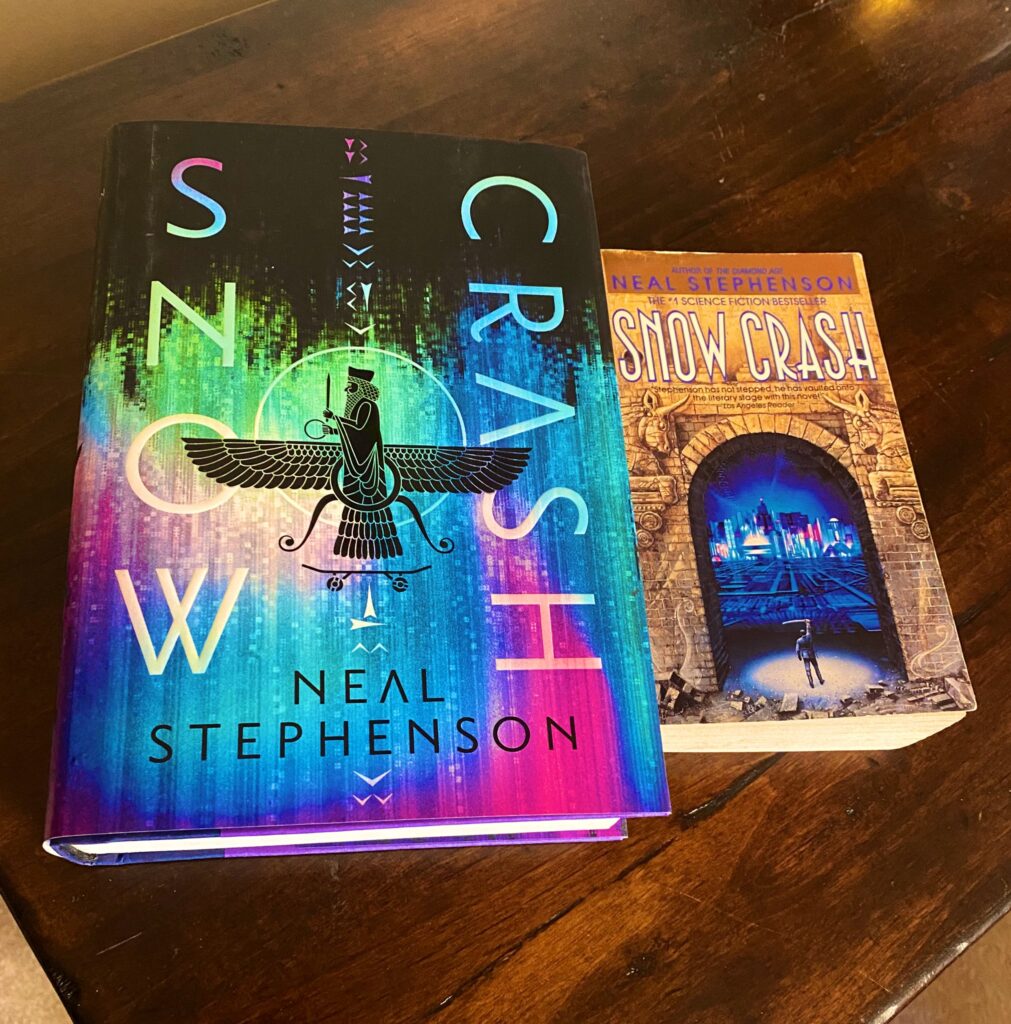
  26. Snow Crash, by Neal Stephenson - If the aforementioned Neuromancer popularized Cyberpunk, Stephenson put the final nail in the coffin with this satirical, action-packed romp through cyber-space. It's a surprisingly prescient novel, though it doesn't get everything quite right. Stephenson is my favorite author, but I would have ranked Cryptonomicon higher (more on that below).
  27. The Martian Chronicles, by Ray Bradbury - On the list of shame.
  28. Cat's Cradle, by Kurt Vonnegut - On the list of shame.
  29. The Sandman Series, by Neil Gaiman - I was always under the impression that Gaiman's Sandman stuff didn't hold up as well as some of his other work, but I guess people still love it. I've never read it, and probably won't...
  30. A Clockwork Orange, by Anthony Burgess - Never read it. If the rest of the list is any indication, there seems to be an inflation of rank for films with great movie adaptations...
  31. Starship Troopers, by Robert Heinlein - An interesting thought experiment from Heinlein, who basically originated the modern military SF genre with this novel, but there's not much of a story here. An important book, but one that would probably chafe a lot of readers with its ideas and the bald way Heinlein presents them.
  32. Watership Down, by Richard Adams - Saw the movie, probably won't read it, makes sense to be on the list though.
  33. Dragonflight, by Anne McCaffrey - Eh, fantasy. Only the third female author so far.
  34. The Moon Is A Harsh Mistress, by Robert Heinlein - My favorite of Heinlein's novels, its libertarian themes and strange sexual politics could probably turn off readers, but there's a well paced story that accompanies things this time, and I really enjoyed the novel.
  35. A Canticle For Leibowitz, by Walter M. Miller - Never read it, but it's in the queue somewhere.
  36. The Time Machine, by H.G. Wells - On the list of shame, though of course I know the general idea of the story (which says something about its importance, I guess).
  37. 20,000 Leagues Under The Sea, by Jules Verne - See previous entry.
  38. Flowers For Algernon, by Daniel Keys - I'd heard of this, but never knew what it was about until now, and I kinda want to read it now.
  39. The War Of The Worlds, by H.G. Wells - See The Time Machine above.
  40. The Chronicles Of Amber, by Roger Zelazny - It's in the queue somewhere.
  41. The Belgariad, by David Eddings - Another fantasy series. Good to know if I want to read some fantasy, but I doubt I'll get to this anytime soon.
  42. The Mists Of Avalon, by Marion Zimmer Bradley - The fourth female author.
  43. The Mistborn Series, by Brandon Sanderson - More fantasy I'm unlikely to ever read.
  44. Ringworld, by Larry Niven - In the queue somewhere, I think my brother might even have a copy somewhere, but I just haven't gotten to it yet.
  45. The Left Hand Of Darkness, by Ursula K. LeGuin - Wonderful SF novel probably deserving a higher spot on this list. And the fifth female author so far.
  46. The Silmarillion, by J.R.R. Tolkien - A little bit of a cheat, as I haven't read the whole thing, but still. Why isn't this considered part of the LotR series?
  47. The Once And Future King, by T.H. White - I think I read this for school? King Arthur and stuff? Must not have made much of an impression.
  48. Neverwhere, by Neil Gaiman - In terms of pure enjoyment, I think this is Gaiman's best. Real page-turning stuff here, and a more satisfying narrative than American Gods or Stardust.
  49. Childhood's End, by Arthur C. Clarke - A solid choice and a good novel, but I've never been as in-love with it as everyone else. There are a couple other Clarke books I'd put ahead of this one.
  50. Contact, by Carl Sagan - Adaptation bump? Whatever the case, I've heard that the movie kinda stops short, while this one make a bolder statement. I've always really loved the movie, but if it really does betray the book, I'd find that disappointing.
  51. The Hyperion Cantos, by Dan Simmons - The first book is certainly on my list to read, but I've heard the rest of the series is kinda meh, and then there's the fact that I've never actually read a good book by Simmons (I read one of his weird vampire books a while back and hated it so much that I drilled a screw through the book so that no one else would read it).
  52. Stardust, by Neil Gaiman - I know I read this, and I'm pretty sure I liked it, but I don't remember anything about it and it's been sorta overridden by the movie adaptation in my mind (rightly or wrongly, I did enjoy the movie, which I understand diverges pretty significantly from the book)
  53. Cryptonomicon, by Neal Stephenson - My favorite book of all time? Perhaps! Would definitely be higher on my list.
  54. World War Z, by Max Brooks - I can only imagine that this is on the list because people love zombies right now. I hate zombie stories.
  55. The Last Unicorn, by Peter S. Beagle - Fantasy. Fleh.
  56. The Forever War, by Joe Haldeman - Considered by many to be Haldeman's response to Heinlein's Starship Troopers, this is first rate SF and it actually features some semblance of a story. There are some flaws (in particular, the way he treats sexuality), but it's still a great book.
  57. Small Gods, by Terry Pratchett - The only Pratchett I've read is Good Omens (co-written with Neal Gaiman), but I was underwhelmed by it and have never really sought out more Pratchett. I should probably do so at some point, but I guess we'll see.
  58. The Chronicles Of Thomas Covenant, The Unbeliever, by Stephen R. Donaldson - Fantasy series. Fleh.
  59. The Vorkosigan Saga, by Lois McMaster Bujold - Love that this made it on the list. I really enjoy these novels and am looking forward to reading more of the series. Would be higher on my list.
  60. Going Postal, by Terry Pratchett - See Small Gods above.
  61. The Mote In God's Eye, by Larry Niven & Jerry Pournelle - I keep hearing about this novel, but I've never read it. It's in the queue.
  62. The Sword Of Truth, by Terry Goodkind - More fantasy. Fleh.
  63. The Road, by Cormac McCarthy - More dystopia. Fleh.
  64. Jonathan Strange & Mr Norrell, by Susanna Clarke - I've wanted to read this for a while, I've just never gotten around to reading it.
  65. I Am Legend, by Richard Matheson - A study of isolation and grim irony. Does this get a bump from the movie adaptation? The movie kinda stinks. The book is far more disturbing, and it's definitely influential in many of the horror writers who followed.
  66. The Riftwar Saga, by Raymond E. Feist - More fantasy. Fleh.
  67. The Shannara Trilogy, by Terry Brooks - More fantasy. Fleh.
  68. The Conan The Barbarian Series, by R.E. Howard - I enjoy the movies, but I doubt I'll ever get to the books...
  69. The Farseer Trilogy, by Robin Hobb - More fantasy. Fleh. But the blurb on NPR sounds nice, I guess. But then, zombies. Fleh.
  70. The Time Traveler's Wife, by Audrey Niffenegger - Doesn't seem like it would be my thing, but I'd be open to reading it, I guess.
  71. The Way Of Kings, by Brandon Sanderson - More fantasy. Fleh.
  72. A Journey To The Center Of The Earth, by Jules Verne - Familiar with the story, but never actually read the book.
  73. The Legend Of Drizzt Series, by R.A. Salvatore - More fantasy. Fleh.
  74. Old Man's War, by John Scalzi - Fantastic modern entry in the military SF canon. Scalzi's tightest novel, though he's got some other good ones.
  75. The Diamond Age, by Neil Stephenson - I'm surprised this made the list, as I'm convinced that Stephenson's reputation for bad/rushed endings comes from this book. Still, it is a really good book, and you can see the transition he was making between Snow Crash and Cryptonomicon. I would probably put Anathem higher than this, but I can't argue with putting it on the list.
  76. Rendezvous With Rama, by Arthur C. Clarke - This might actually be my favorite of Clarke's novels.
  77. The Kushiel's Legacy Series, by Jacqueline Carey - More fantasy. Fleh.
  78. The Dispossessed, by Ursula K. LeGuin - I was less impressed with this novel and it probably wouldn't make my list, but I can see why so many people love it.
  79. Something Wicked This Way Comes, by Ray Bradbury - On the list of shame.
  80. Wicked, by Gregory Maguire - Eh, really?
  81. The Malazan Book Of The Fallen Series, by Steven Erikson - More fantasy. Fleh.
  82. The Eyre Affair, by Jasper Fforde - Never heard of it, but it sounds interesting.
  83. The Culture Series, by Iain M. Banks - In the queue somewhere.
  84. The Crystal Cave, by Mary Stewart - Yet another Arthurian tale (I think this is the third on the list so far). Not much interest here.
  85. Anathem, by Neal Stephenson - Very nice to see this one on the list despite it's relatively recent release. A fantastic novel, his best since Cryptonomicon.
  86. The Codex Alera Series, by Jim Butcher - More fantasy. Fleh.
  87. The Book Of The New Sun, by Gene Wolfe - On my list of shame.
  88. The Thrawn Trilogy, by Timothy Zahn - I'm surprised this Star Wars series made the list. I loved this as a teenager, but when I revisited it a few years later, it wasn't quite as riveting. Still a thousand times better than the prequels! And Grand Admiral Thrawn was indeed quite a great villain for the series. I'm glad Zahn got a place on the list. He's a workhorse, but I tend to enjoy those authors.
  89. The Outlander Series, by Diana Gabaldan - Not familiar with this, may have to add it to the queue!
  90. The Elric Saga, by Michael Moorcock - More fantasy. Fleh.
  91. The Illustrated Man, by Ray Bradbury - *sigh* List of shame.
  92. Sunshine, by Robin McKinley - More fantasy. Vampire fantasy. Fleh.
  93. A Fire Upon The Deep, by Vernor Vinge - One of the best portrayals of a truly alien species in all of SF. The ending is a bit... strange, but I really love the book (A Deepness in the Sky is pretty good as well and I'm really looking forward to The Children of the Sky, which comes out in October I think)
  94. The Caves Of Steel, by Isaac Asimov - As previously mentioned, I'm a big fan of the Robot series. Again, these are books I read as a teenager, and some of them don't hold up as well, but the ideas are great.
  95. The Mars Trilogy, by Kim Stanley Robinson - On my list of shame.
  96. Lucifer's Hammer, by Larry Niven & Jerry Pournelle - In the queue somewhere.
  97. Doomsday Book, by Connie Willis - It's a really good book, but I'm not sure I'm as taken with it as some others.
  98. Perdido Street Station, by China Mieville - It's been sitting on my shelf for, like, 4 years at this point. I have promised myself that I'd read it by the end of this year!
  99. The Xanth Series, by Piers Anthony - Fantasy, but Piers Anthony rings a bell for me. I may check something of his out, maybe not Xanth though.
  100. The Space Trilogy, by C.S. Lewis - I didn't even know these existed!
I did some quick counting of the list:
  • I've read 38 of the books on the list
  • The breakdown between Fantasy and SF is arguable, but a quick count got me 37 fantasy, 63 SF.
  • Only 15 of the books on the list are written by women (and there's at least one woman who comes up twice)
  • Of those 15 books by women, 7 are fantasy (again, the line between SF and Fantasy can be blurry for some of these)
I should note that despite my frequent "fleh" comments above, I don't really have anything against fantasy, I just don't read much of it and thus don't have much to say about it. There are at least a couple series/books above that I'd probably check out at some point. I thought I'd have read more than 38 on the list, but when you consider that only 63 are SF, that does change things a bit, as my focus tends to be on SF.

I'm not sure what to make of the disparity between male and female authors on the list. Is it that there are less female authors of SF/F? Or is it that there are less female readers voting? I can think of one glaring omission on the list - The Sparrow by Mary Doria Russel is superb, and would certainly be on my list (I'm pretty sure it was on the shortlist, but got culled when NPR cut down to 100). Thanks to my incessant Bujold reading, 10 of the 23 books I've read so far this year have been written by a woman (though again, most of that is Bujold). I could probably improve that to 50/50 by the end of the year, which would be nice.

And that about covers it. How many have you read?

Update: Forgot to bold one of the books I read, so my count at the end was off. Updated!
Posted by Mark on September 18, 2011 at 08:32 PM .: Comments (16) | link :.


End of This Day's Posts

Sunday, September 11, 2011

SF Book Review, Part 8: Vorkosigan Edition
I've read the first few books in Lois McMaster Bujold's long-running Vorkosigan Saga and reviewed them in the the last couple SF Book reviews. In short, I've really enjoyed them, and now I've read five more books in the series.

At this point, it's hard to talk about the series without giving a little background info to start with. This, by necessity, means some spoilers, which I'll try to keep at a minimum (if you're sold on the series and want to get started, just skip to the last paragraph of this post). Here goes: In Shards of Honor, Cordelia Naismith of Beta Colony meets Aral Vorkosigan of Barrayar, and they get married around the time Aral becomes the Regent of Barrayar (the planet is ruled by a military class called the Vor, which consists of an Emperor and a bunch of Counts. A Regent is appointed when the current Emperor is not yet old enough to take the throne). Barrayar is a largely feudal society, so there's lots of Machiavellian scheming going on, and thus Aral's Regency was not unchallenged. An assassination attempt exposed the pregnant Cordelia to a teratogenic gas. All survived, including the fetus, but the baby was born with several birth defects, including most notably brittle bones.

That covers the first two books in the series (in a really frighteningly abrupt manner that leaves a ton of important stuff out!), and in The Warrior's Apprentice we are introduced to Miles Vorkosigan, who has grown up in a world that hates and fears "mutants" like himself. Unable to depend on physical prowess, Miles instead relies on his powers of observation and quick-thinking wit. He doesn't give in to the urge for self-pity, but he isn't one-dimensional caricature of a man driven by demons either. Bujold tends to write his stories from his perspective, so we get lots of visibility to what's going on in his head, and he's always thinking ten steps ahead (as is required of him). In The Warrior's Apprentice, he fails to get into the Barrayaran Military Academy due to his physical infirmities, after which he stumbles into a military conflict involving mercenaries, eventually improvising a mercenary fleet of his own (called the Dendarii Free Mercenaries) and foiling a political plot against his father. His mercenary fleet only knows him as Miles Naismith and does not know of his connections to Barrayar, which is a good thing, because Miles and his father propose making them Barrayar's secret army. Impressed, but given few options, the young Emperor pulls strings to get Miles accepted into the Barrayaran Military academy. Whew. That took longer and was probably more spoilery than I intended, but it gives you the appropriate background (I assure you, Bujold is much better at explaining all this! Read the first three books!)
  • The Vor Game - The novel opens with Miles Vorkosigan graduation, followed by his assignment to the Barrayaran equivalent of an arctic outpost (i.e. not a very desirable position). It turns out that the commander there (General Metzov) is rather insane, and a confrontation leads to a career wrecking scandal for Miles. His only option at that point is to work for Barrayaran intelligence, but of course, his first mission there goes belly up as well, forcing him to take command of the Dendarii Mercenaries (again) in order to help save his Emperor. Oh, and there's a Cetagandan invasion fleet on its way to Barrayar too. Yes, it's difficult to describe this plot, but it's an excellent novel, and Bujold deftly maneuvers around various pitfalls and tropes.

    Bujold does a particularly good job with the initial confrontation with the mad General Metzov. Miles has been ordered to participate in a massacre that is most probably illegal. However, disobeying orders isn't exactly a good option either. Miles isn't just a newly minted soldier. He's a Vor Lord, a member of the military caste, son of the Prime Minister (and former Regent) and cousin of the current Emperor. And he's faced with an impossible choice here. Participate in an atrocity, or potentially ruin his life, maybe even taking his father with him and soiling the family name. What do you do when all the available options are bad? It's a recurring theme in these books - and Miles can't just make decisions for himself, he has to constantly consider the political, social and cultural ramifications of his actions.

    Later in the book, he runs across the errant Emperor, where Bujold has steadfastly declined to give in to cliche. Emperor Gregor has been in the series since he was a little boy, protected by Miles' parents during an attempted coup. Miles and Gregor grew up as playmates (inasmuch as the Emperor-to-be could have playmates) and in the hands of a lesser writer, Gregor would have grown into a tyrant that would be the flip-side of Miles's honor. Or something. But Bujold avoids that temptation without going too far in the opposite direction. Gregor is, in himself, a most interesting character. He's got his flaws and some major problems, which we see in this novel, but he's not a tyrant either.

    In the end, it's easy to see why this got the Hugo award for best novel. I don't think it's Bujold's best, but it's definitely a great novel and well worth a read.
  • Cetaganda - One of the great things about this series of novels is that Bujuld doesn't stick to one type of story for all the books. The series is primarily comprised of Space Opera stories, but there are a number of books that stray from the path, and this is one of them. Miles and his cousin Ivan (who is Miles's cousin and something of a foil, usually referred to by Miles as "That idiot Ivan.") are sent to represent Barrayar at the Imperial funeral of the dowager Empress, mother of the current Cetagandan Emperor. The Cetagandans are generally the villains of the Vorkosigan universe, so you can imagine that when Miles gets into trouble (which happens almost immediately upon arrival), things get hairy pretty quickly. In essence, this novel takes the form of a murder mystery, with some espionage and political wrangling thrown in for effect. The Cetagandan empire has a multi-tiered aristocracy, along with numerous castes and an almost inconceivable list of customs, traditions, and ceremonies. Like the best SF, Bujold keeps the info-dumps to a minimum, letting us infer the details of all this from the context of the story. Of course, Miles is in-over-his-head almost immediately, yet he manages to pull it out (that's not really a spoiler, right?). Indeed, given his earlier career (as discussed above, along with the fact that his exploits with the Dendarii Mercenaries can't be trumpeted), his success on Cetaganda proves almost politically embarrassing! This is actually the most recently written book of the ones listed in this post, though it is placed rather early in the actual chronology. I guess this is getting a bit repetitive, but it's a good, fun read, handled with wit and care, like all of Bujold's work.
  • Ethan of Athos - Perhaps the most unusual of the novels in the series in that it does not feature Miles (or anyone from his family) at all, instead focusing on Dr. Ethan Urquhart, from the planet Athos - a planet entirely populated by men. It's an isolated and reclusive planet that does not seek any real outside contact. They reproduce using uterine replicators (something mentioned often in the series, actually), basically technological wombs where children can be grown. However, they do require certain genetic materials, which means that someone has to go out into the big bad galaxy and secure some new biological samples. Ethan is their man, but he's quickly embroiled in a galactic conspiracy. He is helped in his task by Commander Elli Quinn of the Dendarii Free Mercenaries (which is one of the ways in which this book connects with the rest of the series). When we last saw Quinn, she had her face blown off during a battle in The Warrior's Apprentice, but she has since had reconstructive surgery, and is now quite the beauty. Given that Ethan has never had contact with women, this makes for a somewhat interesting dynamic. The bulk of the action takes place on a space station and it takes the form of an espionage thriller. This was actually among the first books of the series to be published, and I think you can see that, but once again, it's a really good story, and provides you with some background information on an important character (Elli Quinn) and obliquely connects with a couple other books in the series. Another good read.
  • Borders of Infinity - Ah, this is the book that causes a great deal of confusion for those of us seeking to read the series in chronological order. It's basically a collection of three 100 page (or so) novellas, with some connective tissue provided in the form of an interview conducted by Simon Illyan, who is the head of the dreaded Barrayaran Imperial Security Service (basically an intelligence organization). However, the confusion comes in because each story takes place between other books in the series. I tried to read them in the appropriate order, but kinda messed up because the connective tissue takes place after Brothers in Arms (which is the next book below). No matter, because these are three of the best stories in the series.

    The first story, entitled "The Mountains of Mourning" is particularly effective, and it even earned Bujold a (well-earned) Hugo award for best novella. It's another of the murder/mysteries, but it takes place in the backwoods of Barrayar, allowing Bujold to explore certain Barrayaran prejudices - especially for their intolerance to birth defects or "mutants". This is particularly impactful because Miles is, himself, something of a mutant, and he has a lot of political considerations to make during this investigation.

    In "Labyrinth", Bujold tells a somewhat less plausible tale, but it is one which connects with Ethan of Athos and Cetaganda a bit, and it is quite an enjoyable read. I'm kinda curious as to whether or not the character Taura will make another appearance in the series (it would certainly be a welcome development!) The third and final story, "The Borders of Infinity" starts a little strangely, but it quickly escalates, and Bujold manages a few interesting twists in what basically amounts to a prison-break story. It ends on a bit of a tragic note, but I still enjoyed it quite a bit.

    Like a lot of short story collections, this one doesn't quite work as a whole as much as a single novel would, but that's to be expected, and each individual story is truly excellent. Indeed, I would put "The Mountains of Mourning" up as one of the best stories in the series, and the other two aren't too shabby either. If you're looking at reading the series and think it's ok to skip these because they're "only novellas", think again - these are really fantastic and should not be skipped. I believe they're better integrated into the omnibus editions that are now in print, but that's probably a topic for another post someday.
  • Brothers in Arms - One of the things I've always found somewhat improbably about this series was that Miles would be able to lead an entire fleet of mercenaries without anyone noticing that he was one of the most famous Barrayaran noblemen in the galaxy. In this book, Bujold solves that problem rather handily. If I tell you how she did so, well, it will sound ridiculous. And it kinda is. In the hands of a lesser writer, it might have fallen flat, but Bujold does an excellent job executing her solution here. It's almost comedic, though she never quite goes that far (if you just accept the premise and go with it, you'll find yourself laughing). However, by the time of the time you reach this novel, she's laid all the groundwork, and it actually fits rather well. The story itself is more of a political espionage tale, and quite a good one at that. Elli Quinn makes another appearance here, and the story ends at a point that leads into the whole connective tissue parts of Borders of Infinity. I expect to see more of a few of these characters in later books as well.
Yes, I'm completely hooked by this series. The only reason I haven't devoured the 8 remaining books is that I'm deliberately trying to prolong the experience, as I will no doubt experience a bit of withdrawal when I finish the series. Of course, the most recent installment was just published last year, so more books are not out of the question.

I heartily recommend the series. If you're interested, I would start with Shards of Honor (or the omnibus edition called Cordelia's Honor, which features Shards of Honor and the hugo-award winning Barrayar) which primarily deals with Miles's parents, or The Warrior's Apprentice (which is probably easier found as part of the omnibus called Young Miles, which features The Warrior's Apprentice, "The Mountains of Mourning" from Borders of Infinity (another Hugo winner), and The Vor Game (yet another Hugo award winner)). Actually, I think those two omnibus editions are an excellent deal, and will give you a significant amount of the series with just two purchases... Well worth it, if you ask me.
Posted by Mark on September 11, 2011 at 08:42 PM .: Comments (4) | link :.


End of This Day's Posts

Wednesday, August 17, 2011

More on Spoilers
I recently wrote about the unintended consequences of spoiler culture, and I just came across this post which has been making waves around the internets. That post points to a study which concluded that readers actually like to have a story "spoiled" before they start reading.
The U.C. San Diego researchers, who compiled this chart showcasing the spoiler ratings of three genres (ironic twist stories, mysteries or literary stories), posited this about their findings: "once you know how it turns out, it’s cognitively easier - you’re more comfortable processing the information - and can focus on a deeper understanding of the story."
Jonah Lehrer apparently goes so far as to read the last 5 pages of the novels he reads, just so he has an idea where the story's headed. He clearly approves of the research's conclusions, and makes a few interesting observations, including:
Surprises are much more fun to plan than experience. The human mind is a prediction machine, which means that it registers most surprises as a cognitive failure, a mental mistake. Our first reaction is almost never “How cool! I never saw that coming!” Instead, we feel embarrassed by our gullibility, the dismay of a prediction error. While authors and screenwriters might enjoy composing those clever twists, they should know that the audience will enjoy it far less.
Interestingly, a few years ago, I posted about this conundrum from the opposite end. Author China MiƩville basically thinks it's extremely difficult, maybe even impossible, to write a crime story or mystery with a good ending:
Reviews of crime novels repeatedly refer to this or that book’s slightly disappointing conclusion. This is the case even where reviewers are otherwise hugely admiring. Sometimes you can almost sense their bewilderment when, looking closely at the way threads are wrapped up and plots and sub-plots knotted, they acknowledge that nothing could be done to improve an ending, that it works, that it is ‘fair’ (a very important quality for the crime aficionado - no last-minute suspects, no evidence the reader hasn’t seen), that it is well-written, that it surprises… and yet that it disappoints.

The reason, I think, is that crime novels are impossible. Specifically, impossible to end.
There's a lot to parse out above, but I have two thoughts on the conclusions raised by the original study. First is that there may actually be something to the cognitive benefits theory of why people like this. The theory and methodology of interpretation of text is referred to as hermeneutics*. This is a useful field because language, especially figurative language, is often obscure and vague. For example, in the study of religious writings, it is often found that they are written in a certain vernacular and for a specific audience. In order to truly understand said writings, it is important to put them in their proper cultural and historical context. You can't really do that without knowing what the text says in the first place.

This is what's known as the hermenutic circle. It's kinda like the application of science to interpretation. Scientists start by identifying a problem, and they theorize the answer to that problem. In performing and observing their experiment to test the problem, they gain new insights which must then be used to revise their hypothesis. This is basically a hermeneutic circle. To apply it to the situation at hand: When reading a book, we are influenced by our overall view of the book's themes. But how are we to know the book's themes as a whole if we have not yet finished reading the parts of the book? We need to start reading the book with our own "pre-understanding", from which we hypothesize a main theme for the whole book. After we finish reading the book, we go back to each individual chapter with this main theme in mind to get a better understanding of how all the parts relate to the whole. During this process, we often end up changing our main theme. With the new information gained from this revision, we can again revise our main theme of the book, and so on, until we can see a coherent and consistent picture of the whole book. What we get out of this hermeneutic circle is not absolute and final, but it is considered to be reasonable because it has withstood the process of critical testing.

This process in itself can be fulfilling, and it's probably why folks like Jonah Lehrer don't mind spoilers - it gives them a jump start on the hermeneutic circle.

Second, the really weird thing about this study is that it sorta misses the point. As Freddie points out:
The whole point of spoilers is that they're unchosen; nobody really thinks that there's something wrong with people accessing secrets and endings about art they haven't yet consumed. What they object to is when spoilers are presented in a way that an unsuspecting person might unwittingly read them. The study suggests that people have a preference for knowing the ending, but preference involves choice. You can't deliberately act on a preference for foreknowledge of plot if you are presented the information without choosing to access it.
And that's really the point. Sometimes I don't mind knowing the twist before I start watching/reading something, but there are other times when I want to go in completely blind. Nothing says that I have to approach all movies or books (or whatever) exactly the same way, every time. And context does matter. When you see a movie without knowing anything about it, there can be something exhilarating in the discovery. That doesn't mean I have to approach all movies that way, just that the variety is somethings a good thing.

* - Yeah, I plundered that entry that I wrote for everything2 all those years ago pretty heavily. Sue me.
Posted by Mark on August 17, 2011 at 06:03 PM .: Comments (0) | link :.


End of This Day's Posts

Sunday, July 17, 2011

The Book Queue
So the last book queue I posted at the beginning of this year had 12 books on it, and I've made great strides against that list. Only 4 remain, and I'm halfway through one of those. I've also read at least 7 other books that weren't on that list (mostly Bujold's Vorkosigan Saga books, of which only the first was on the original list). With only 3 books remaining, I'm looking to fill up the immediate queue again.

Holdovers
The four remaining books from my last queue...
  • Guns, Germs, and Steel: The Fates of Human Societies by Jared Diamond: It's been a bit of a slog. Two weeks of reading, and I'm still only about halfway through it. However, it's gotten better as I've read. It still hasn't quite overcome the bad first impression, but there is at least some interesting stuff going on now. I plan to nail it down this week.
  • Perdido Street Station, by China Miéville: I admit, this is getting ridiculous. This has been in the queue, even sitting on my shelf, for years. I will definitely get to this one this year.
  • Godel, Escher, Bach: An Eternal Golden Braid by Douglas R. Hofstadter: I'm making such good progress this year, but I have a feeling that if I start this, even if I'm reading every day, it will take me a long time to finish it off. It's a 900+ page book, with small type and dense material that I'm sure I'll really enjoy, but which will totally break the momentum I've built up this year. Definitely in 2012 though!
  • Inherent Vice by Thomas Pynchon: Trashy noir novel by Pynchon? Sounds awesome (also apparently being adapted by Paul Thomas Anderson for the screen, so I want to read this before that movie comes out). This one hasn't even been on the list that long though, so it's not a big deal that it's a holdover. Will definitely get to it this year.
Vorkosigan Saga
I started Lois McMaster Bujold's long-running series of science fiction novels mostly (but not solely) chronicling the adventures of the physically diminutive but mentally gifted Miles Vorkosigan. So far this year, I've read 7 novels in the (loosely connected) series. I've got a whole stack of other books just waiting on my shelf now too... and Bujold just released a new one last year, so there's always the chance of more books in the future! I don't know if these are the nerdiest books I've ever read, but referring to them as the Vorkosigan Saga certainly makes it seem so... In any case, this is what I've got left in the series. I'm trying not to read too many of these in a row - I can already sense that I'll be a bit bummed when I finish the series because I very much enjoy spending time with these characters: New Stuff
Pretty self explanatory:
  • Readme by Neal Stephenson: I've already posted about this several times. Stephenson is probably my favorite author, so of course a new novel will immediately jump to the top of the queue (even though it's a 900+ page behemoth). Comes out in September.
  • The Children of the Sky by Vernor Vinge: I've also posted about how much I'm looking forward to this one, another book in Vinge's Zones of Thought universe (not really a series, though maybe, kinda, sorta). This one comes out in October and will probably jump to the top of the queue after I finish Reamde.
  • The Quantum Thief by Hannu Rajaniemi: A science fiction heist story. I am so there.
  • Savage Season by Joe R. Lansdale: The first in a series of crime novels by Lansdale, whom you may know from his work on Bubba Ho-Tep (a book/movie where a black JFK and an old Elvis fight a mummy in a modern-day Texas retirement home). I'm not anticipating a book that's quite that crazy, but this series seems to get some good reviews, so I'll check it out...
So that's 15 books right there, which should keep me busy through the end of the year. Of course, new books will undoubtedly be added (especially since I've just noticed that there's no new non-fiction on the list) and so on, but that is the way of the book queue.
Posted by Mark on July 17, 2011 at 01:55 PM .: Comments (0) | link :.


End of This Day's Posts

Sunday, July 10, 2011

Flow and Games
When I read a book, especially a non-fiction book, I usually find myself dog-earing pages with passages I find particularly interesting or illuminating. To some book lovers, I'm sure this practice seems barbaric and disrespectful, but it's never really bothered me. Indeed, the best books are the ones with the most dog-ears. Sometimes there are so many dog-ears that the width of the book is distorted so that the top of the book (which is where the majority of my dog-ears go) is thicker than the bottom. The book Flow, by Mihaly Csikszentmihalyi1 is one such book.

I've touched on this concept before, in posts about Interrupts and Context Switching and Communication. This post isn't a direct continuation of that series, but it is related. My conception of flow in those posts is technically accurate, but also imprecise. My concern was mostly focused around how fragile the state of flow can be - something that Csikszentmihalyi doesn't spend much time on in the book. My description basically amounted to a state of intense concentration. Again, while technically accurate, there's more to it than that, and Csikszentmihalyi equates the state with happiness and enjoyment (from page 2 of my edition):
... happiness is not something that happens. It is not the result of good fortune or random chance. It is not something that money can buy or power command. It does not depend on outside events, but, rather, on how we interpret them. Happiness, in fact, is a condition that must be prepared for, cultivated, and defended privately by each person. People who learn to control inner experience will be able to determine the quality of their lives, which is as close as any of us can come to being happy.

Yet we cannot reach happiness by consciously searching for it. "Ask yourself whether you are happy," said J.S. Mill, "and you cease to be so." It is by being fully involved with every detail of our lives, whether good or bad, that we find happiness, not by trying to look for it directly.
In essence, the world is a chaotic place, but there are times when we actually feel like we have achieved some modicum of control. When we become masters of our own fate. It's an exhilarating feeling that Csikszentmihalyi calls "optimal experience". It can happen at any time, whether external forces are favorable or not. It's an internal condition of the mind. One of the most interesting things about this condition is that it doesn't feel like happiness when it's happening (page 3):
Contrary to what we usually believe, moments like these, the best moments of our lives, are not the passive, receptive, relaxing times - although such experiences can also be enjoyable, if we have worked hard to attain them. The best moments usually occur when a person's body or mind is stretched to its limits in a voluntary effort to accomplish something difficult and worthwhile. Optimal experience is thus something that we make happen. For a child, it could be placing with trembling fingers the last block on a tower she has built, higher than any she has built so far; for a swimmer, it could be trying to beat his own record; for a violinist, mastering an intricate musical passage. For each person there are thousands of opportunities, challenges to expand ourselves.

Such experiences are not necessarily pleasant at the time they occur. The swimmer's muscles might have ached during his most memorable race, his lungs might have felt like exploding, and he might have been dizzy with fatigue - yet these could have been the best moments of his life. Getting control of life is never easy, and sometimes it can be definitely painful. But in the long run optimal experiences add up to a sense of mastery - or perhaps better, a sense of participation in determining the content of life - that comes as close to what is usually meant by happiness as anything else we can conceivably imagine.
This is an interesting observation. The best times of our lives are often hectic, busy, and frustrating while they're happening, and yet the feeling of satisfaction we get after-the-fact seems worth the effort. Interestingly, since Flow is a state of mind, experiences that are normally passive can become a flow activity through taking a more active role. Csikszentmihalyi makes an interesting distinction between "pleasure" and "enjoyment" (page 46):
Experiences that give pleasure can also give enjoyment, but the two sensations are quite different. For instance, everyone takes pleasure in eating. To enjoy food, however, is more difficult. A gourmet enjoys eating, as does anyone who pays enough attention to a meal so as to discriminate the various sensations provided by it. As this example suggests, we can experience pleasure without any investment of psychic energy, whereas enjoyment happens only as a result of unusual investments of attention. A person can feel pleasure without any effort, if the appropriate centers in his brain are electrically stimulated, or as a result of the chemical stimulation of drugs. But it is impossible to enjoy a tennis game, a book, or a conversation unless attention is fully concentrated on the activity.
As someone who watches a lot of movies and reads a lot of books, I can definitely see what Csikszentmihalyi is saying here. Reading a good book will not always be a passive activity, but a dialogue2. Rarely do I accept what someone has written unconditionally or without reserve. For instance, in the passage above, I remember thinking about how arbitrary Csikszentmihalyi's choice of terms was - would the above passage be any different if we switched "pleasure" and "enjoyment"? Ultimately, that doesn't really matter. Csikszentmihalyi's point is that there's a distinction between hedonistic, passive experiences and complex, active experiences.

There is, of course, a limit to what we can experience. In a passage that is much more concise than my post on Interrupts and Context Switching, Csikszentmihalyi expands on this concept:
Unfortunately, the nervous system has definite limits on how much information it can process at any given time. There are just so many "events" that can appear in consciousness and be recognized and handled appropriately before they begin to crowd each other out. Walking across a room while chewing bubble gum at the same time is not too difficult, even though some statesmen have been alleged to be unable to do it; but, in fact, there is not that much more that can be done concurrently. Thoughts have to follow each other, or they get jumbled. While we are thinking about a problem we cannot truly experience either happiness or sadness. We cannot run, sing, and balance the checkbook simultaneously, because each one of those activities exhausts most of our capacity for attention.
In other words, human beings are kinda like computers in that we execute instructions in a serial fashion, and things like context switches are quite disruptive to the concept of optimal experience3.

Given all of the above, it's easy to see why there isn't really an easy answer about how to cultivate flow. Csikszentmihalyi is a psychologist and is thus quite careful about how he phrases these things. His research is extensive, but necessarily imprecise. Nevertheless, he has identified eight overlapping "elements of enjoyment" that are usually present during flow. Through his extensive interviews, he has noticed at least a few of these major components come up whenever someone discusses a flow activity. A quick summary of the components (pages 48-67):
  • A Challenging Activity that Requires Skills - This is pretty self explanatory, but it should also be noted that "challenging" does not mean "impossible". We need to confront tasks which push our boundaries, but which we also actually have a chance of completing.
  • The Merging of Action and Awareness - When all of our energy is concentrated on the relevant stimuli. This is related to some of the below components.
  • Clear Goals and Feedback - These are actually two separate components, but they are interrelated and on a personal level, I feel like these are the most important of the components... or at least, one of the most difficult. In particular, accurate feedback and measurement are much more difficult than they sound. Sure, for some activities, they're simple and easy, but for a lot of more complex ones, the metrics either don't exist or are too obtuse. This is something I struggle with in my job. There are certain metrics that are absolute and pretty easy to track, but there are others that are more subjective and exceedingly difficult to quantify.
  • Concentration on the Task at Hand - Very much related to the second point above, this particular component is all about how that sort of intense concentration removes from awareness all the worries and frustrations of everyday life. You are so focused on your task that there is no room in your mind for irrelevant information.
  • The Paradox of Control - Enjoyable experiences allow people to exercise a sense of control over their actions. To look at this another way, you could see it as a lack of worry about losing control. The paradox comes into play because this feeling is somewhat illusory. What's important is the "possibility, rather than the actuality, of control."
  • The Loss of Self-Consciousness - Again related to a couple of the above, this one is about how when you're involved in flow, concern about the self disappears. Being so engrossed in a project or a novel or whatever that you forget to eat lunch, and things along those lines. Interestingly, this sort of thing eventually does lead to a sense of self that emerges stronger after the activity has ended.
  • The Transformation of Time - The sense of duration of time is altered. Hours pass by in minutes, or conversely, minutes pass by in what seem like hours. As Einstein once said: "Put your hand on a hot stove for a minute, and it seems like an hour. Sit with a pretty girl for an hour, and it seems like a minute. THAT'S relativity."
So what are the implications of all this? There were a few things that kept coming to mind while reading this book.

First, to a large extent, I think this helps explain why video games are so popular. Indeed, many of the flow activities in the book are games or sports. Chess, swimming, dancing, etc... He doesn't mention video games specifically, but they seem to fit the mold. Skills are certainly involved in video games. They require concentration and thus often lead to a loss of self-consciousness and lack of awareness of the outside world. They cause you to lose track of time. They permit a palpable sense of control over their digital environment (indeed, the necessity of a limited paradigm of reality is essential to video games, which lends the impression of control and agency to the player). And perhaps most importantly, the goals are usually very clear and the feedback is nearly instantaneous. It's not uncommon for people to refer to video games in terms of addiction, which brings up an interesting point about flow (page 70):
The flow experience, like everything else, is not "good" in an absolute sense. It is good only in that it has the potential to make life more rich, intense, and meaningful; it is good because it increases the strength and complexity of the self. But whether the consequences of any particular instance of flow is good in a larger sense needs to be discussed and evaluated in terms of more inclusive social criteria. The same is true, however, of all human activities, whether science, religion, or politics.
Flow is value neutral. In the infamous words of Buckethead, "Like the atom, the flyswatter can be a force for great good or great evil." So while video games could certainly be a flow activity, are they a good activity? That is usually where the controversy stems from. I believe the flow achieved during video game playing to be valuable, but I can also see why some wouldn't feel that way. Since flow is an internal state of the mind, it's difficult to observe just how that condition is impacting a given person.

Another implication that kept occurring to me throughout the book is what's being called "The gamification of everything". The idea is to use the techniques of game design to get people interested in what are normally non-game activities. This concept is gaining traction all over the place, but especially in business. For example, Target encouraged their cashiers to speed up checkout of customers by instituting a system of scoring and leaderboards to give cashiers instant feedback. In the book, Csikszentmihalyi recounts several examples of employees in seemingly boring jobs, such as assembly lines, who have turned their job from a tedious bore to a flow activity thanks to measurement and feedback. There are a lot of internet startups that use techniques from gaming to enhance their services. Many use an awards system with points and leaderboards. Take FourSquare, with its badges and "Mayorships", which turns "going out" (to restaurants, bars, and other commercial establishments) into a game. Daily Burn uses game mechanics to help people lose weight. Mint.com is a service that basically turns personal finance into a game. The potential examples are almost infinite4.

Again, none of this is necessarily a "good" thing. If Target employees are gamed into checking out faster, are they sacrificing accuracy in the name of speed? What is actually gained by being the "mayor" of a bar in Foursquare? Indeed, many marketing schemes that revolve around the gamification of everything are essentially ways to "trick" customers or "exploit" psychology for profit. I don't really have a problem with this, but I do think it's an interesting trend, and its basis is the flow created by playing games.

On a more personal note, one thing I can't help but notice is that my latest hobby of homebrewing beer seems, at first glance, to be a poor flow activity. Or, at least, the feedback part of the process is not very good. When you brew a beer, you have to wait a few weeks after brew day to bottle or keg your beer, then you have to wait some time after that (less if you keg) before you can actually taste the beer to see how it came out (sure, you can drink the unfermented wort or the uncarbonated/unconditioned beer after primary fermentation, but that's not an exact measurement, and even then, you have to wait long periods of time). On the other hand, flow is an internal state of mind. The process of brewing the beer in the first place has many places for concentration and smaller bits of feedback. When I thought about it more, I feel like those three hours are, in themselves, something of a flow activity. The fact that I get to try it a few weeks/months later to see how it turned out is just an added bonus. Incidentally, the saison I brewed a few weeks ago? It seems to have turned out well - I think it's my best batch yet.

In case you can't tell, I really enjoyed this book, and as longwinded as this post turned out, there's a ton of great material in the book that I'm only touching on. I'll leave you with a quite that seems to sum things up pretty well (page 213): "Being in control of the mind means that literally anything that happens can be a source of joy."

1 - I guess it's a good thing that I'm writing this as opposed to speaking about it, as I have no idea how to pronounce any part of Mihaly Csikszentmihalyi's name.

2 - Which is not to take away the power of books or movies where you sit down, turn your brain off, and veg out for a while. Hey, I think True Blood is coming on soon...

3 - This is, of course, a massive simplification of a subject that we don't even really understand that well. My post on Interrupts and Context Switching goes into more detail, but even that is lacking in a truly detailed understanding of the conscious mind.

4 - I have to wonder how familiar Casinos are with these concepts. I'm not talking about the games of chance themselves, though that is also a good example of a flow activity (and you can see why gambling addiction could be a problem as a result). Take, for example, blackjack. The faster the dealer gets through a hand of blackjack, the higher the throughput of the table, and thus the more money a Casino would make. Casinos are all about probability, and the higher the throughput, the bigger their take. I seriously wonder if blackjack dealers are measured in some way (in terms of timing, not money).
Posted by Mark on July 10, 2011 at 07:44 PM .: Comments (0) | link :.


End of This Day's Posts

Sunday, July 03, 2011

The Unintended Consequences of Spoiler Culture
Chuck Klosterman's recent article over at Grantland (Bill Simmons' new site) features some interesting musings on twist endings and the spoilers that can (potentially) ruin them.
...could The Sixth Sense exist today?

Now, I don't mean "Do we still have the technology to make this picture?" because (obviously) we do. We could make it better, probably. I'm also not asking, "Would the twist to The Sixth Sense be spoiled on the Internet?" because (obviously) that would happen, too. It's simply how the media now works. I'm also not wondering if simultaneously promoting and protecting The Sixth Sense would be a marketer's nightmare, because that's undeniable and not particularly important. What I'm asking is this: Are screenwriters now affected by "spoiler culture" before they even begin the writing process? If you know a twist will be unavoidably revealed before the majority of people see the work itself, and if you concede that selling and marketing a film with a major secret will be more complicated for everyone involved … would you even try? Would you essentially stop yourself from trying to write a movie that's structured like The Sixth Sense?
It's an interesting premise, but even Klosterman admits that it's impossible to know for sure. He gives a few examples: the aforementioned The Sixth Sense, the semi-recently concluded TV show Lost, and the new TV show The Killing. I think part of the problem with the article, though, is that it lacks some of the context of what makes these particular twists work.

Take The Sixth Sense. Writer and director M. Night Shyamalan, as of right now, is almost comically known for his reliance on twists, but it's important to remember that back in 1999, Shyamalan was an unknown. The movie was basically a Bruce Willis vehicle, and even then, it was dumped into theaters in August, the month Hollywood releases movies to die. So what does all that mean? Well, there wasn't much buzz about the movie beforehand - few people were following the making of the movie, thus they didn't have to worry much about spoilers on the internet (and while it's probably worse today, there were still plenty of movie rumor sites active back in the day). The only thing the filmmakers needed to do was to ensure that the marketing didn't give away the twist1... and luckily, the film had other readily marketable elements.

Shyamalan's problems came later and are mostly his own fault. After the twist ending of Unbreakable, he had pretty much pigeon-holed himself as a twist ending writer. Twists rely on an audience that isn't expecting a twist. This works in a movie like The Sixth Sense because there were lots of other things going on. The reason the twist works so well is that the film wasn't asking you to explain anything throughout the film. The ending provided an answer to a question we didn't realize needed asking. And it did so in a way that didn't feel cheap or contrived. It just fit. But it probably wouldn't work so well if you were looking for it all throughout the film.

This is where Klosterman's point comes in. Once you're known for writing twists, it becomes much more difficult to pull them off. I readily agree that Shyamalan and Damon Lindelof (of Lost) will have trouble writing a new movie/show that is heavily reliant on twists... but only because both of those writers have abused the twist in their previous work. The same goes for most TV series, especially police procedurals, all of which tend to fall into certain established patterns of red herrings, etc... A while ago, in reference to Hitchcock's earliest works, I made a similar observation:
...the "twist" at the end of the story wasn't exactly earth-shattering. These days, we're so zonked out on Lost and 24 that our minds immediately and cynically formulate all the ways the filmmakers are trying to trick us. Were audiences that cynical 80 years ago? Or did the ending truly surprise them?
In this respect, Klosterman is certainly correct: if audiences are looking for your twist, you're going to have a really rough time. So writers known for their twists - even if it's just one big twist - will have to contend with that.

The problem here is that this doesn't necessarily mean that Hollywood is skewing away from twists... just that writers like Shyamalan and Lindelof are. Nothing's stopping anyone else from writing a twist ending, and there's no real shortage of examples, even in the past couple years (I have a whole category devoted to plot twists in the yearly Kaedrin Movie Awards). They just happen to come from movies where we're not necessarily looking for the twist2.

Klosterman also points out that hiding the twist can also lead to disappointment. His chief example:
Take the 2008 sci-fi film Cloverfield: The marketing campaign was flawless. Without revealing any aspect of the story, the trailers for Cloverfield made it clear that something cataclysmic was going to happen in New York, and that this massive event was some unthinkable secret. Considering how the media now operates, the makers of Cloverfield did a remarkable job of keeping its details clandestine. Yet this secrecy probably hurt the film's ultimate reception — when people realized it was "only" an updated version of a traditional monster movie, they were often disappointed.
Well, that's certainly one way to look at it. Another way to look at it was that audiences were disappointed because the movie kinda sucked3. Also, that's a "twist" manufactured by marketing, not one related to storytelling or anything. In a very real sense, Super 8 has similar issues, though I think that ended up being a much better movie.

Ultimately, I think the "twist" is here to stay. Oh sure, it may go away for a while as the Shyamalans and Lindelofs of the world move on to more straightforward narratives. But the twist will make a comeback soon enough, just when we least expect it. Which is, of course, the whole point of a twist.

1 - This is not a trivial challenge. Terminator 2: Judgment Day provides an interesting example. Watch that film with a blank slate, and you'll notice that it's written as if the audience doesn't know that Schwartzenegger's terminator is a "good guy" and that Robert Patrick's T-1000 is the villain. In the absence of marketing, it would be reasonable for someone not familiar with the movie to assume that it's following the same pattern as the previous installment. When I was little, I was a huge Terminator fan, so I distinctly remember a lot of the marketing surrounding T2... and they gave all of it away. Of course, the reveal happens relatively early in the film, but I still remember finding it a bit weird that they spent so much time trying to obscure what everyone already knew.

2 - The first example that came to mind was kinda odd because it's not very prominent in it's film (and I doubt anyone would call it out in a discussion of twists), but I always liked it: the last scene in Batman Begins (in the board room, not the action sequence on the train) is wonderful, and I think it did more to cement how much I liked that movie than anything else. It fits very well with the story, and there are even hints about it earlier in the movie. But it's an action film and the twist was far away from most of the central plot points, so I never saw it coming.

3 - I guess that's a bit unfair. The film has its merits, but most people who saw it complained about the shaky cam much more than the fact that it was a monster movie. Seriously, even I had problems with the camerawork in that movie making me sick, and I'm normally fine with that sort of thing. The premise is actually the best part about the movie - a monster movie told from the perspective of normal folks fleeing the attack. No spunky scientist teaming up with a hardened military veteran to take down the monster, just normal folks trying to survive. Unfortunately, the execution of this was... lacking.
Posted by Mark on July 03, 2011 at 03:23 PM .: Comments (0) | link :.


End of This Day's Posts

Sunday, June 26, 2011

Tasting Notes - Part 4
Another edition of Tasting Notes, a series of quick hits on a variety of topics that don't really warrant a full post. So here's what I've been watching/playing/reading/drinking lately:

Television
  • Game of Thrones - The season finale aired last week, and I have to say, I'm impressed. My usual approach to stuff like this is to let it run for a couple of seasons to make sure it's both good and that it's actually heading somewhere. At this point, the book series isn't even finished, but friends who've read it think it's great and they say the books get better, so I gave the series a shot - and I'm really glad I did. It's a fantastic series, much more along the lines of swords-and-sandals (a la Spartacus or Gladiator) than outright fantasy (a la Lord of the Rings). People talk about magic and dragons and whatnot, but most of that seems to be in the distant past (though there are hints of a return to that sort of thing throughout the series and especially in the last minutes of the season). Most of the season consists of dialogue, politics, Machiavellian scheming, and action. Oh, and sex. And incest. Yeah, it's a fun show. The last episode of the season doesn't do much to resolve the various plotlines, and hints at an even more epic scale. Interestingly, though, I don't find this sort of open-endedness that frustrating. Unlike a show like Lost, the open threads don't seem like red-herrings or even mysteries at all. It's just good, old fashioned storytelling. The worst thing about it is that I'm all caught up and will have to wait for the next season! Prediction: Geoffrey will die horribly, and I will love it. But not too quickly. He's such a fantastic, sniveling little bastard. I want to keep hating him for a while before someone takes him down.
  • Netflix Watch Instantly Pick of the Week: Doctor Who - Most of the semi-recently rebooted series is available on watch instantly, and I've only just begun to pick my way through the series again. I vaguely remember watching a few of Christopher Eccleston's Ninth Doctor episodes, but I never finished that first season. I'm not very far in right now - just saw the first appearance of the Daleks, which should be interesting.
Movies
  • 13 Assassins - Takashi Miike tends to be a hit-or-miss filmmaker for me. Fortunately for him, he is ridiculously prolific. His most recent effort is a pretty straightforward Samurai tale about a suicide mission to assassinate a cruel and ruthless evil lord. Seven Samurai, it is not, but it is still quite engaging and entertaining to watch. It starts a bit slow, but it finishes with an amazing 45 minute setpiece as our 13 heroes spring their trap on 200 enemies. Along the way, we get some insight into Japanese culture as the days of the Samurai and Shogunate faded, though I don't think I'd call this a rigorously accurate film or anything. Still, there's more going on here than just bloody action, of which there is a lot. An excellent film, among the top films I've seen so far this year.
  • HBO has a pretty great lineup right now. In the past couple weeks, I've revisited Inception, Scott Pilgrim vs. the World, and How to Train Your Dragon. All of these films have improved upon rewatching them, a subject I've always found interesting. Scott Pilgrim, in particular, has improved it's standing in my mind. I still think it's got some problems in the final act, but I also think it's a dreadfully underappreciated film.
  • Netflix Watch Instantly Pick of the Week: Transcendent Man - I mentioned this a couple weeks ago, but it's an interesting profile of Ray Kurtzweil, a futurist and singularity proponent. I don't really buy into his schtick, but he's an interesting guy and the documentary is worth a watch for that.
Video Games
  • I'm still playing Mass Effect 2, but I have not progressed all that far in the game. I've found this is common with RPGs lately - it takes a long time to get anything accomplished in an RPG, so I sometimes find it hard to get started. Still, I have liked what I've seen of this game so far. It's far from perfect, but it's got some interesting elements.
  • Since I had to hook up my Wii to get Netflix working during the great PSN outage of '11, I actually did start playing Goldeneye again. I even got a Wii classic controller, and that made the game approximately 10 times more fun (but I have to say, plugging the Wiimote into the classic controller to get it to work? That's just stupidly obtuse, though I guess it keeps the cost down). Since I could play it in short 30 minute chunks, I actually did manage to finish this one off in pretty short order. It's a pretty simple FPS game, which I always enjoy, but there's nothing particularly special about it, except for some muted nostalgia from the original.
Music
  • The Black Keys - Brothers - This is a pretty great album. Lots of crunchy blues guitars and catchy rhythms. I'm greatly enjoying it.
  • Deerhoof - Deerhoof vs. Evil - Another hipster rock album, but I rather like it, especially the song Secret Mobilization. Good stuff.
Books
  • I've been cranking my way through Lois McMaster Bujold's Vorkosigan Saga novels, of which there are many (and I'm actually quite glad, as they're all great fun). I've covered the first few novels in SF Book Reviews, and will probably have finished enough other books to do a Bujold-only edition in the near future. I'm currently reading Ethan of Athos, which seems to me to be a kinda spinoff/standalone novel, but an interesting one nonetheless (and we get to catch up with a character from one of the other books).
  • I also started Guns, Germs, and Steel by Jared Diamond, but have found myself quickly bogging down (it doesn't help that I have, like, 10 Bujold novels sitting around, begging me to read them) almost from the start. It's not bad, per say, but there's something about the style and scope of the book that bothers me. There are some interesting ideas, and Diamond admits that his methods are, by necessity, not that rigorous, but it's still seems extremely speculative to me. I would normally be fine with that sorta approach, but I'm finding something about this grating and I haven't figured it out just yet...
  • If you count the aforementioned Guns, Germs, and Steel, I'm down to just 4 unread books from my last Book Queue, which is pretty good! And I've only really added the Bujold books and Fuzzy Nation since then. I'm actually at a point where I should start seeking out new stuff. Of course, it probably won't take long to fill the queue back up, but still. Progress!
The Finer Things...
  • I've managed to have some pretty exceptional beers of late. First up is Ola Dubh Special Reserve 40, an imperial porter aged in 40 year old Highland Park casks. It's an amazing beer, though also outrageously priced. Still, if you can get your hands on some and don't mind paying the premium, it's great.
  • Another exceptional beer, the legendary Pliny the Elder (currently ranked #3 on Beer Advocates Best Beers on Planet Earth list). It's a fantastic double IPA. Not sure if it's really #3 beer in the world fantastic, but fantastic nonetheless.
  • One more great beer, and a total surprise, was Sierra Nevada Boot Camp ExPortation. Basically, Sierra Nevada has this event every year where fans get to go to "Beer Camp" and collaborate on new beers with Sierra Nevada brewers and whatnot. My understanding is that the batches are extremely limited. Indeed, I never expected to see these, but apparently there were a few on tap at a local bar, sorta leftover from Philly Beer Week. The beer is basically a porter with Brettanomyces added and aged in Pinot Noir barrels. This is all beer-nerd-talk for a sour (in a good way) beer. I'm not normally big into the style or Brett, but I'll be damned if this isn't a fantastic beer. I loved it and unfortunately, I'll probably never see it again. If you see it, try it. At the very least, it will be an interesting experience!
And that's all for now.
Posted by Mark on June 26, 2011 at 06:22 PM .: Comments (2) | link :.


End of This Day's Posts

Wednesday, May 25, 2011

How Boyd Wrote
I'm currently reading a biography of John Boyd, and in light of Sunday's post, I found a recent chapter particularly interesting. Boyd was a Fighter Pilot in the Air Force. He flew in Korea, made a real name for himself at Fighter Weapons School (which was later copied by the Navy - you may have heard of their version: Top Gun), and spent the latter part of his career working on groundbreaking strategic theories. He was an instructor at FWS for several years, and before leaving, he made his first big contributions to the Air Force. He wrote a tactics manual called Aerial Attack Study. Despite the passage of Vietnam and the Gulf War, nothing substantial has been added to it. It's served as the official tactics manual all over the world for over 40 years (actually, more like 50 at this point).

And Boyd almost didn't write it. Robert Coram (the author of the aforementioned biography) summarizes the unconventional manner in which the manual was written (on page 104 of my edition):
Boyd could not write the manual and continue flying and teaching; there simply wasn't enough time. Plus, the idea of sitting down at a desk and spending hundreds of hours writing a long document brought him to the edge of panic. He was a talker, not a writer. When he talked his ideas tumbled back and forth and he fed off the class and distilled his thoughts to the essence. But writing meant precision. And once on paper, the ideas could not be changed. ...

Spradling came up with the solution. "John, don't make this a big thing. We have some good Dictaphones. Why don't you just dictate the damn thing?"
It's a subject I didn't really cover much in my last post: the method of communication can impact the actual message. The way we communicate changes the way we think. Would Boyd's work have been as great if he didn't dictate it? Maybe, but it probably wouldn't have been the same.

Incidentally, I don't normally go in for biographies, but this is an excellent book so far. Part of that may be that Boyd is a genuinely interesting guy and that he was working on stuff that interests me, but I'm still quite enjoying myself.
Posted by Mark on May 25, 2011 at 08:09 PM .: Comments (0) | link :.


End of This Day's Posts

Sunday, April 24, 2011

Tasting Notes - Part 3
Another edition of Tasting Notes, a series of quick hits on a variety of topics that don't really warrant a full post. So here's what I've been watching/playing/reading/drinking lately:

Television
  • Community is actually a pretty fun show. In a lot of ways, it's standard sitcom fodder, but the inclusion of the character of Abed redeems most of the potentially overused cliches. Abed is a pop-culture obsessed film student who appears to be aware that he's a part of a sitcom, and thus his self-referential observations are often quite prescient. The cast is actually pretty fantastic and there are lots of traditionally funny jokes along the way. Honestly, I think my favorite part of the episode are the post-credits sequences in which Abed and Troy are typically engaging in something silly in a hysterically funny way. I've only seen the first season, but I'm greatly looking forward to the second season (which is almost complete now, and probably available in some form, but I haven't looked into it too closely).
  • Netflix Watch Instantly Pick of the Week: The X-Files - It looks like the entire series is available. I watched the series frequently when it was on, but I never realized just how many episodes I missed. I was never a fan of the alien conspiracy episodes (in part because it was difficult to watch them in the right order and I never knew what was going on), but I've always loved the "freak of the week" style episode, and now that all of them are at my fingertips, I'm seeing a bunch that I never knew even existed. The show holds up reasonably well, though it's a little too on-the-nose at times (especially in the early seasons). In the context in which the shows were being produced, though, it's fantastic. From a production quality perspective, it's more cinematic than what was on TV at the time (and a lot of what's on today), and it was one of the early attempts at multi-season plot arcs and continuity (technology at the time wasn't quite right, so I don't think it flourished quite as much as it could have if it had started 10 years later).
Video Games
  • Ratchet & Clank Future: Tools of Destruction is a lot of fun, though you can sorta tell that it was a near launch game. I actually mentioned this a while back, and because it was my first Ratchet & Clank game, I didn't suffer from most of the repetitive and derivative elements (which I gather is what disappointed old fans). Some minor usability issues (constantly changing weapons/tools is a pain), but otherwise great fun. I particularly enjoyed the Pirate themed enemies, who were very funny. I enjoyed this enough that I'll probably check out the more recent A Crack in Time, which I hear is pretty good.
  • Call of Duty: Black Ops - It's another CoD game, so I got pretty much exactly what I expected. The single player game actually has a semi-interesting story, though the animators fell in love with the overly-hyper cutting and shaky-cam style that is already overused in film, and which is mostly unnecessary in video games. Don't get me wrong, the story is kinda hokey, but it's entertaining in its own way. And, of course, the combat is very well balanced and fun (as every game I've played in the series is...) The game ends with one of the most gleefully manic sequences I've ever played (much better than, for example, the airline thing at the end of CoD4). The multi-player is not particularly noob-friendly, but I got a few hours out of it and even managed to win a round one time. The kills come so quickly that it's pretty rare that you'll escape anyone once they start shooting (the way you can in some other games). This is both good and bad though. All in all, it's a good FPS for console.
  • I've started playing Mass Effect 2 for the PS3. I have no idea what's going on with the story (I thought there was supposed to be some sort of PS3 intro thingy, but I didn't see it when I started the game), but I'm having fun so far. It's not something I've been playing a lot though, perhaps because I don't have a ton of time to dedicate to it...
  • Remember when i said I would play more Goldeneye for the Wii? Yeah, I still haven't unpacked the Wii from that trip, which is a pretty good expression of how I generally feel about the Wii these days. I guess it's a good thing Nintendo is announcing their next console soon (though I have to admit, the rumors I'm hearing aren't particularly encouraging).
Movies
  • James Gunn's comic book spoof Super continues the trend towards deconstruction of superheroes that's been going on recently in comic book cinema (though things look like they're about to revert a bit this summer). As such, it's semi-derivative at times, but it sticks to its guns (or should I say, Gunns!) and never flinches at its target. It's also not afraid to embrace the weird (such as, for instance, tentacle rape). It's extremely graphic and violent, and some of it is played for laughs, but there's at least one unforgivable moment in the film. One thing I have to note is that there's going to be a lot of teenage nerds falling in love with Ellen Page because of her enthusiastic performance in this movie. She's awesome. The critical reception seems mixed, but I think I enjoyed it more than most. I wouldn't call it one of the year's best, but it's worth watching for superhero fans who can stomach gore.
  • Hobo with a Shotgun does not fare quite as well as Super, though fans of Grindhouse and ultra-violence will probably get a kick out of it. If Super represents a bit of a depraved outlook on life, Hobo makes it look like the Muppets. A few years ago, when Grindhouse was coming out, there was a contest for folks to create fake grindhouse-style trailers, and one of the winners was this fantastically titled Hobo With a Shotgun. Unfortunately what works in the short form of a fake trailer doesn't really extend well to a full-length feature. There are some interesting things about the film. Rutger Hauer is great as the hobo (look for an awesome monologue about a bear), the atmosphere is genuinely retro, it actually feels like a grindhouse movie (as opposed to Tarantino and Rodriguez's efforts, which are great, but you can also kinda tell they have a decent budget, whereas Hobo clearly has a low budget), and the armored villains known as the Plague are entertaining, if a bit out of place. Ultimately the film doesn't really earn its bullshit. Like last year's Machete (another film built off of the popularity of a "fake" trailer), I'm not convinced that this film really should have been made. Again, devotees to the weird and disgusting might enjoy this, but it's a hard film to recommend.
  • Netflix Watch Instantly Pick of the Week: The Good, the Bad, the Weird - Kim Jee-woon's take on the spaghetti western is actually quite entertaining, if a bit too long and maybe even a bit too derivative. Still, there are some fantastic sequences in the film, and it's a lot of fun. Jee-woon is one of the more interesting filmmakers that's making a name for Korean cinema on an international scale. I'm greatly looking forward to his latest effort, I Saw the Devil.
Books
  • In my last SF book post, I mentioned Lois McMaster Bujold's Shards of Honor. I really enjoyed that book, which was apparently the first in a long series of books, of which I've recently finished two: Barrayar and The Warrior's Apprentice. I'll save the details for the next SF book review post, but let's just say that I'm fully onboard the Bujold train to awesome. I put in an order for the next several books in the series, which seems to be quite long and varied.
  • Timothy Zahn's Cobra Trilogy is what I'm reading right now. I'm enjoying them, but it's clear that Zahn was still growing as a storyteller when writing these. Interestingly, you can see a lot of ideas that he would feature in later works (and he would do so more seamlessly too). I'm about halfway through the trilogy, and should be finishing it off in the next couple weeks, after which, you can expect another SF book review post...
  • I've also started Fred Brooks' The Design of Design, though I haven't gotten very far just yet. I was traveling for a while, and I find that trashy SF like Zahn and Bujold makes for much better plane material than non-fiction. Still, I'm finding Brooks' latest work interesting, though perhaps not as much as his classic Mythical Man Month.
The Finer Things...
  • The best beer I've had in the past few months has been the BrewDog/Mikkeller collaboration Devine Rebel. It's pricey as hell, but if you can find a bottle of the 2009 version and if you like English Barleywines (i.e. really strong and sweet beer), it's worth every penny. I got a bottle of the 2010 version (which is apparently about 2% ABV stronger than the already strong 2009 batch) recently, but I haven't popped it open just yet.
  • My next homebrew kit, a Bavarian Hefeweizen from Northern Brewer, just came in the mail, so expect a brew-day post soon - probably next week, if all goes well. I was hoping to get that batch going a little earlier, but travel plans got in the way. Still, if this goes as planned, the beer should be hitting maturity right in the dead of summer, which is perfect for a wheat beer like this...
  • With the nice weather this weekend, I found myself craving a cigar. Not something I do very often and I really have no idea what makes for a good cigar, but I'll probably end up purchasing a few for Springtime consumption... Recommendations welcome!
That's all for now. Sorry about all the link dumps and general posting of late, but things have been busy around chez Kaedrin, so time has been pretty short. Hopefully some more substantial posting to come in the next few weeks...
Posted by Mark on April 24, 2011 at 06:36 PM .: Comments (0) | link :.


End of This Day's Posts

Wednesday, March 23, 2011

Recent Television on DVD/BD
I don't watch a lot of live television, but thanks to the magic of DVD/BD/Netflix Instant, I can catch up on a series pretty quickly if I want to. The biggest issue with this approach happens when the series isn't done yet, and you have to then either slow down and wait between episodes (and deal with things like commercials!) or wait a year or more for the next set of DVDs to come out. That being said, watching a TV series like this can get really addictive, really fast. Here's a few things I've been watching lately:
  • Sherlock - Without a doubt the best Sherlock Holmes series, I've probably ever seen. This includes movies, like Guy Richie's recent Sherlock Holmes and the 1985 Spielberg-produced Young Sherlock Holmes (which I have a soft spot for, despite the fact that no one ever knows what I'm talking about when I reference that movie). Heck, it's even better than the Sherlock-inspired House, which was probably the best modernized update of the Sherlock Holmes ideal... until now. I've only seen the first two episodes, but they're long episodes (90 minutes each), and there have only been three episodes created so far (with another three scheduled to air later this year). But this is high quality stuff. It's got a contemporary setting (unlike the usual Victorian setting) and excellent writing, casting, and acting. The visual style of the show even shows more flare than your typical British production. Holmes has his usual quirks, though he is altogether more likeable here than Greg House or Robert Downey Jr.'s version of Holmes. Watson is fun, though I don't think he's really been given enough time to really shine just yet. And of course, the mysteries are intriguing (indeed, I rather enjoy this more than what limited stories I've actually read). Highly recommended. Thanks to Otakun for his recommendation a while back, as I surely wouldn't have put this in my Netflix queue without that recommendation. He's also got some extra info on the series and some interesting links to online tie-in sites (like Watson's blog, etc...)
  • Fringe - I was in the mood for an X-Files style show, and so I popped this series into my Netflix queue and what I found was something that started off in a similar vein, but which pretty quickly managed to establish its own identity. The show revolves around a series of strange science-gone-wrong accidents that seem to be occurring (ominously referred to as, The Pattern), the idea being that there are these mad-scientists out there experimenting with chemical and biological weapons out in public. It's creepy stuff, actually. Of course there's the FBI's Fringe division, lead by Agent Olivia Dunham and her sidekicks: Walter and Peter Bishop. Walter is a fun character, eccentric and brilliant. You get the impression that he's done a lot of bad things in the past, but he's clearly a different person now. And so on. It takes its time, but it eventually establishes a main, overarching conflict which seems pretty compelling. Some of the execution is a bit silly or uninspired (tons of cliches), but it's a generally entertaining series. What passes for "science" in the show is a bit fluffy, but coming from the guys who dreamed up "red matter" in the Star Trek reboot, that's par for the course. In that respect, it reminds me a bit of Lost. Again, generally entertaining, but not something I'm convinced will pay off that well. Still, I'd like to watch more of it (alas, we're well into season 3 now, so I have no idea when I'll be able to catch up).
  • Breaking Bad - Based mostly on the enthusiastic recommendations of the /Filmcast, I checked out the short first season of this series about a high school chemistry teacher who learns he's going to die, and to pay for the cancer treatments, he teams up with a former student to cook meth. It's a lot better than I'm making it sound, and very well acted, but on the other hand, there's something a little off about the show that I can't quite place. It was an interesting first season, but I can't say as though I'm all that excited to revisit these characters. I suppose that I can see why the series has inspired so much love, but it just isn't clicking with me. I may give it another chance at some point, but probably not anytime soon.
There are a bunch of other series I have in the queue, including Veronica Mars, Deadwood, and a few others (including some Anime). And, of course, the next season of Sherlock.

Update: Damn you, cliffhanger! (Just finished the last episode of Sherlock.)
Posted by Mark on March 23, 2011 at 08:35 PM .: Comments (3) | link :.


End of This Day's Posts

Sunday, March 20, 2011

SF Book Review, Part 6
It's been a while since I followed up on my book queues (and some of the books on here weren't even on the queue, they just jumped to the top of the queue - which is probably why the queue is so long).
  • Doomsday Book by Connie Willis - This is one of a notable few SF novels to have won both the Hugo and Nebula awards for best novel (technically this book tied with another Kaedrin favorite, Vernor Vinge's A Fire Upon the Deep, for the Hugo). Indeed, Willis has apparently written a few other novels in the same universe, and they seem to have racked up the awards as well. This particular installment is about time-traveling historians. Young Kivrin is travelling back to the 14th century to observe daily life. Her mentor and father-figure, Dunworthy, is against the trip from the start, as it's a dangerous era and the further back in time you travel, the less precise the technology becomes. The novel proceeds on two main timelines - One at a futuristic Oxford University, the other at a small 14th century town. This is clearly not a predictive novel - the future Oxford is quite absurd at times (in particular, the lack of communication infrastructure is ridiculous - they don't even have much in the way of telephones, let alone cell phones or the internets). I don't know enough about history to say whether or not the 14th century bits are more realistic, but they seem more appropriate. Of course, it doesn't really matter. The story is effective on its own merits, and it operates according to its own internal logic, which is quite sound. One thing I found refreshing for a time-travel story is that there is no real consideration or recursive examination of paradoxes and the like. There are some off-hand references to the fact that the time travel mechanism won't let you change the past, but there isn't much in the way of circular causality events or anything resembling that sort of time-travel pyrotechnics that you see so frequently. Indeed, Kivrin might as well have been traveling to a dangerous alien planet. That being said, the historical section plays out in an interesting fashion. I won't get into too much detail here, but I will say that diseases are involved (in both timelines) and that Willis is brutally unforgiving. Her style is prosaic, more like classical hard SF, which kinda gave me a false sense of security. But Willis managed to pull the rug out from underneath me - several times. It might not seem like it at the beginning of the novel, but this isn't a book for the faint of heart. That being said, there is a hint of redemption and hope at the very end of the novel. I enjoyed this and may someday get around to the others in the series, but I'm not exactly in a hurry to do so.
  • The Space Merchants by Frederik Pohl and C. M. Kornbluth - Widely considered to be the best SF novel produced by the Futurians - a group of SF fans who eventually turned into editors and authors themselves, often focusing less on hard science and more on sociology and politics. This book is basically a satirical look at advertising and consumerism, and as such, it's actually still pretty relevant today (even if the specifics of technology are a bit odd at this point). The story follows an advertising copywriter, Mitch Courtenay, who gets ahold of a big new account (Venus!), and all the inter-office intrigue that he has to deal with. It goes some cliched places, but this book probably helped shape some cliches in itself. Stylistically, there's nothing special going on here, though the pages seem to turn themselves pretty quickly. It's a short book and a very easy, fun read.
  • Shards of Honor by Lois McMaster Bujold - Bujold is one of the authors that seemed to pick up the pieces after the whole Cyberpunk thing happened, returning SF to its Cambellian origins. This is a pretty straightforward space opera, though a very well executed one that I probably enjoyed more than any of the other books in this post. The story concerns a Betan scientist named Cordelia and her encounter with Lord Vorkosigan, of the Barrayarans. At first, they are enemies, but they quickly develop into more. And of course, they are surrounded by war and conflict between their two peoples, and during the course of the story, we're treated to all sorts of deceptions and treachery. This probably makes it sound trashy, and maybe it is, but it's still great fun. This book is apparently part of a large, wide-ranging series of books. Opinions differ as to which way to read them - in order of publication, or in order of internal chronology. Either way, Shards of Honor is the start of the series (i.e. it's the first published and the first in the chronology). I've already purchased the next two internal chronology books though, and am greatly looking forward to reading them.
  • Time's Eye - A Christmas gift from my brother, and apparently also the first in a series of novels, this particular book starts out with a premise similar to Clarke's 2001. One day, a bunch of Spherical objects (i.e. objects similar in concept to the Monolith) appear on the planet, and suddenly, the planet is a jumble of times. It seems that each region of the planet (the size of the regions appear to be small, though no definites are given) has been replaced with an earlier version of itself, sometimes stretching back millions of years. As such, most of the planet is now devoid of humanity. This story concerns itself with 5 main groups of people. Two are modern (a 3-person UN Peacekeeping team and a 3-person crew of Astronauts who were orbiting the planet at the time of the event), one relatively contemporary contingent (a British regiment, circa late 19th century, stationed in India), and two ancient powers (Alexander the Great's Macedonian army, and Ghengis Khan's Mongolian hoards). If you like the concept of modern folks mixing with historical folks (i.e. what would happen if modern astronauts met up with some Mongolians? And so on...), this would be a lot of fun, and I managed to have a pretty good time with it. Ultimately, there isn't much in the way of answers here, and I've read enough Arthur C. Clarke series to know that it probably won't be completely satisfying by the end of the series, but it was an enjoyable enough read, and there is an internal struggle between the Macedonians and the Mongols that is pretty compelling. It just doesn't seem that interested in resolving the various mysteries it set up. Perhaps the future books will delve into that a bit, but I have to admit that I'm unlikely to pursue this any further.
  • The Picture of Dorian Gray - I've always known that Oscar Wilde was famous for his wit, but I do believe this is the first thing of his that I've read (I suppose he's more notable as a playwright, and you can see that sort of talent in this novel), and I was surprised at the density of witty remarks within the book. It seems like you can't go a page without getting some wondrous monologue, usually spoken by Lord Henry (a quasi-villain? The book certainly doesn't have a traditional conflict). You also get a long series of fantastic one-liners, such as "Nowadays people know the price of everything, and the value of nothing." and "Dorian is far to wise not to do foolish things now and then," and "There is a luxury in self-reproach. When we blame ourselves we feel that no one else has a right to blame us." and "Nothing can cure the soul but the senses, just as nothing can cure the senses but the soul." Much of this is oxymoronic or nonsensical in nature, but oddly compelling nonetheless. The story is a bit on the thin side, and is really just an excuse for Wilde to run, well, wild, with his witty imagination. I suppose you could say that this isn't science fiction - it's pretty firmly in the realm of fantasy - but I'll make an exception here. It's not a particularly heartwarming tale, but there's a lot of thematic depth and as I've already mentioned, lots of witty repartee that keeps the pages turning. I wouldn't call it a favorite, but I'm really glad I read it.
And there you have it! Coming up in the queue are some more Bujold novels, perhaps some Timothy Zahn, and even though it's probably not SF, some Thomas Pynchon for good measure. I may also need to do a Non-Fiction book review soon, as I've been reading a lot of that lately too...
Posted by Mark on March 20, 2011 at 07:58 PM .: Comments (0) | link :.


End of This Day's Posts

Wednesday, February 02, 2011

Anecdotal
I'm currently reading Cognitive Surplus: Creativity and Generosity in a Connected Age, by Clay Shirky. There seems to be a pattern emerging from certain pop-science books I've been reading in the past few years. Namely, a heavy reliance on fascinating anecdotes, counter-intuitive psychology experiments, and maybe a little behavioral economics thrown in for good measure. Cognitive Surplus most certainly fits the mold. Another book I've read recently, How We Decide by Jonah Lehrer, also fits. Most of Malcolm Gladwell's work does too (indeed, he's a master of the anecdote).

I don't think there's anything inherently wrong with this format. In fact, it can be quite entertaining and sometimes even informative. But sometimes I feel a bit uncomfortable with the conclusions that are drawn from all of this. Anecdotes, even well documented anecdotes, can make for great reading, but that doesn't necessarily make them broadly applicable. Generalizing or extrapolating from anecdotes can lead to some problematic conclusions. This is a difficult subject to tackle though, because humans seem to be hard wired to do exactly that. The human brain is basically a giant heuristic machine.

This is not a bad thing. Heuristics are an important part of human life because we usually don't always have all the information needed to use a more reliable, logical process. We all extrapolate from our own experiences; that is to say, we rely on anecdotal evidence in our daily lives all the time. It allows us to operate in situations which we do not understand.

Unfortunately, it's also subjective and not entirely reliable. The major issue is that it's rather easy to convince yourself that you have properly understand the problem, when in fact, you don't. In other words, our incompetence masks our ability to recognize our incompetence. As a result, we see things like Cargo Cults. Security beliefs and superstitions are also heuristics, albeit generally false ones. But they arise because producing such explanations are a necessary part of our life. We cannot explain everything we see, and since we often need to act on what we see, we must rely on less than perfect heuristics and processes.

So in a book like Cognitive Surplus, there's this instinctual impulse to agree with conclusions extrapolated from anecdotes, which is probably the source of my discomfort. It's not that I doubt the factual content of the anecdotes, it's that I'm not always sure how to connect the anecdote with the conclusion. In many cases, it seems like an intuitive leap, but as previously noted, this is a subjective process.

Of course, Shirky does not rely solely on anecdotal evidence in his book (nor do the other authors mentioned above). There are the aforementioned psychology experiments and behavioral economics studies that rely on the scientific notions of strictly controlled conditions and independent reproduction. The assumption is that conclusions extrapolated from this more scientific data are more reliable. But is it possible that they could suffer from the same problems as anecdotes?

Maybe. The data is almost always presented in an informal, summarized format (very similar, in fact, to the way anecdotes are formed), which can leave a lot of wiggle room. For instance, strictly controlled conditions necessary to run an experiment can yield qualifying factors that will make the results less broadly applicable than we may desire. I find this less troubling in cases where I'm already familiar with a study, such as the Ultimatum Game. It also helps that such a study has been independently reproduced countless times since it first appeared, and that many subsequent tests have refined various conditions and variables to see how the results would come out (and they all point in the expected direction).

Later in the book, Shirky references an economic study performed on 10 day-care centers in Haifa, Israel. I will not get into the details of the study (this post is not a review of Shirky's book, after all), except to say that it was a single study, performed in a narrow location, with a relatively small data set. I don't doubt the objective results, but unlike the Ultimatum Game, this study does not seem to have a long history of reproduction, nor did the researchers conduct obvious follow-up experiments (perhaps there are additional studies, but they are not referenced by Shirky). The results seem to violate certain economic assumptions we're all familiar with, but they are also somewhat intuitive when you realize why the results came out the way they did. On the other hand, how do we know why they came out that way? I'm virtually certain that if you vary one particular variable of the experiment, you'll receive the expected result. Then what?

I don't mean to imply that these books are worthless or that they don't contain valuable insights. I generally find them entertaining, helpful and informative, sometimes even persuasive. I like reading them. However, reading a book like this is not a passive activity. It's a dialogue. In other words, I don't think that Cognitive Surplus is the last word on the subjects that Shirky is writing about, despite a certain triumphal tone in his writing. It's important to recognize that there is probably more to this book than what is on the page. That's why there's a lengthly Notes section with references to numerous papers and studies for further reading and clarification. Cognitive Surplus raises some interesting questions and it proposes some interesting answers, but it's not the end of the conversation.

Update: I thought of a few books that I think are better about this sort of thing, and there's a commonality that's somewhat instructive. One example is The Paradox of Choice: Why More Is Less, by Barry Schwartz. Another is Flow: The Psychology of Optimal Experience by Mihaly Csikszentmihalyi. The interesting thing about both of these books is that they are written by researchers who have conducted a lot of the research themselves. Both of them are very careful in the way they phrase their conclusions, making sure to point out qualifying factors, etc... Shirky, Gladwell, etc... seem to be summarizing the work of others. This is also valuable, in its own way, but perhaps less conclusive? (Then again, correlation does not necessarily mean causation. This update basically amounts to heuristic, and one based on the relatively small sample of pop-science books I've read, so take it with a grain of salt.)

Again Update: I wrote this post before finishing Cognitive Surplus. I'm now finished, and in the last chapter, Shirky notes (pages 191-192):
The opportunity we collectively share, though, is much larger than even a book's worth of examples can express, because those examples, and especially the ones that involve significant cultural disruption, could turn out to be special cases. As with previous revolutions driven by technology - whether it is the rise of literate and scientific culture with the spread of the printing press or the economic and social globalization that followed the invention of the telegraph - what matters now is not the new capabilities that we have, but how we turn those capabilities, both technical and social, into opportunities.
In short, I think Shirky is acknowledging what was making me uncomfortable throughout the book: anecdotes and examples can't paint the whole picture. Shirky's book is not internet triumphalism, but a call to action. I suppose you could argue that even the assertion that these opportunities exist at all is a form of triumphalism, but I don't think so.
Posted by Mark on February 02, 2011 at 08:27 PM .: Comments (0) | link :.


End of This Day's Posts

Wednesday, January 26, 2011

Lost
Over the past year or so, I've been making my way through seasons 2-6 of Lost. I watched the first season on DVD shortly after it came out, and after following along with the broadcast for a couple weeks of season 2, I resolved to stop watching until I had some indication that the show would actually end (i.e. I was worried the writers would continually make stuff up and withhold any answers indefinitely). I dutifully avoided most contact with the series until early last year. By that time, the writers had declared a definite ending point and from observations of friends' responses to new episodes, I gathered that the show was picking up steam, rather than bogging down.

As you might imagine, given the fact that I pretty much ignored the series for a few years there, I'm not a huge fan of the series. I didn't actively dislike it either, I was just never hooked or convinced that it was going anywhere interesting. But then there were some things I was able to glean about what was happening and then Netflix made all of the seasons available on their Watch Instantly service, at which point, I had no real excuse to keep avoiding it. I burned through season 2 pretty quickly, though again, I was pretty unimpressed. Season 3 was even more of a slog, though I had been warned that this was the case. Apparently during the course of Season 3, the writers/producers agreed on an ending (or at least, how many more seasons/episodes remained). There was an almost immediate improvement in the quality of the episodes, but again, I was not terribly impressed.

Don't get me wrong, I was enjoying myself. I had no issues burning through a bunch of episodes all at once, and having the entire series at my fingertips made that prospect all too easy. Nevertheless, I never really had a problem taking a break either. Last year, I gave up Television for Lent. Despite just having started season 3, I had no problem staying away for 40 days. Later in the year, when I had finished season 5, but season 6 wasn't available on DVD/Netflix yet, I wasn't all that broken up about it. If this was a show that I loved, such delays would have been quite frustrating. As it was, I'm lucky I even remembered to check for season 6.

Ultimately, I'm glad that I did. I still have a lot of issues with the series as a whole, and even the last season itself, but in the end, I found it to be a worthwhile venture. I've tried to avoid Spoilers for most of this post, but there are some things you may not want to know and there are definitely spoilers towards the end of the post. To summarize my thoughts, I found the ending of the series to be emotionally satisfying, but not intellectually satisfying.

This is actually an interesting reaction for me, because I usually respond in the opposite way. For example, a few years ago, I saw the movie Capote and thought it was fantastic. The writing, the acting, the direction, cinematography, just about everything about the film was extremely well done. On an intellectual level, I found it amazing. On an emotional level, I didn't connect with it nearly as well. I have no idea why. There were a couple of scenes towards the end of the film where I kept thinking to myself This is devastating! and yet, I never actually felt devastated myself. I only really recognized the devastation on an intellectual level. There are lots of other movies I feel similarly about, and it's a real shame, because that feeling (or lack of feeling, as it were) leaves those films feeling a bit hollow in my mind.

Lost (at least, the final season) ended up being the opposite, especially when it came to the "Flash-Sideways" sequences. Nothing seemed to make much sense intellectually, but it was emotionally satisfying nonetheless. I'm sure there are tons of people who hate those sequences. They're full of sticky-sweet sentimentality and schmaltz. I'm a guy who doesn't mind a happy ending, but lots of people seem to hate them. You often see these people excoriating Hollywood cinema for this sort of thing, and to be honest, they're not entirely wrong. But sometimes they are, and for me, Lost worked. At least, in that specific respect, it worked.

I think my problems with the series have primarily to do with a few early choices that the writers seemed to get away from in later seasons. First, the series initially seemed like a science fiction story. It is not. It is a fantasy. But the writers attempted to use tropes from SF to spice up their story (in particular, the Dharma Initiative and time travel subplots), and that does represent a bit of a problem because the explanation for a lot of the mysterious happenings on the island basically amount to something like "A wizard did it!" or "It was magic!" Even when it comes to the time travel stuff, there isn't really any science in that fiction - it's all fantasy. There isn't anything inherently wrong with that sort of thing, but leveraging SF tropes implies a certain plausibility that Lost could never really deliver. Once I realized this, I became a little more accepting of some of the more ridiculous aspects of the series, most of which can be summed up as: The island is a weird place and Jacob has weird powers. However, I think there were a number of times when the series established some convention or set of rules, then went ahead and broke them for no other reason than that it would, like, totally make for a sweet cliffhanger. I think this is, in large part, why the series is not intellectually satisfying for me.

This sort of inconsistency was especially frustrating from a characterization standpoint. Jack and Kate love each other, but then Kate loves Sawyer, but Sawyer's evil, no wait he's just a con-man with a heart of gold, but then he does something evil again, but he's really a good guy, but no, he's only out for himself, but then he gets married and settles down and now he wants to kill Jack, but Jack loves Juliet, but Juliet is married to Sawyer even though she really loves Jack, but they're divorced and did I mention that Sawyer is selfish and only looking out for himself but that he's in love with Kate, no, wait, I meant Juliet and then Ben loves Juliet but she doesn't really care, but Jack and Juliet are divorced and Kate and Jack are together but then they're separated and Jack wants to leave the island, but only until he wants to return to the island because it's his destiny, but no, really it's Hugo's destiny, but Jack still has some sort of destiny on the island and isn't meth awesome!?

Now, here's the thing: most of that is actually fine. I don't have a problem with a character who changes their mind or goes through something traumatic and is changed in the process. The issue is that many of these changes happen only because the plot requires them to, not because of a natural outgrowth or reaction of the character. Even worse, the plot often doesn't require such twists - they're only included to make for a snappy cut to commercial or cliffhanger ending. So you get these weird character reversals where Kate wants to leave the island, but she doesn't want to leave, but she does, but she doesn't. All within the course of, like, 15 minutes. I don't know, maybe I'm exaggerating. I didn't make a note every time I thought to myself: Wait, what? Why would this character do that? Oh dammit, end of episode, fuck! But I know I had such thoughts often. (If I ever rewatch the series, I will try to document these occurrences).

Perhaps towards the end of the fifth season and leading into the sixth, this issues seemed to straighten out a bit. I didn't have nearly as many problems during the sixth season. Maybe that's because my brain was so addled by the previous seasons that I knew what to expect, but still, things seemed more consistent. Of course, this only leads to my next question, which is: What the hell were the first 5 seasons for again?

I mean, there's a very basic conflict at the heart of the Lost universe. Jacob vs. Smoke Monster. Protect the magic golden light. That's really it. The rest of the series is basically just some messed up people trying to work through some personal issues. Some of them think the island can help, most don't, but in the end, the island brought them together and ultimately brought out the best in them (well, in a bunch of them). That's all background though, and the aforementioned central conflict? It isn't even revealed in the series until, like, late in the fifth season. We don't even hear Jacob's name until the third season, and even when we think we've seen him, we haven't.

I can accept the fact that it takes a good amount of time to establish characters and their backgrounds and the series is fantastically complex when it comes to that web of character interactions, on and off the island, in the future and in the past. But did we really need 4-5 seasons of that before we got on with the actual story?

Well, this post is turning into a bit of rant about the things I didn't like about the series, and that's not what I initially set out to do. None of the above is to say that the series isn't worthwhile. Indeed, much of it could be construed as nitpicks. I don't think it's possible to have a show air for 6 seasons and not have such nitpicks. Shit happens. A cast member want to quit, so you need to write a quick exit (bye bye, Mr Eko!). Other cast members demand way too much money and a couple others get a DUI so they all need to be written off. These things happen.

And even then, the writers managed to build a story with, like, a hundred main characters. That sounds like hyperbole, and I suppose it is, but it's not that far off. What's more, most of those characters are interacting, before, during, and after their stay on the island. The non-linear exploration of such connections is actually pretty impressive in its own way. If you're a science fiction type, you certainly won't be impressed because there's no real explanation beyond "Magic" or "Destiny" or "Fate" or something, but there is something admirable about the number of characters and the extent to which their stories were woven together. The "Flashback" conceit was something I was quite dubious about at the beginning of the series, but the writers managed at least one shocking twist in that respect. The "Flash-forward" was a brilliant idea, and it was quite well executed. The "Flash-sideways" of the last season was a little baffling, but quite resonant from an emotional perspective.

So we come back to my basic feeling about the series: satisfying on an emotional level, but not on an intellectual level. I have my issues with the series, but it's still a well produced, well written series that can get addictive at times (of course, I was able to stop when i wanted as well, but there were a lot of Dammit! Ok, one more episode! moments as the writers laid one of their cliffhangers on me - even some of the lame ones that break character are still compelling in some way).
Posted by Mark on January 26, 2011 at 08:36 PM .: Comments (0) | link :.


End of This Day's Posts

Sunday, January 23, 2011

The Suspicions of Mr. Whicher
One of the themes of 2010 cinema has been a question of reality. Is what we're watching real? Or is it a fabrication? Or perhaps some twisted combination of the two? Interestingly, this theme can be found in the outright fictional (films like Inception certainly induce questions of reality), the ostensibly true story that is notably and obviously fictionalized (a la The Social Network), and most interestingly of all, the documentary. Films like Catfish and Exit Through the Gift Shop are certainly presented as fact, though many questions have arisen about their verisimilitude. Joaquin Phoenix and Casey Affleck collaborated on I'm Still Here, a supposed documentary about Phoenix's strange transition from a well known actor to a crazy aspiring rapper that Phoenix and Affleck have since admitted was something of a hoax (I have not seen the film, but from what I can see, many of the events certainly did happen, even if they were manufactured). In most cases, audiences don't seem to mind the blurring of reality with fiction (this includes myself), so long as that blurring is made clear (that may sound paradoxical, but it is perhaps better understood as the main component of the Reflexive Documentary: movies that acknowledge the biases of the filmmakers and the subjectivity of the material at hand are more trustworthy than movies that claim objectivity). Indeed, one could probably make a case for the presence of fiction in most non-fiction stories. Bias, subjectivity, and context can yield dramatically different results depending on how they're portrayed.

It is in this frame of mind that I picked up The Suspicions of Mr. Whicher: A Shocking Murder and the Undoing of a Great Victorian Detective by Kate Summerscale. It was immediately obvious that I was in for something that blurred the lines between fact and fiction. As Summerscale herself acknowledges in the introduction (page XIII):
This book is modelled on the country-house murder mystery, the form that the Road Hill case inspired, and uses some of the devices of detective fiction. The content, though, aims to be factual. The main sources are the government and police files on the murder, which are held in the National Archives at Kew, south-west London, and the books, pamphlets, essays and newspaper pieces published about the case in the 1860s, which can be found in the British Library. Other sources include maps, railway timetables, medical textbooks, social histories and police memoirs. Some descriptions of buildings and landscapes are from personal observation. Accounts of the weather conditions are from press reports, and the dialogue is from testimony given in court.
Even with the acknowledgement, the book is an odd amalgam of embellished factual accounts of a horrific murder, straightforward biographical information of the titular Johnathan Whicher and the family Kent, and a survey of mid-nineteenth century detective fiction. There are times when Summerscale follows one of these three tangential threads too far, but for the most part, she manages to weave them together in a deft and engaging fashion.

The mystery at the center of the book concerns a gruesome murder of three-year-old Saville Kent in 1860. Local police bumbled through the investigation, eventually leading the government to dispatch Scotland Yard Detective Inspector Jack Whicher to the small town to investigate. Whicher sized up the situation and quickly came to the shocking conclusion that the murderer must have been a member of the Kent household. Everyone from Saville's father to his nursemaids came under suspicion, though Whicher favored Saville's half-sister, Constance Kent. However, Whicher had been brought into the case nearly a week after the murder. The evidence was mostly circumstantial and most leads had gone cold before he even started the case.

And it was a very odd case. It's easy to see why fiction authors appropriated so much from the story in later novels. Every clue, every piece of new information, every close examination of the evidence at hand seemed to make the case less clear. Summerscale writes (page 75):
The family story that Whicher pieced together at Road Hill House suggested that Saville's death was part of a mesh of deception and concealment. The detective stories that the case engendered, beginning with The Moonstone in 1868, took this lesson. All the suspects in a classic murder mystery have secrets, and to keep them they lie, dissemble, evade the interrogations of the investigator. Everyone seems guilty because everyone has something to hide. For most of them, though, the secret is not murder. This is the trick on which detective fiction turns.
Summerscale delves into the tricks of Whicher's trade from time to time, and it does make for fascinating reading. I love to read about the devils in the details on which something like this murder mystery hinges. For instance, one of the mini-mysteries the case presents us with is a missing nightdress. This sounds like a minor detail, but Whicher immediately seizes upon the missing clothing as a precious clue. Summerscale takes the opportunity to describe the origins of the word "clue" and why Whicher was so keen on solving the mini-mystery of the missing nightdress (from page 68):
The word ‘clue’ derives from ‘clew,’ meaning a ball of thread or yarn. It had come to mean ‘that which points the way’ because of the Greek myth in which Theseus uses a ball of yarn, given to him by Ariadne, to find his way out of the Minotaur’s labyrinth. The wirters of the mid-nineteenth century still had this image in mind when they used the word… a plot was a knot, and a story ended in a 'denouement', an unknotting.

Then, as now, many clues were literally made of cloth - Criminals could be identified by pieces of fabric.
Summerscale then proceeds to detail several cases where Whicher himself managed to solve a crime due to the fortuitous discovery of unique or identifiable clothing, eventually concluding (from page 70):
The thread that led Theseus out of the maze was true to another principle of Whicher’s investigation: the progress of a detective was backwards. To find his way out of danger and confusion, Theseus had to retrace his steps, return to the origin. The solution to a crime was the beginning as well as the end of a story.
I have a fascination with such details, so of course I wouldn't have minded if Summerscale indulged in more of such analysis, but it's clear that she was trying to walk a tight line. I would be easy to stray too far from her focus on the mystery and the man sent to investigate, and she manages to walk that line well enough.

Whicher is an interesting man in himself. Most of what we know about him is in his police reports and correspondence. I would have loved to read more about the man, but from what I can tell, Summerscale has unearthed every conceivable piece of knowledge about the man, and still came up a bit short. As a plain-clothes detective, he obviously avoided attention as much as possible, which probably explains some of the missing information - for instance, there doesn't appear to be any pictures or paintings of the main available. That being said, he's certainly a worthy subject for study. He seems to possess keen observational skills as well as a knack for finding holes in a story and clues. He appears quite confident in his perceptions, though as the subhead of the book notes, he is somewhat shaken by the mystery at Road Hill House. His initial investigation yielded no convictions and he returned to London a different man, though I think calling this his "Undoing" is perhaps a bit of an exaggeration. Indeed, after Summerscale establishes the central mystery, I feared that the subhead implied that no solution would really be found.

Fortunately, there is a closure of sorts, though I will not spoil the book by delving too deeply into that here. Suffice to say that by the end of the book, we are a bit closer to what actually happened, though the inherent difficulty of rebuilding a picture of the past is one of the themes of the book. In today's day and age, with TV shows like CSI showing what you can do with forensics in explicit detail, it's easy to forget how difficult it would be to figure out what happened in the past (and to be honest, even given the advanced forensic technology available, shows like CSI still gloss over the difficulties of a murder investigation). Mr. Whicher had no such forensic luxuries in his day and had to rely on his cunning and intuition, perhaps moreso than would be comfortable with modern populations. Indeed, one of the undercurrents of the book is how England was reacting to the notion of a "detective" - a concept that was somewhat new to the world. Many felt that detectives were too intrusive and seedy, in it only for the money or glory. Whicher does not seem like that type though. He's reserved and curious, confident in his prowess, but honorable in his manner.

Of course, I'm basing my opinion of the man on what could be argued is a partially-fictional representation of the man and his actions. This question of what is real and what is fiction is something that kept coming to mind while reading this book. Part of that might be the year in film, as previously mentioned, but I think other readers would find such questions arising when reading the book as well. Of the three main components of the story I mentioned earlier (murder mystery, biography, and survey of detective fiction), it is the latter that calls reality into question the most. There seems to be a general idea that quoting fiction in a formal argument is bad form, and as such I can see some people being taken aback by Summerscale's book. While impeccably researched and sourced, she does give the book a flare you don't normally see in non-fiction. As she mentions in her introduction, she uses many devices of detective fiction in her writing. She directly references detective fiction of the day, as well as authors like Charles Dickens, Edgar Allan Poe, Henry James, and Wilkie Collins (Arthur Conan Doyle is not really referenced until later in the book, as Doyle did not start writing his Sherlock Holmes books until well after Whicher's heyday). Some of these references are to non-fiction - Dickens interviewed Whicher, for instance, and Summerscale includes many of Dickens' insights into Whicher and the case at Road Hill House - but some references are directly from detective fiction. Again, some might find that inappropriate, but I'm sympathetic to such techniques, and I think Summerscale does an exceptional job mixing fact and fiction, to the point where I don't think the book would be as informative or interesting if it didn't mix those seemingly incompatible components. Ultimately, I think this combination yields some insights that a traditional scholarly effort might have missed, and I quite enjoyed the book for the way it treated both real and fictional detectives (page 304):
Perhaps this is the purpose of detective investigations, real and fictional - to transform sensation, horror and grief into a puzzle, and then to solve the puzzle, to make it go away. 'The detective story," observed Raymond Chandler in 1949, 'is a tragedy with a happy ending.' A storybook detective starts by confronting us with a murder and ends by absolving us of it. He clears us of guilt. He relieves us of uncertainty. He removes us from the presence of death.
It was a good read, and I would recommend it to any one interested in mysteries or the era. Special thanks to longtime Kaedrin reader and friend, Spencer, for giving me this book.
Posted by Mark on January 23, 2011 at 03:48 PM .: Comments (0) | link :.


End of This Day's Posts

Wednesday, January 05, 2011

The Book Queue (Updated)
According to my records, I read 21 books last year. This is not a large number by any means, but it was an improvement over recent years. Earlier in the year, I posted my book queue, featuring 10 books that I had sitting on my shelves (an unprecedented number of unread books for me, as I usually don't work that far ahead of myself) and of course, I've only read 7 of those. So three of the below are repeats, and in looking at some other previous lists, there's a couple other repeat books as well. Then there are several new additions, meaning that somehow that unprecedented list of 10 unread books has actually grown despite my reading 21 books last year. Score. Anyway, for the record, these are the books:
  • The Picture of Dorian Gray by Oscar Wilde: This one is next up in the queue. Not sure why I got this one in the first place, nor why it's taken me so long to pick it up, but there you have it. It seems relatively short, so hopefully I'll knock this one off quickly.
  • Perdido Street Station, by China Miéville: I've some mixed feelings about Miéville, but the fact that his work is described as "weird fiction" in the vein of H.P. Lovecraft and M. R. James has always interested me and since he's one of the more prolific and popular genre authors these days, I figured I should give him a shot. But then, while my friend Sovawanea enjoyed the book, she also mentioned that it was a bit of a slog at the beginning, and looking at the 600+ page book with small type, well, I don't want to get bogged down to start the year, so it probably will be a while before I pick this up. That being said, I do want to get through it, if only because it's been on my shelf for 2 years!
  • Godel, Escher, Bach: An Eternal Golden Braid by Douglas R. Hofstadter: I think I've read the first chapter of this book about 3 times. And I really like it! But this is another of those do I really have time to read a dense, 900+ page book with tiny type books. That being said, it's a classic geek text, and something I really do want to finish off this year (assuming I can get through some other stuff first).
  • Boyd: The Fighter Pilot Who Changed the Art of War by Robert Coram: Another one that's been sitting on my shelf for years. Boyd is apparently quite influential in military circles and his theories are apparently quite important in current conflicts around the world (in particular, he's frequently referenced by John Robb in Brave New War, a book I read from the last book queue post). I'm not usually a big biography fan, but it's something I should try out.
  • The Suspicions of Mr. Whicher: A Shocking Murder and the Undoing of a Great Victorian Detective by Kate Summerscale: A gift from longtime Kaedrin friend and reader Spencer, I will most definitely be reading this early in the year (probably before most of the above). I don't know that much about it, but then, the subtitle pretty much says it all, doesn't it?
  • Guns, Germs, and Steel: The Fates of Human Societies by Jared Diamond: Another gift from Spencer, and another one that I'll most likely be tackling early in the year.
  • Cognitive Surplus: Creativity and Generosity in a Connected Age by Clay Shirky: I picked this up on a whim whilst at the bookstore a few months ago. Shirky is always entertaining and fun to read, though sometimes I feel like his ideas are too high level. He's a good writer, but perhaps too clever for his own good. Or maybe not - I guess we'll find out.
  • Inherent Vice by Thomas Pynchon: I get the impression that Pynchon is slumming it in a genre story (hard boiled detective fiction) with this book, so I'm actually quite looking forward to this, as Pynchon is a brilliant prose stylist and yet this novel seems more accessible than his other, more literary works. Also, I want to read this before Paul Thomas Anderson finishes his movie adaptation (which I will also look forward to!)
  • The Cobra Trilogy by Timothy Zahn: And of course I return to one of my favorite trashy science fiction workhorses. This is apparently one of his older books, but I'm still looking forward to it. Of course, this is also an omnibus collection of three books, so it's a monster (around 950 pages).
  • Shards of Honor by Lois McMaster Bujold: The first in an apparently longstanding science fiction series, including several Hugo Award winners. I'm looking forward to this, but I can easily see myself getting sucked into the series (and thus delaying some of the other books in this list).
  • The Design of Design: Essays from a Computer Scientist by Fred Brooks: I'm a big fan of Brooks's The Mythical Man Month, and this book about design from a computer science perspective should be interesting.
  • Time's Eye (A Time Odyssey) by Arthur C. Clarke and Stephen Baxter: A Christmas gift from my brother and yet another first book in a series (!), I will try getting to this, but I have a feeling that it will be pushed back by some of the above...
A lot of these books are longer than the ones I read last year. In my zeal to cut down the book queue, I seem to have gravitated towards shorter books, leaving only longer (and in a lot of cases, denser) books. As such, I think I'll be lucky to hit 20 books again this year... but that shouldn't really matter.
Posted by Mark on January 05, 2011 at 09:35 PM .: Comments (0) | link :.


End of This Day's Posts

Sunday, November 28, 2010

Tasting Notes...
Another edition of Tasting Notes, a series of quick hits on a variety of topics that don't really warrant a full post [Previous Editions: part 1 | part 2]. So here's what I've been watching/playing/reading/drinking lately:

Television
  • The Walking Dead has been an agreeable series so far, though I do have one major issue with it. Indeed, it's one of the things that always bothers me about zombie movies. In short, nothing of import actually happens, and this series is a good example. It starts out promisingly enough, with the sheriff waking in a hospital (a la 28 Days Later...) and setting out on a mission to find his family during the zombie apocalypse. But then he finds them in, like, the second episode, leaving no real purpose to the series. Everyone is so reactive, and that's where all the tension comes from. That's fine for what it is, and each episode seems pretty well constructed, but the focus is more on characters rather than any sort of story. What's more, I don't really see an overarching story emerging since zombies are uniformly boring antagonists and the notion that "humans are the real monsters" is just as lame if not even more boring. The show is entertaining enough, but I'm not really in the "Best New Show!" camp just yet either (then again, of the "new" shows, it's the only one I'm really watching, so maybe I should be in that camp...)
  • Courtesy of WatchTrek.com, I've been revisiting some of my favorite Star Trek: The Next Generation episodes. Not sure how long this site will be up (it certainly doesn't seem official), but it's pretty damn cool. Favorite revisited episode: Peak Performance.
Video Games
  • I've started Uncharted 2: Among Thieves, and it's quite good! If you've played the first game, you pretty much know what you're in for, but it's still a lot of fun. The biggest observation I have about the game is a more general one about how sequels always need to strip you of all your abilities and weapons, then gradually give them back. The God of War games are the worst in this respect (I mean, really? Kratos forgot how to spin around with his blades of whatever?), but Uncharted has that too - you start the game without any weapon, then a dart gun, then a pistol, gradually working back up to the more powerful guns. Of course, that's only about the first hour, but still. I hate that. It's a big part of why I never got into GTA IV either - lame cars, lame weapons, etc... start the game, which is boring. I've already played the same game like 5 times before, why do I need to keep going through the paces?
  • Now that the hockey season is in full swing, NHL 10 has entered the playing rotation again. It's amazing that something so repetitive can continually keep my interest, but there you have it.
  • Has anyone played the new Goldeneye for the Wii? Is it worth picking up? I'm hearing good things, but I'm almost always disappointed by games for the Wii these days...
Movies
  • Harry Potter and the Deathly Hallows: Part 1 is fine, I guess, but like the past couple of films in the series, I can't really shake the feeling of filmmakers simply going through the motions (minor spoilers for the rest of the paragraph). I understand that there's a certain difficulty in adapting such beloved source material, but I think the final book could probably have used some liberal editing when being translated to the screen. Do we really need to portray all 7 horcruxes in the movies? Do we really need to break the last book into two movies? Indeed, I think that's the biggest problem with this movie, which is that it's incomplete. They chose a decent place to end the first part, I guess. There's a meaningful death... but then, the really strange thing is that the death that happens in this movie is probably given more attention and fanfare as Dumbledore in the previous film. And while I always liked the character who died and was sad to see him go, I don't think he needed quite so heroic a sendoff. In any case, there were plenty of things to like about the movie - it's quite beautifully shot, there's a great animated sequence in the film, and for the section of the film intended to be all about character building, there are a few decent action sequences (there is, for instance, a nifty "shootout" in a coffee shop that I rather enjoyed). I'm looking forward to the last film, but then, I still think the fourth film is probably the most fun...
  • The Quentin Tarantino and Edgar Wright commentary track on Hot Fuzz is amazing and worth the price of the BD alone. (Update: Ohhh, there's a page that neatly collects all the films referenced in the commentary - 190 in total, which is pretty astounding.)
Books
  • Currently reading Flow: The Psychology of Optimal Experience by Mihaly Csikszentmihalyi. It's great, and it reminds me that I need to revisit that (planned) series of posts that touches on this subject...
  • My recent beer brewing adventures were preceded by some books on the subject, notably How to Brew by John Palmer (also available online for free) and The Complete Joy of Homebrewing Third Edition by Charles Papazian. They're both pretty good, though I'd probably recommend the Palmer book for those just getting started (as I was). Papazian's book is good too, though I have to admit that his frequent advice to "relax... don't worry... and have a homebrew" is really annoying for the first timer (as, you know, I don't have any homebrew yet, and why don't you just rub it in some more!?) I think he might address that situation once, claiming that bottled beer is ok for the first timer, but it's still annoying. Anyway, while the beginner's section could use some work, the rest of the book is rather interesting (though I have yet to read the final sections on Advanced All Grain brewing) and there's lots of detailed information and recipes and whatnot (I think my next beer will be based on his recipe for a Belgian-style Tripel - page 191).
The Finer Things And that about wraps up this edition of tasting notes!
Posted by Mark on November 28, 2010 at 07:37 PM .: Comments (2) | link :.


End of This Day's Posts

Wednesday, November 10, 2010

Mute
Earlier in the year, I had noticed a pile of books building up on the shelf and have made a concerted effort to get through them. This has gone smoothly at times, and at other times it's ground to a halt. Then there's the fact that I can't seem to stop buying new books to read. Case in point, during the Six Weeks of Halloween, I thought it might be nice to read some horror, and realized that most of what I had on my shelf was science fiction, fantasy, detective fiction, or non-fiction (history, technology, biography, etc...) So I went out and picked up a collection of Richard Matheson short stories called Button, Button (the title story was the source material for a very loose film adaptation, The Box).

It was a very interesting collection of stories, many of which play on variations of the moral dilemma most famous in the title story, Button, Button:
"If you push the button," Mr Steward told him, "somewhere in the world, someone you don't know will die. In return for which you will receive fifty thousand dollars."
In the film adaptation, the "reward" was raised to a million dollars, but then, they also added a ton of other stuff to what really amounts for a tight, 12 page story. Anyway, there are lots of other stories, most containing some sort of moral dilemma along those lines (or someone exploiting such a dilemma). In particular, I enjoyed A Flourish of Strumpets and No Such Thing as a Vampire, but I found myself most intrigued by one of the longer stories, titled Mute. I suppose mild spoilers ahead, if this is something you think you might want to read.

The story concerns a child named Paal. His parents were recent immigrants and he was homeschooled, but his parents died in a fire, leaving Paal to the care of the local Sheriff and his wife. Paal is a mute, and the community is quite upset by this. Paal ends up being sent to school, but his seeming lack of communication skills cause issues, and the adults continually attempt to get Paal to talk.

I will leave it at that for now, but if you're at all familiar with Matheson, you can kinda see where this was going. What struck me most was how much a sign of the times this story was. Of course, all art is a product of its cultural and historical context, but for horror stories, that must be doubly so. Most of the stories in this collection were written and published in the 1950s and early 1960s, which I find interesting. With respect to this story, it's primarily about the crushing pressure of conformity, something that was surely on Matheson's mind after having just finished of the uniformity of the 1950s. The cultural norms of the 50s were perhaps overly traditional, but after having witnessed the deadliest conflict in human history in the 1940s, you can hardly blame people for wanting some semblance of tradition and stability in their lives. Of course, that sort of uniformity isn't really natural evil, and like a pendulum, things swing from one extreme to the other, until eventually things settle down. Or not.

Anyway, writing in the early 60s (or maybe even the late 50s), Matheson was clearly disturbed by the impulse to force conformity, and Mute is a clear expression of this anxiety. Interestingly, the story is almost as horrific in today's context, but for different reasons. Matheson was writing in response to a society that had been emphasizing conformity and had no doubt witness such abuses himself. Interestingly, the end of the story is somewhat bittersweet. It's not entirely tragic, and it's almost an acknowledgement that conformity isn't necessarily evil.
It was not something easily judged, he was thinking. There was no right or wrong of it. Definitely, it was not a case of evil versus good. Mrs. Wheeler, the sheriff, the boy's teacher, the people of German Corners - they had, probably, all meant well. Understandably, they had been outraged at the idea of a seven-year-old boy not having been taught to speak by his parents. Their actions were, in light of that, justifiable and good.

It was simply that, so often, evil could come of misguided good.
In today's world, we see the opposite of the 1950s in many ways. Emphasis is no longer placed on conformity (well, perhaps it still is in some places), but rather a rugged individuality. There are no one-size fits all pieces of culture anymore. We've got hundreds of varieties of spaghetti sauce, thousands of music choices that can fit on a device the size of a business card, movies that are designed to appeal to small demographics, and so on. We deal with problems like the paradox of choice, and the internet has given rise to the niche and concepts like the Long Tail. Of course, rigid non-conformity is, in itself, a form of conformity, but I can't imagine a story like Mute being written in this day and age. A comparable story would be about how lost someone becomes when they don't conform to societal norms...
Posted by Mark on November 10, 2010 at 09:23 PM .: Comments (0) | link :.


End of This Day's Posts

Sunday, August 22, 2010

SF Book Review, Part 5
Still working my way through the book queue, here are a few SF books I've read recently. [See also: Part 1 | Part 2 | Part 3 | Part 4]
  • Diaspora by Greg Egan: One way to divvy up the various scientific disciplines is to make a distinction between hard science (natural sciences like physics) and soft science (social sciences like psychology). Given this popular notion, it thus follows that science fiction is also divided in such a way, with hard science fiction focusing on the nuts-and-bolts details of technology and science (and stories that progress in a logical fashion), and soft science fiction focusing much less on science (if there's any science at all) and more human behavior. Of course, given a specific SF story, it will probably fall somewhere around inbetween these two arbitrary poles. However, Greg Egan's Diaspora veers strongly in the direction of hard SF and rarely looks back. This is most certainly not a book for beginners, but if you don't mind lengthy discussions of mathematics, geometry, particle physics, and even more complicated notions, then this is the book for you.

    The story begins about a thousand years from now. Humanity has fragmented considerably. Some, called statics, exist mostly in the same way we do today. Others are still made of flesh and bone, but have been genetically augmented, sometimes in quite thorough ways. There are Gleisner robots, which are individual AI beings that nevertheless choose to mostly operate in the physical world via mechanical bodies. And finally, there are polises, which are basically networks of distinct artificial consciousnesses. Most citizens of a polis were uploaded from a human, but there are occasionally "orphans", which are citizens that are created without any ancestor. The main character of the book is Yatima, an orphan, and most of the action is told from the point of view of polis citizens, which is interesting because said citizens can't quite be categorized as human. Indeed, Egan uses gender-neutral pronouns (Ve, Vis, Ver) to refer to most citizens (there are some recent converts that cling to their original gender).

    The setting alone provides a rich space for speculation and exploration, but once the basics of the universe are settled, Egan starts to throw various crises at our characters, and that's when things start to get really interesting. I won't go into detail here, but Egan has crafted an exceptionally ambitious tale here. The scope and scale of the story grows exponentially, with Egan casually skipping past hundreds or thousands of years at a time and by the end, time pretty much ceases to have much meaning. This is audacious stuff, and probably the "hardest" SF I've ever read (again, this is not "hard" in a sense of difficulty, just in the way science is treated). It's not all "hard" stuff, of course. It still exists on that continuum, it's just way more hard than it is soft. There's a lot of depth to this book, and a short blog post like this isn't even beginning to scratch the surface of the ideas and issues that arise out of the paradigm that Egan has set up (I've already written a bit of a deeper exploration of some ideas, but there are lots of other things that could be fleshed out). For the purposes of this post, I'll just say that this is among the most ambitious and audacious SF novels I've ever read, and if you're not scared away by a little (ok, a lot of) math, it is definitely worth a read.
  • The City and the Stars by Arthur C. Clarke: Since The Matrix came out in 1999, I've often found myself recognizing bits and pieces of other media as being part of the formula that created The Matrix. Indeed, one of the big reasons the movie is so great is that it pulls on a large number of diverse sources and mashes them together into something seemingly new and exciting. Of course, it's not, and that's why I keep seeing pieces of it, even in 60 year old novels like The City and the Stars. The story takes place about a billion years in the future, in an insular city named Diaspar. No one has left or come into the city for as long as anyone can remember, and most citizens have lived many lives within the city. It's a sort of utopia, and most of its residents are perfectly content. However, there is one man, a "unique" in that he has had no past lives, who doesn't fear the universe outside the city. He makes plans to exit the city to see what he can find, but it seems that no one even really knows how to leave. To accomplish his task, he enlists the help of "the Jester", and this is where the Matrix series really takes from.
    Long ago it had been discovered that without some crime or disorder, Utopia soon became unbearably dull. Crime, however, from the nature of things, could not be guaranteed to remain at the optimum level which the social equation demanded. If it was licensed and regulated, it ceased to be crime.

    The office of Jester was the solution - at first sight naive, yet actually profoundly subtle - which the city had evolved. ... On rare and unforeseeable occasions, the Jester would turn the city upside-down by some prank which might be no more than an elaborate practical joke, or which might be a calculated assault on some currently cherished belief or way of life. All things considered, the name "Jester" was a highly appropriate one. There had once been med with very similar duties, operating with the same license, in the days when there were courts and kings.
    (Sound familiar? On the other hand, Clarke himself was clearly drawing on longstanding traditions himself.) Then we find out that this "unique" is actually part of a long line of "uniques", only this time, things are different. He opts to go further and do more than any other unique, and he essentially breaks down the walls of the city (sorry, I guess that's a spoiler, but it's necessary to keep up the comparison to The Matrix, and in specific Neo). It's a really wonderful SF book and it's aged pretty well. There are some inconsistencies and Clarke's prose might strike some modern readers as being a bit sparse, but that's characteristic of the era in which he was writing. The ideas are great and thought provoking, and that's what a good SF book needs.
  • Conquerors' Pride by Timothy Zahn: Zahn has been the workhorse of my SF reading over the past few years. I can always count on Zahn to turn the pages and trot out some interesting ideas along the way, which is more than you can say for a lot of supposedly better written novels. I actually read this series about 15 years ago when they came out, but I wanted to re-read them, as I remember enjoying the books a lot, but some of the things I liked back then aren't as great as I remember. I'm happy to report that this series is about as good as I remember. This book is the first in the series, and it begins as a first contact story. Things don't go well, as the alien ships immediately attack, quickly obliterating an entire human fleet (in a ruthless move, they even attack escape pods). So now humans are at war with a new and deadly species, and the Cavanagh family is caught in the middle. When Commander Pheylan Cavanagh is captured by the aliens, his family leaps into action to mount a rescue mission. What follows is another compelling Space Opera from Zahn, whose storytelling skills have never been better. I have some minor complaints about some of the plot details, but it's otherwise an above average page-turner. Being the first in a series can sometimes be a challenge, but Zahn finds a way to end this one in a satisfying fashion.
  • Conquerors' Heritage by Timothy Zahn: The second book in the series is interesting in that it is told entirely from the perspective of the "Conquerors" (i.e. that aliens). This does tend to slow things down a bit, but that's common in the middle book of a series, and at least Zahn does keep things moving forward by continuing where we left off in the last book (i.e. he doesn't retell the first book from another perspective, he keeps progressing the story.) Switching perspectives makes for an interesting plot device, though I guess you could call it gimmicky, and like a lot of alien species in SF, it seems like these are just humans with slightly different faces and sharp tongues. There is one social component that is unique though, which is that Conquerors have something called a Fsss organ. After a Conqueror's body dies, they live on in an incorporeal form that is tied to the fsss organ. If you split the organ in two, the spirit can move between the two cuttings nearly instantaneously, which gives the Conquerors FTL communication capabilities. This is an interesting idea, and Zahn plays a bit with the social and psychological consequences of such a system. Since there's a whole book dedicated to their perspective, I guess it's not a spoiler to say that we're meant to have a sympathetic relationship with even the Conquerors (who, ironically, refer to the humans as Conquerors as well), though saying how Zahn pulls it off would most certainly be a spoiler. In the end, it's a solid middle entry and it moves the story forward, albeit not as quickly as the first book (I still managed to read it in only a couple of days, so it's still a page turner).
  • Conquerors' Legacy by Timothy Zahn: The final book in the series is told from mixture of perspectives, and now that Zahn has all the pieces in place, he drives the plot forward quickly and relentlessly. I don't want to give anything away here, but it's got a satisfying ending and most of what I said about the first two books apply to this one as well. It's a fast-paced, page-turning conclusing to a solid Space Opera series. This isn't deep or overly hard SF, but it's an above-average SF tale and well worth reading if you like this sort of thing.
I'm currently reading Doomsday Book by Connie Willis, and have a few others to finish up from my current book queue. My next book post will probably be about non-fiction books though, as there are a few I've read and some others on the queue that I'd like to finish off.
Posted by Mark on August 22, 2010 at 08:12 PM .: Comments (0) | link :.


End of This Day's Posts

Sunday, August 15, 2010

Game Boys
Back when I first got my PS3 and started looking for good gaming podcasts, one of the things I found was the already defunct (but awesome) GFW radio (If you're not familiar, this 4 hour best-of compilation will keep you busy for a while and is well worth a listen). Despite the fact that all the regulars had left 1up to pursue other careers, I delved a bit into their back catalog of podcasts, and in one episode they mentioned an interesting book called Game Boys: Professional Videogaming's Rise from the Basement to the Big Time by Michael Kane. It sounded interesting so I ordered a copy and promptly put it on my shelf, where it gathered dust and got buried under other books. Earlier this year, I vowed to clear off my shelf and read these suckers (7 out of 10 down and only 2 new books added in the meantime!), and I just finished reading Game Boys last week.

The book delves into the world of competitive video gaming and essentially follows two teams of Counter-Strike players as they vie to become the best US gaming team. One team, called 3D, has heavyweight sponsors like Intel and Nvidia. Their players tend to pull in around $30k a year in salary, plus any winnings from tournaments. At the start of the book, they're pretty much the uncontested champions of the US circuit. After all, most players at tournaments are talented amateurs playing for the love of the game. They can't really compete with professional players who spend full workday's practicing CS. But then we find out about team compLexity. This team also plays its players a salary, but it doesn't have any major sponsors. Their manager/coach, Jason Lake, is funding the entire enterprise out of pocket because he believes that professional gaming is the way of the future and he wants to get in on the ground floor. As the book progresses, we see Lake struggle to find sponsors and when we find out that he's sunk in about $200k of his own cash, we can't help but feel a little bad for the guy. He's middle aged, has a family and a successful law practice, but his passion seems to be getting professional gaming off the ground.

Lake fancies himself a coach and he seems to be a stereotypical jock. He paces behind his team, cheering them on and generally getting fired up as the matches progress. Interestingly, one of the angles that the author highlights frequently is how gamers at this level aren't necessarily the fat slobs who spend all their time in the basement staring at their computer - indeed, many seem to be former jocks who realized they couldn't cut it at their sport of choice and turned to video games as something they could do really well. Kane perhaps goes a bit overboard with this angle at times, but it's interesting that the biggest competitors in video gaming tend to come from actual physical gaming backgrounds.

The author, Michael Kane, didn't really come from a video gaming background. He was a sports journalist who did a story on competitive gaming and got intrigued. As such, the book reads like a standard sports underdog story, with Lake's compLexity taking the role of the scrappy, underrated upstarts, while team 3D (lead by manager Craig Levine, who doesn't take the same "coach"-like role that Lake does) are portrayed as the unbeatable champions. As one player describes, 3D is like the Yankees and compLexity is like the Red Sox. Of course, that's not exactly the case, but the human drama represented by that dynamic is one of the interesting things that draws you in when reading the book.

As a sports journalist, Kane does an exceptional job explaining the game, whether that be describing the intricacies of the CS maps, the strategies (or strats) used by the teams, or the blow-by-blow accounts of various matches. I've never played CS, but by the end of this book, I think I had a pretty good idea about what makes the game tick. Kane also does a good job describing the interpersonal relationships and team dynamics that drive the competition. He falters a bit when describing biographical details of each player, but while such asides can break the momentum of the book from time to time, it's still good information and gives the later chapters more of a sense of urgency.

The most interesting thing about the book is Kane's description of competition at the highest level, and how gaming was constantly struggling to break into the mainstream. As previously mentioned, the players aren't quite the pimply nerd types as you might assume, and the way Kane describes their various talents is interesting. Team 3D seems to have a more tumultuous lineup, as their manager, Craig Levine, will ruthlessly replace players who don't play well. Towards the beginning of the book, team 3D suffers a setback and Levine shakes things up by rehiring a former player, with the gamer handle of Moto. Moto is 23 years old and while he was once a top player (Kane describes one infamous game which has coined the term Moto Box), his skills have declined considerably. To make up for these shortcomings, he is able to devise complicated strategies and formal drills for his team that can give them a bit of an edge. Moto also seems to be much better at handling media attention than any other player, and this is something that Levine was counting on... Levine seems to be a savvy businessman. He's recognized that there's money to be made from gaming, and he sees 3D as one part of a larger scheme. Having Moto on the team is not so much about 3D winning as it is about getting gaming to a mainstream audience. This, of course, doesn't sit so well with teammate Rambo, who has a much different philosophy. As one of the elite players, he doesn't care for the precision strategies designed for Moto - he's much more of a run-and-gunnner, and he's got the skills to pull it off. Moto and Rambo clash for most of the book, and it presents an interesting dynamic.

Team compLexity, on the other hand, seems to have a tighter-knit crew of players. The star of the team, and perhaps the best player in the world (at the time), is fRoD, and the team basically revolves around him. fRoD has an amazing kill ratio and is unstoppable with a sniper rifle. Storm takes on the thankless role of defense, but I think Kane does an exceptional job describing the value of Storm's defensive prowess. Warden seems like the team leader, holding the five players together (and late in the book, he single-handedly keeps compLexity alive). Towards the end of the book, at a big, fancy tournament being put on by DirecTV, one of the precursor events is a series of drills meant to test each players skills - things like speed and tracking.
No one from compLexity cracked the top five, a further testament that their success comes more from teamwork and coordination than individual skills. Either that or they tanked it on purpose... (page 232)
The rivalry between 3D and compLexity is the center of the book, but along the way, we're treated to lots of other amusing details about the game, culture, and the goings on at various tournaments. Highlights include an embarrassing appearance by born-again Christian Stephen Baldwin (page 106), the gamers of the Mug N Mouse team (amateur players with drug habits and probably criminal records who share a practice venue with team 3D), and amusing gamer tags (my favorite of which appears on page 136: "Ryan's alias was 'TedDanson,' which may be the greatest gamer tag ever on the grounds of weirdness alone.")

This is surprisingly compelling stuff. As previously mentioned, the pacing is sometimes a bit uneven, but once Kane has established the players and the details of the game, it becomes riveting. There are some occasional mistakes (for instance, early in the book, Kane mentions that Halo 3 sold something like 4 billion copies in the first day) as well, but overall, Kane has done an exceptional job capturing what it's like to play video games at the highest level. As with anything involving that level of skill, there are fascinating intricacies and unintended consequences when you see players at that level. It's well worth a read if you're interested in video games or even if you just like a well written sports story.

As someone mentioned in the podcast referenced above, this seems like ideal fodder for the documentary crew that made The King of Kong: A Fistful of Quarters. There's a surprising amount of drama in the book, especially towards the end, as DirecTV seems poised to launch gaming as a mainstream event. Of course, the book was published in 2008 and covers events leading up to the establishment of 2007's DirecTV gaming league. Here in 2010, we know that DirecTV has cancelled the league and while the gaming tournaments continue, there isn't as much interest in mainstream competitive gaming on TV these days.

The events leading up to DirecTV's kickoff event are interesting to read because presenting a game of Counter-Strike to a mainstream audience presents numerous challenges. First of all, watching people play video games has never been a particularly entertaining venture. The game does allow a sorta free-roaming camera for spectators, but it's still a challenge - there's 10 people playing, and you never know where the excitement will happen. Then you have to consider that most people in a potential mainstream audience won't have any idea what's going on in the game. Long-time players will recognize the maps, the strats, the weapons, and so on, but a newcoming won't have any of that shared background.

The events of the book were happening just after poker had exploded onto television. But the difference between poker and Counter-Strike is that everyone knows what's happening in poker. Comparatively few people know the intricacies of CS. The problem with professional gaming in the long run is that it has to feature a game that nearly everyone is familiar with. In Korea, nearly everyone plays StarCraft, so it makes some sort of sense when you watch a video like this (ok, no, that video still blows my mind - look at their uniforms! Look at the crowd!) Such a thing isn't really possible in the US because while video games in general are quite popular, there's no single game that everyone can get on board with.

Kane's book proves that Counter-Strike can be made accessible to just about anyone (his sports writing background ensures that sort of tone), but I just can't see that translating to a full blown sports league that people will tune into every week. That being said, the book works well for what it is, and it covers an interesting and seemingly pivotal period of gaming.
Posted by Mark on August 15, 2010 at 07:09 PM .: Comments (0) | link :.


End of This Day's Posts

Wednesday, July 14, 2010

Tasting Notes...
So Nick from CHUD recently revived the idea of a "Tasting Notes..." post that features a bunch of disconnected, scattershot notes on a variety of topics that don't really warrant a full post. It sounds like fun, so here are a few tasting notes...

Television
  • The latest season of True Blood seems to be collapsing under the weight of all the new characters and plotlines. It's still good, but the biggest issue with the series is that nothing seems to happen from week to week. That's the problem when you have a series with 15 different subplots, I guess. The motif for this season seems to be to end each episode with Vampire Bill doing something absurdly crazy. I still have hope for the series, but it was much better when I was watching it on DVD/On Demand, when all the episodes are available so you don't have to wait a week between each episode.
  • Netflix Watch Instantly Pick of the Week: The Dresden Files. An underappreciated Sci-Fi (er, SyFy) original series based on a series of novels by Jim Butcher, this focuses on that other magician named Harry. This one takes the form of a creature-of-the-week series mixed with a bit of a police procedural, and it's actually pretty good. We're not talking groundbreaking or anything, but it's great disposable entertainment and well worth a watch if you like magic and/or police procedurals. Unfortunately, it only lasted about 12 episodes, so there's still some loose threads and whatnot, but it's still a fun series.
Video Games
  • A little late to the party (but not as late as some others), I've started playing Grand Theft Auto IV recently. It's a fine game, I guess, but I've had this problem with the GTA series ever since I played GTA III: There doesn't seem to be anything new or interesting in the game. GTA III was a fantastic game, and it seems like all of the myriad sequels since then have added approximately nothing to its legacy. Vice City and San Andreas added some minor improvements to various gameplay mechanics and whatnot, but they were ultimately the same game with some minor improvements. GTA IV seems basically like the same game, but with HD graphics. Also, is it me, or is it harder to drive around town without constantly spinning out? Maybe Burnout Paradise ruined me on GTA driving, which I used to think of as a lot of fun.
  • I have to admit that this year's E3 seems like a bit of a bust for me. Microsoft had Kinect, which looks like it will be a silly failure (not that it really matters for me, as I have a PS3). Sony has finally caught up to where the Wii was a few years ago with Move, and I don't particularly care, as motion control games have consistently disappointed me. Sony also seems to have bet the farm on 3D gaming, but that would require me to purchase a new $5,000 TV and $100 glasses for anyone who wants to watch. Also, there's the fact that I could care less about 3D. Speaking of which, Nintendo announced the 3DS, which is a portable gaming system with 3D that doesn't require glasses. This is neat, I guess, but I could really care less about portable systems. There are a couple of interesting games for the Wii, namely the new Goldeneye and the new Zelda, but in both cases, I'm a little wary. My big problem with Nintendo this generation has been that they didn''t do anything new or interesting after Wii Sports (and possibly Wii Fit). Everything else has been retreads of old games. There is a certain nostalgia value there, and I can enjoy some of those retreads (Mario Kart Wii was fun, but it's not really that different from a game that came out about 20 years ago, ditto for New Super Mario Brothers Wii, and about 10 other games), but at the same time, I'm getting sick of all that.
  • One game that was announced at E3 that I am looking forward to is called Journey. It's made by the same team as Flower and will hopefully be just as good.
  • Otherwise, I'll probably play a little more of GTA IV, just so I can get far enough to really cause some mayhem in Liberty City (this is another problem with a lot of sequels - you often start the sequel powered-down and have to build up various abilities that you're used to having) and pick up some games from last year, like Uncharted 2 and Batman: Arkham Asylum.
Movies
  • I saw Predators last weekend, and despite being a member of this year's illustrious Top 5 Movies I Want To See Even Though I Know They'll Suck list, I actually enjoyed it. Don't get me wrong, it's not fine cinema by any stretch of the imagination, but it knows where its bread is buttered and it hits all the appropriate beats. As MovieBob notes, this movie fills in the expected sequel trajectory of the Alien series. It's Aliens to Predator's Alien, if that makes any sense. In other words, it's Predator but with multiple predators and higher stakes. It's ultimately derivative in the extreme, but I really enjoyed the first movie, so that's not that bad. I mean, you've got the guy with the gatling gun, the tough ethnic girl who recognizes the predators, the tough ethnic guy who pulls off his shirt and faces the predator with a sword in hand to hand combat, and so on. Again, it's a fun movie, and probably the best since the original (although, that's not really saying much). Just don't hope for much in the way of anything new or exciting.
  • Netflix Watch Instantly Pick of the Week: The Girl with the Dragon Tattoo, for reasons expounded upon in Sunday's post.
  • Looking forward to Inception this weekend. Early reviews are positive, but I'm not really hoping for that much. Still in a light year for movies, this looks decent.
The Finer Things
  • A couple weekends ago, I went out on my deck on a gorgeous night and drank a beer whilst smoking a cigar. I'm pretty good with beer, so I feel confident in telling you that if you get the chance, Affligem Dubbel is an great beer. It has a dark amber color and a great, full bodied taste. It's as smooth as can be, but carbonated enough that it doesn't taste flat. All in all, one of my favorite recent discoveries. I know absolutely nothing about cigars, but I had an Avo Uvezian Notturno XO (it came in an orange tube). It's a bit smaller than most other cigars I've had, but I actually enjoyed it quite a bit. Again, a cigar connoisseur, I am not, so take this with a grain of salt.
  • I just got back from my monthly beer club meeting. A decent selection tonight, with the standout and surprise winner being The Woodwork Series - Acasia Barreled. It's a tasty double style beer (perhaps not as good as the aforementioned Affligem, but still quite good) and well worth a try (I'm now interested in trying the other styles, which all seem to be based around the type of barrel the beer is stored in). Other standouts included a homebrewed Triple (nice work Dana!), and, of course, someone brought Ommegang Abby Ale (another Dubbel!) which is a longtime favorite of mine. The beer I brought was a Guldenberg (Belgian tripel), but it must not have liked the car ride as it pretty much exploded when we opened it. I think it tasted a bit flat after that, but it had a great flavor and I think I will certainly have to try this again (preferably not shaking it around so much before I open it).
And I think that just about wraps up this edition of Tasting Notes, which I rather enjoyed writing and will probably try again at some point.
Posted by Mark on July 14, 2010 at 07:38 PM .: Comments (0) | link :.


End of This Day's Posts

Wednesday, June 02, 2010

The Mongoliad
About a week ago at the SF App Show, an alpha version of something called The Mongoliad was presented. The description shows promise:
The Mongoliad is a sort of serialized story, created by Neal Stephenson, and written by Neal, Greg Bear, Nicole Galland, and a number of other great authors. It will be told via custom apps on iPad, iPhone, Kindle, and Android, and will be something of an experiment in post-book publishing and storytelling.
Besides Kaedrin favorite Neal Stephenson, the project also seems to be attracting some other high profile talent like Greg Bear. The use of New Media apps to deliver the stories gives pause, and I have to wonder if this is being optimized for the form factor of the medium, or if it's just because that's the hot new thing to do... Details of the project are a bit scarce, buy you can find some info at the Subtai Corporation page as well as their Facebook page. The overview on the Facebook site gives a little more info on the setting and the plan for populating the world with stories...
The Mongoliad is a rip-roaring adventure tale set 1241, a pivotal year in history, when Europe thought that the Mongol Horde was about to completely destroy their world. The Mongoliad is also the beginning of an experiment in storytelling, technology, and community-driven creativity.

Our story begins with a serial novel of sorts, which we will release over the course of about a year. Neal Stephenson created the world in which The Mongoliad is set, and presides benevolently over it. Our first set of stories is being written by Neal, Greg Bear, Nicole Galland, Mark Teppo, and a number of other authors; we're also working closely with artists, fight choreographers & other martial artists, programmers, film-makers, game designers, and a bunch of other folks to produce an ongoing stream of nontextual, para-narrative, and extra-narrative stuff which we think brings the story to life in ways that are pleasingly unique, and which can't be done in any single medium.
Still not sure if the New Media route is the best way to distribute this sort of information, but it at least seems like a better medium than the standard dead tree novel. The other piece of info that's come out about the project is that it will apparently be seeking fan submissions:
Very shortly, once The Mongoliad has developed some mass and momentum, we will be asking fans to join us in creating the rest of the world and telling new stories in it. That’s where the real experiment part comes in. We are building some pretty cool tech to make that easy and fun, and we hope lots of you will use it.
It's an interesting concept, and not something I can think of seeing before. There have been various experiments in serialized novels being released on the web, but I can't think of anything massively successful and nothing quite this ambitious has been tried. Stephenson's involvement pretty much guarantees that I'll be trying this app out, but I have to admit to being a bit skeptical about the fan-fiction aspect and the post-book ambitions. I think it's a worthy effort though, and I'm glad to see people of this caliber willing to experiment with new forms like this.

Another funny note about Stephenson, from Subutai's team page:
He is also the Company’s armorer, in charge of developing and producing helmets, gauntlets, and other such protective items as may be required.
Heh. Other members of the team seem to have their own funny quirks as well. If nothing else, it's an interesting idea, and I'm looking forward to it...
Posted by Mark on June 02, 2010 at 10:58 PM .: Comments (0) | link :.


End of This Day's Posts

Wednesday, May 05, 2010

The Book Queue
I recently mentioned that I'm working my way through a backlog of book purchases. This is actually somewhat unusual for me. I've always had a long list of books I wanted to read, but I usually only had a few unread books waiting on my shelf. But lately, I've been building up a large library of books I haven't read. Sitting on my shelf right now: Don't you just love how non-fiction almost always has a long, descriptive subhead? The only one that doesn't in this list is How We Decide, and that's perhaps because Lehrer chose a self-explanatory title. The others have fluffy titles that need some sort of explanation. Except Boyd. That's a biography of a guy named John Boyd. But I suppose he's more exciting when you know that he's a "Fighter Pilot Who Changed the Art of War". Then again, GEB has a subhead that's more mysterious than the title. So I'm just babbling now and should probably stop (and then read these books). Interestingly, I thought I had more books to put on this list, but I've made relatively good progress the last few months...
Posted by Mark on May 05, 2010 at 08:08 PM .: Comments (0) | link :.


End of This Day's Posts

Sunday, May 02, 2010

SF Book Review, Part 4
It's been a while since I posted one of these. Some of the below aren't quite SF, but they're close enough. For more SF, check out Part 1, Part 2 and Part 3.
  • The Dispossessed by Ursula K. Le Guin: Because of the recommendation of long-time Kaedrin friend Sovawanea, I picked up two Le Guin books. The first was The Left Hand of Darkness, which I really enjoyed. In The Dispossessed, Le Guin covers much of the same thematic ground, but in a much more blatant way.

    The book is set on the planet Urras and its moon Anarres. About 200 years before the events of the book, a group of anarchists lead by a woman on Urras named Odo were given the right to colonize the moon. The Odonians made their way to the moon and cut themselves off from the rest of the universe. Theoretically, it's a non-authoritarian communist society, with no property and no formal government. In practice, things are a little more complicated. The story follows a physicist named Shevek. He's working on a General Temporal Theory, but no one on Anerres understands his work and indeed, many stand in his way. So he makes the choice to travel to Urras. The physicists there understand his work and are also in touch with alien societies like the Terrans and the Hainish. Urras is pretty clearly supposed to represent Earth during the 1960s and early 1970s, even if the technology is more advanced. There are two main powers on Urras. A-Io represents the United States and Thu represents the Soviet Union. During the course of the story, there's even a proxy war in Benbili, which is clearly meant to be Vietnam.

    The book's prose has an artistry lacking in a lot of SF of the era, yet it remains straightforward enough to remain accessible. I also found the structure of the book interesting. Each chapter alternates between Shevek's experiences on Urras and the events on Anarres leading up to his trip. Interestingly, this non-linear structure reinforces the physics of time that Shevek is attempting to work out (i.e. his theories eschew the common notion of time being linear). Unfortunately, I found the clear allusions to the US vs Soviet Union to be a bit too bald for my tastes. A good portion of the book consists of various lectures on the nature of government and property and communism, which I found a bit grating. On the one hand, I found most of the specifics of A-Io and Anarres to be unconvincing. On the other hand, I have a certain respect for thought experiments in this vein (for example, Heinlein's Starship Troopers literally contains lecturing on various political stances). I don't think Anarres is a place that could ever exist in reality, for instance. By the end of the novel though, this feeling was not nearly as pronounced as it was throughout. The big issue here, though, is that I didn't really care that much about Shevek. There were times I was rooting for him, but I mostly didn't care and in one particular instance, I really despised what he was doing (even if he was drunk at the time). In the end, it's an interesting book, but not really my thing. I don't think it's soured me on Le Guin, though it has tempered my enthusiasm. In a lot of ways, The Left Hand of Darkness explores similar territory with respect to societal structures, government and even sexuality, but it does so with much more subtlety and depth. One thing I can say about The Dispossessed is that it made me appreciate The Left Hand of Darkness more... and I would certainly recommend that novel over The Dispossessed.
  • The Man in the High Castle by Philip K. Dick: I'd actually never read a Philip K. Dick novel before this one, which I found to be quite interesting, if a little inconclusive. It's an alternate history novel (a subject that's come up recently here) but what really sets it apart from the others I've seen is the notion of recursion. In this novel, the Axis powers won WWII and have occupied the United States. The story mostly takes place on the West Coast, where the Japanese run things. There are references to the Nazi occupied East Coast, but we don't really see anything there. The most interesting thing about the book, though, is the recursive book-within-abook. There's a man in this novel who has written an alternate history book of his own - one in which the Allies won WWII (that book does not match our reality though). That author is the titular man in the High Castle, and several of the characters in the book have read his novel-within-the-novel, driving various plots forward. The notion being explored here is that there isn't a singular reality, but many, and that we'd all be better for considering more than our own conception of reality. Dick writes with a lot of soul here. Like Le Guin, there's more artistry in his prose than in a lot of other SF, and the storytelling isn't quite as straightforward either. This novel contains a lot of interesting elements, including assassination attempts, love affairs, nuclear war plots, antiques forgery, spies and espionage, and yet, the book does not feel like a story that contains those elements. It seems much more concerned with the way various characters cope with living in a totalitarian regime, and much of the novel focuses on the tone and atmosphere of a Japanese occupied America. I have to admit, it's a convincing portrait. Dick doesn't go to cartoonish lengths to demonstrate the world and as a result, it seems oddly realistic. There's not much closure in the end, but there are some interesting happeneings and it was an intriguing read nonetheless.
  • Angelmass by Timothy Zahn: Another page-turner from Zahn, and I have to admit that he's become a standard fallback for me. Whenever I get burnt out on the thematic complexities of various novels and want something more entertaining that will turn the pages fast, I know I can count on Zahn. In this story, we get something a little different than the typical Space Opera story that Zahn seemingly specializes in... There's a scientist who is enlisted as a spy and a con girl and a nice cast of supporting characters, all focussed around a stable black hole which emits particles dubbed as Angels. When placed in proximity to humans, these Angels seem to induce calm, reasonable feelings. They even seem capable of rendering humans incapable of lying. Of course, there are two major governments in the story. One has embraced the Angels, requiring its members to carry an Angel at all times. The other sees the Angels as an alien plot to control humanity. I have to admit that I didn't find this to be a very compelling idea at first, but Zahn has a knack for page turning stories, and this is no exception. About 15 years ago, I read Zahn's Conqueror's Trilogy, which I remember really enjoying - and I think I'm going to revisit that series again next.
  • John Dies at the End by David Wong: You might recognize the name David Wong from his work as the editor of cracked.com and his brilliant articles like The Ultimate War Simulation Game, Life after the Video Game Crash, and Was 9/11 an Inside Job?. In this novel, Wong is in fine form, though it is far from a perfect effort. It's really more of a horror/comedy novel than anything else, but it does skirt the boundaries of SF and explore some SF ideas. The plot would be tough to describe in a short space, but there's a number of funny and entertaining set pieces, my favorite being an encounter in a shopping mall where the titular John intuits that they are basically living in an FPS video game, thus finding health packs and shotgun ammo in various crates, etc... It's a great sequence, and there are a bunch of them throughout the novel, but at the same time, there's a distinctive lack of connective tissue here. The book reads more like a semi-connected series of one-off stories, and there's not really a conclusive ending, though despite the book's title, I found myself quite surprised at what happened to John. It's all good fun and I enjoyed it for what it was, but it isn't really anchored by anything and it doesn't really go anywhere in the end. This isn't necessarily a terrible thing, and Wong's humor certainly keeps the pages turning, so it does have a lot going for it (it's got a certain cult sensibility), but I was expecting more.
  • Alice's Adventures in Wonderland and Through the Looking Glass by Lewis Carroll: It's been many years since I read this, and I have to wonder if most of it didn't just fly over my head the first time. There isn't much of a story to either book - they're really just a series of encounters with strange and fantastical creatures that give Caroll, a mathematician, the chance to play word games and explore things like formal logic, philosophy, and history. What we end up with is a series of non sequiturs that can be entertaining at times but which can also be a little hard to read. That being said, I can see why it's so influential. The reason I wanted to reread this book was Tim Burton's film version, a movie I never got around to seeing (more because I'm not a big fan of Burton than for any other reason). It's not one of my favorite books, but it certainly has its moments.
That wraps things up for now. Currently reading Zahn's Conqueror's Trilogy and working my way through my backlog of book purchases (I've built up a stack of unread novels and non-fiction that I've resolved to finish reading before purchasing anything new). I've only gotten through about half the books I've posted about wanting to read, but I've got many of them sitting on my shelf right now, so hopefully I can work my way through them pretty quickly.
Posted by Mark on May 02, 2010 at 10:37 AM .: Comments (0) | link :.


End of This Day's Posts

Wednesday, March 03, 2010

Various and Sundry
I must get back to being an inadvertently incompetent FBI agent in Heavy Rain (in fairness, my private eye is doing a stellar job), so just a few short notes:
  • First, an announcement! Yes, the Oscars are this Sunday, and in accordance with tradition, I will be liveblogging the event (as I have for the last several years). Feel free to stop by and stick around. I might even get me one of them event chat thingies.
  • The 2009 Muriel Awards: Speaking of movie awards, it's nice to see that some other folks are as tardy as I am with my awards. In any case, it's a good list, and lots of worthy winners.
  • I'm probably the only person who cares about this, but I found this announcement that 2K sports won't be putting out a NHL game for the PS3 or 360 (instead focusing on a Wii version) mildly interesting, and probably a victory for PS3 and 360 owners. My own experience with the 2K Hockey game was rather poor, and I found it very strange indeed when the unforgivable bug that was in my 2005 game was still in evidence at least 3 years later. In any case, this move probably makes sense for 2K, as they only sold somewhere on the order of 150 thousand copies of the game last year (on the PS3 and 360) while selling 250 thousand on the Wii. I suppose it also helps that EA isn't putting out their NHL game on the Wii (yet), as EA's games are clearly superior to the 2K versions. That being said, hockey games (and probably sports titles in general, including Madden) have gotten a bit too complicated for their own good these days. Aside from the tacked-on inclusion of the NHL 94 controller scheme in EA's games, these aren't really games you can just pick up and play. Whatever you may think of the Wii, it does represent an opportunity to rethink the way you approach a game. Often, making a game simpler can increase the fun-factor. But then, I'm not exactly confident in 2K games making that sorta leap. Still, it could prove interesting if EA followed 2K to the Wii. In other news, both 2K and EA missed out on another opportunity at an Olympic Hockey themed game, which I think could be a great change of pace for the Hockey gaming crowd.
  • Frederik Pohl has been writing a sorta retrospective of his friend Isaac Asimov (part 2, part 3, part 4, and ostensibly more coming). I've read a ton of Asimov and credit him with being one of the first SF authors to really get me into reading, but I've never read any of Pohl's books. Yet another addition to the book queue, I guess. In other news, I've actually been making some progress against the queue of late (3 books in 3 weeks, which is pretty good for me, though probably not a sustainable pace), so perhaps I'll get to a Pohl book sometime in the next decade.
  • Holy cow is this post boring... To spice things up, I present this item from the "I'm not scared enough of the Japanese" file (not really NSFW, but worth noting I guess). MGK, as usual, perfectly captures the situation with his captions (note the one underneath the image too).
  • Haven't seen many 2009 movies, why not spoil them all?
Alright, I better end here, or this is going to get really boring.
Posted by Mark on March 03, 2010 at 08:54 PM .: Comments (3) | link :.


End of This Day's Posts

Sunday, February 21, 2010

Is Inglourious Basterds Science Fiction?
John Scalzi recently tackled the question of whether or not Quentin Tarantino's WWII epic Inglourious Basterds qualifies for science fiction. Unfortunately, I should mention at this point that the rest of this post contains mild spoilers about the movie. If you haven't seen it, I recommend it (also, it was my favorite movie of 2009).

In any case, the entire argument hinges around the SF sub-genre of alternate history. In such stories, authors will change some aspect of history in order to explore some sort of narrative idea. This type of story takes all sorts of forms, such as Phillp K. Dick's The Man in the High Castle, where Dick speculates about what would have happened if the Axis powers won WWII. There are tons of other examples. I've never read one of his books, but I know Harry Turtledove has made something of a career out of similar alternate history stories. Often, the alternate history comes about due to some form of time travel (such as The End of Eternity) or speculation about the many worlds theory of parallel universes (such as Anathem).

A more recent example of the genre is Michael Chabon's The Yiddish Policeman's Union. Set in the present day, that book's alternate timeline starts that during WW II, when a temporary settlement for Jewish refugees was established in Alaska. Chabon uses the premise to explore Jewish social and cultural issues, but never really uses "science" to explain his settings (i.e. there's no time travel or mention of parallel universes, etc...) This is a particularly relevant example because it really does skirt the boundaries of several genres (the book reads more like a noir detective story than a SF tale), yet it's generally considered part of the SF canon. We'll revisit this book later in this post.

Without getting into too much detail, let's just say that at a certain point in the movie, Tarantino diverges significantly from history. As Scalzi points out, the movie is still very much a WWII movie, but by the end, it's just not quite the same WWII as what's in the history books.

In his post, Scalzi outlines 4 arguments against the interpretation that Basterds is SF. However, I don't find them entirely convincing:
1. It wasn't marketed as science fiction
From a practical point of view, neither writer-director Quentin Tarantino nor The Weinstein Company made any attempt to play up its speculative elements, and indeed probably hoped to keep them under wraps until the last possible moment.
While true from a factual standpoint, I don't find this argument at all convincing. It wasn't marketed as SF because the SF elements were meant to be a surprise. Marketing it as an alternate history would be akin to marketing The Sixth Sense as a movie in which Bruce Willis plays a ghost. It's also worth noting that the marketing for a movie isn't always entirely accurate. This is especially true when it comes to cross-genre pieces like Basterds. By necessity, marketing simplifies a given movie to it's basest, most salable features. Indeed, the marketing campaign for Basterds focused almost entirely on Brad Pitt's motley crew of Nazi-hunters and their action packed exploits, yet those characters are not really the focus of the film and indeed, several of the main characters are barely mentioned. So no, it's not surprising that the marketing didn't focus on the SF aspects of the story. That doesn't necessarily make it less of a SF story.
2. The science fictional aspects of the movie are not necessarily essential to it
To be sure, without the alternate history aspect it becomes a somewhat different movie in the end. But the fact is that the majority of the movie's themes, characters and narrative are developed without engaging in or resorting to the alternate historical aspects ...
On this point, I wholeheartedly disagree. Scalzi does admit that changing the SF aspects would make it a different movie, but what he doesn't note is that the movie would be drastically inferior in that case. Without the ending (which is where the SF elements really kick in), the movie might still work, but it wouldn't work nearly as well as it did. That ending is necessary to the success of the movie. It's also worth noting that the movie does start with some premises that could be considered SF. For instance, take the trailer for the movie in which Brad Pitt gives a speech to his men on their upcoming mission. This scene ostensibly takes place before the D-Day invasion of Germany and it assumes a lot of things. For instance, it's revealed that all the members of the squad are Jewish. As present day audiences, we know what this means (and Tarantino is certainly counting on that), but in reality, while the Allies knew of Nazi antisemitism in a general sense, the specifics of the Holocaust were not known until after the invasion when various concentration camps and mass graves were discovered. Now, I'm not going to call this science fiction, but it's clear that Tarantino is counting on audience knowledge of the Holocaust during this scene, and he uses that knowledge to his advantage. This is something that will come up again later in this post.
3. It's kinda more like fantasy than scifi anyway
This is certainly a fair point, but at the same time, a lot of what we consider SF could also be termed "Fantasy". You could probably make a compelling argument that Star Wars is more fantasy than SF. Perhaps this is why SF and fantasy seem to get lumped together in bookstores and whatnot. There is certainly a fantasy element to Basterds though, but I'm just not sure if it outweighs the SF elements.
4. If Inglourious Basterds is science fiction, so are most historical movies
Most historical epics are about as alternate in their history as Inglourious Basterds is. For example, take Gladiator -- the most recent historical epic to win the Best Picture Oscar
Another fair point and probably the most compelling among Scalzi's arguments, though I think some important distinctions need to be made here. Movies like Gladiator and Braveheart just contain bad history. For the most part, the people who made those movies were altering history to make for more entertaining narratives, and they knew they could get away with it because 99.9% of the audience doesn't know or care about the real history involved (and in all fairness, such tactics work - both are very good movies).

With Inglourious Basterds, something different is happening. Scalzi even mentiones that "Tarantino's messing with history we actually still remember." And that's important because Tarantino is attempting something subversive. Unlike Gladiator and Braveheart, Basterds actually relies on the audience's knowledge of history. This is a movie that wouldn't work nearly as well if you didn't know anything about WWII. In terms of information theory, Tarantino is making masterful use of exformation whereas movies like Gladiator change history with the confidence that the audience won't notice or care. In short, changing history is the whole point of Basterds, whereas it's just used to spice up the narrative in Gladiator and Braveheart.

In a very real sense, the primary theme of Basterds is the transformative power of cinema. To achieve this goal, Tarantino employs several techniques. One is the direct role of cinema in the plot. A British film critic and a German actress team up with the Basterds to accomplish a specific goal. At several points, discussions of classic German cinema become integral to the plot. Old nitrate filmstock becomes a key plot element. The final showdown occurs in a movie theater that's run by our heroine. And so on. There's obvious symbolism at work there. But let's return to the idea of exformation, as it's an interesting topic (and one I've mentioned before). In short, exformation refers to communication that is dependent on a shared body of knowledge between the parties involved. Wikipedia has a great anecdotal example:
In 1862 the author Victor Hugo wrote to his publisher asking how his most recent book, Les Misérables, was getting on. Hugo just wrote “?” in his message, to which his publisher replied “!”, to indicate it was selling well. This exchange of messages would have no meaning to a third party because the shared context is unique to those taking part in it. The amount of information (a single character) was extremely small, and yet because of exformation a meaning is clearly conveyed.
In the case of Inglourious Basterds, Tarantino uses exformation masterfully. He knows what the audience knows about WWII and he plays on that. At first, he does so with small things, like the all-Jewish Basterds team (which, at first glance, plays like a Braveheart-style historical inaccuracy, but upon further reflection once the film is over, you can see that Tarnatino is really foreshadowing his subversion of history). A movie like Braveheart diminishes in value when you learn more about the true historical basis for the story. I'm sure there are plenty of historians who get incredibly frustrated when watching a movie like that. But Inglourious Basterds only grows stronger, even as you learn more about the historical basis for that film. For instance, the film does not require you to know all about prewar German cinema, but it certainly could be enhanced by such knowledge.

Take the aforementioned symbolic components, add in Tarantino's use of exformation to manipulate audiences, and then look at how the ending cements the whole film (this is another strike against Scalzi's second point). It's not just that Tarantino doesn't follow history in his movie, it's that he explodes history. He's making an audacious and subversive statement about the power of cinema, and he knows he can go over the top with it because we already know about WWII (not because he thinks he can get away with a few historical inaccuracies).

However, it is interesting to note how history often plays a role in science fiction literature. Indeed, for a while, it seemed like a lot of science fiction authors were leaving behind their SF roots in favor of historical fiction. For example, William Gibson and Bruce Sterling, both known for their dystopic cyberpunk work, went out on a limb and published The Difference Engine. Similarly, Kaedrin favorite Neal Stephenson went from his popular futuristic stories in Snow Crash and The Diamond Age, the semi-historical WWII/present day thriller Cryptonomicon. He then dove even further into the past with the massive Baroque Cycle, a series of books that took place in late 17th, early 18th centuries. It did concern itself with the emergence of modern science and featured notable scientists and organizations like the Royal Society. In an interview with Salon, Stephenson speculated about whether or not the Baroque Cycle was SF:
I always make it clear that I consider myself a science fiction writer. Even the "Baroque Cycle" fits under the broader vision of what science fiction is about.

And what's that?

Fiction that's not considered good unless it has interesting ideas in it. You can write a minimalist short story that's set in a trailer park or a Connecticut suburb that might be considered a literary masterpiece or well-regarded by literary types, but science fiction people wouldn't find it very interesting unless it had somewhere in it a cool idea that would make them say, "That's interesting. I never thought of that before." If it's got that, then science fiction people will embrace it and bring it into the big-tent view of science fiction. That's really the role that science fiction has come to play in literature right now. In arty lit, it's become uncool to try to come to grips with ideas per se.
And he also mentions SF's relationship with history:
There was a review of "Cryptonomicon" with a line in it that struck me as interesting. The guy said, "This is a book for geeks and the history buffs that they turn into." I'm turning into one.
Of course, he does note that this fits under a "broader vision" of science fiction, but at the same time, there's more to it than just the subject matter and ideas. Science fiction authors approach the world in a certain way, and that sort of thing tends to come through in their writing, even if what they're writing is not science fiction in the strictest sense. So while The Baroque Cycle is primarily a historical series, it's got some science in it and it reads enough like science fiction that SF fans can appreciate it without any issue.

But the difference between Tarantino and Stephenson is that Stephenson fully acknowledges his SF roots, while Tarantino has not. This is why I previously brought up Michael Chabon's novel, The Yiddish Policeman's Union. Like Tarantino, Chabon is not known primarily for science fiction work. Yet he produced this exceptional alternate history novel that ended up winning the Hugo award for best novel. There are a lot of other similarities between Chabon's book and Tarantino's movie. Both are set in an alternate universe, but neither really explores the speculative aspects of their situations. Chabon's novel probably comes closer to doing so and does not rely on the alternate history as a surprise or shock in the way that Basterds does. Both the novel and the movie are cross-genre stories (the novel using elements of noir and the detective story; the movie using war movie tropes). I don't remember any marketing around The Yiddish Policeman's Union, but I remember being surprised that it won the best novel Hugo (this was before I had read the book and known about its alternate history premise), so I'm guessing that neither movie really calls itself SF.

Then again, the Hugo website does note:
Science Fiction? Fantasy? Horror?
While the World Science Fiction Society sponsors the Hugos, they are not limited to sf. Works of fantasy or horror are eligible if the members of the Worldcon think they are eligible.
And so we finally arrive at the classic classification problem. What is science fiction anyway? It turns out that according to the Hugos, it's whatever they say is SF. Going by Stephenson's broader definition, it makes sense that a book like The Yiddish Policeman's Union could win a Hugo, as it certainly contains its fair share of interesting ideas. Similarly, I think that Inglourious Basterds could easily be considered SF. It contains interesting ideas and is reliant on relatively sophisticated information theory concepts like exformation.

Observant readers may notice that the Kaedrin Movie Awards contains a category for best SF or Horror film, and that Inglourious Basterds was absent from the nominations in that category. So it seemed that back then, I didn't consider it SF enough to nominate. And now? I think it certainly could (and it would have won). But I think what it really comes down to is the Hugo test: Do most people consider it SF? And that's where I think my argument that it is SF falters. I think most people do not think of it as a SF movie. This may stem from the nature of the plot, which makes it hard to market the movie as SF (and to Scalzi's point there, blatant categorizations like SF exist for marketing purposes in the first place). Tarantino isn't generally associated with the SF world and isn't calling the movie SF either, which also tends to diminish my argument. But after thinking about it, I still like to think of it as SF. It may not be like any other alternate history story, but just because it's wholly unique in that respect doesn't make it less of a SF movie.
Posted by Mark on February 21, 2010 at 07:00 PM .: Comments (6) | link :.


End of This Day's Posts

Wednesday, December 30, 2009

More on Visual Literacy
In response to my post on Visual Literacy and Rembrandt's J'accuse, long-time Kaedrin friend Roy made some interesting comments about director Peter Greenaway's insistence that our ability to analyze visual art forms like paintings is ill-informed and impoverished.
It depends on what you mean by visually illiterate, I guess. Because I think that the majority of people are as visually literate as they are textually literate. What you seem to be comparing is the ability to read into a painting with the ability to read words, but that's not just reading, you're talking about analyzing and deconstructing at that point. I mean, most people can watch a movie or look at a picture and do some basic contextualizing. ... It's not for lack of literacy, it's for lack of training. You know how it is... there's reading, and then there's Reading. Most people in the United States know how to read, but that doesn't mean that they know how to Read. Likewise with visual materials--most people know how to view a painting, they just don't know how to View a Painting. I don't think we're visually illiterate morons, I just think we're only superficially trained.
I mostly agree with Roy, and I spent most of my post critiquing Greenaway's film for similar reasons. However, I find the subject of visual literacy interesting. First, as Roy mentions, it depends on how you define the phrase. When we hear the term literacy, we usually mean the ability to read and write, but there's also a more general definition of being educated or having knowledge within a particular subject or field (i.e. computer literacy or in our case, visual literacy). Greenaway is clearly emphasizing the more general definition. It's not that he thinks we can't see a painting, it's that we don't know enough about the context of the paintings we are viewing.

Roy is correct to point out that most people actually do have relatively sophisticated visual skills:
Even when people don't have the vocabulary or training, they still pick up on things, because I think we use symbols and visual language all the time. We read expressions and body language really well, for example. Almost all of our driving rules are encoded first and foremost as symbols, not words--red=stop, green=go, yellow=caution. You don't need "Stop" or "Yield" on the sign to know which it is--the shape of the sign tells you.
Those are great examples of visual encoding and conventions, but do they represent literacy? Why does a stop sign represent what it does? There are three main components to the stop sign: Stop
  1. Text - It literally says "Stop" on the sign. However, this is not universal. In Israel, for instance, there is no text. In it's place is an image of a hand in a "stop" gesture.
  2. Shape - The octagonal shape of the sign is unique, and so the sign is identifiable even if obscured. The shape also allows drivers facing the back of the sign to identify that oncoming drivers have a stop sign...
  3. Color - The sign is red, a "hot" color that stands out more than most colors. Blood and fire are red, and red is associated with sin, guilt, passion, and anger, among many other things. As such, red is often used to represent warnings, hence it's frequent use in traffic signals such as the stop sign.
Interestingly, these different components are overlapping and reinforcing. If one fails (for someone who is color-blind or someone who can't read, for example), another can still communicate the meaning of the sign. There's something similar going on with traffic lights, as the position of the light is just as important (if not more important) than the color of the light.

However, it's worth noting that the clear meaning of a stop sign is also due to the fact that it's a near universal convention used throughout the entire world. Not all traffic signals are as well defined. Case in point, what does a blinking green traffic light represent? Blinking red means to "stop, then proceed with caution" (kinda like a stop sign). Blinking yellow means to "slow down and proceed with caution." So what does a blinking green mean? James Grimmelmann tried to figure it out:
It turns out (courtesy of the ODP and rec.travel), perhaps unsurpsingly, that there is no uniform agreement on the meaning of a blinking green light. In a bunch of Canadian provinces, it has the same general meaning that a regular green light does, with the added modifier that you are the undisputed master of all you survey. All other traffic entering the intersection has a stop sign or a red light, and must bow down before your awesome cosmic powers. On the other hand, if you're in Massachusetts or British Columbia and you try a no-look Ontario-style left turn on a blinking green, you're liable to get into a smackup, since the blinking green means only that cross traffic is seeing red, with no guarantees about oncoming traffic.
Now, maybe it's just because we're starting to get obscure and complicated here, but the reason traffic signals work is because we've established a set of conventions that are similar most everywhere. But when we mess around with them or get too complicated, it could be a problem. Luckly, we don't do that sort of thing very often (even the blinking green example is probably vanishingly obscure - I've never seen or even heard of that happening until reading James' post). These conventions are learned, usually through simple observation, though we also regulate who can drive and require people to study the rules of driving (including signs and lights) before granting a license.

Another example, perhaps surprising because it is something primarily thought of as a textual medium, is newspapers. Take a look at this front page of a newspaper1 :

The Onion Newspaper

Newspapers use numerous techniques (such as prominence, grouping, and nesting) to establish a visual hierarchy, allowing readers to scan the page to find what stories they want to read. In the image above, the size of the headline (Victory!) as well as its placement on the page makes it clear at a glance that this is the most important story. The headline "Miami Police Department Unveils New Pastel Pink and Aqua Uniforms" spans three columns of text, making it obvious that they're all part of the same story. Furthermore, we know the picture of Crockett and Tubbs goes with the same story because both the picture and the text are spanned by the same headline. And so on.

Now I know what my younger readers2 are thinking: What the fuck is this "newspaper" thing you're babbling about? Well, it turns out that a lot of the same conventions apply to the web. There are, of course, new conventions on the web (for instance, links are usually represented by different colored text that is also underlined), but many of the same techniques are used to establish a visual hierarchy on the web.

What's more interesting about newspapers and the web is that we aren't really trained how to read them, but we figure it out anyway. In his excellent book on usability, Don't Make Me Think, Steve Krug writes:
At some point in our youth, without ever being taught, we all learned to read a newspaper. Not the words, but the conventions.

We learned, for instance, that a phrase in very large type is usually a headline that summarizes the story underneath it, and that the text underneath a picture is either a caption that tells me what it's a picture of, or - if it's in very small type - a photo credit that tells me who took the picture.

We learned that knowing the various conventions of page layout and formatting made it easier and faster to scan a newspaper and find the stories we were interested in. And when we started traveling to other cities, we learned that all newspapers used the same conventions (with slight variations), so knowing the conventions made it easy to read any newspaper.
The tricky part about this is that the learning seems to happen subconsciously. Large type is pretty obvious, but column spanning? Captions? Nesting? Some of this stuff gets pretty subtle, and for the most part, people don't care. They just scan the page, find what they want, and read the story. It's just intuitive.

But designing a layout is not quite as intuitive. Many of the lessons we have internalized in reading a newspaper (or a website) aren't really available to us in a situation where we're asked to design a layout. If you want a good example of this, look at web pages designed in the mid-90s. By now, we've got blogs and mini-CMS style systems that automate layouts and take design out of most people's hands.

So, does Greenaway have a valid point? Or is Roy right? Obviously, we all process visual information, and visual symbolism is frequently used to encode large amounts of information into a relatively small space. Does that make us visually literate? I guess it all comes down to your definition of literate. Roy seems to take the more specific definition of "able to read or write" while Greenaway seems to be more concerned with "education or knowledge in a specified field." The question then becomes, are we more textually literate than we are visually literate? Greenaway certainly seems to think so. Roy seems to think we're just about equal on both fronts. I think both positions are defensible, especially when you consider that Greenaway is talking specifically about art. Furthermore, his movie is about a classical painting that was created several centuries ago. For most young people today, art is more diffuse. When you think about it, almost anything can be art. I suspect Greenaway would be disgusted by that sort of attitude, which is perhaps another way to view his thoughts on visual literacy.

1 - Yeah, it's the Onion and not a real newspaper per say, but it's fun and it's representative of common newspaper conventions.

2 - Hahaha, as if I have more than 5 readers, let alone any young readers.
Posted by Mark on December 30, 2009 at 07:13 PM .: Comments (4) | link :.


End of This Day's Posts

Sunday, December 13, 2009

Visual Literacy and Rembrandt's J'accuse
Perhaps the most fascinating film I saw at the 18½ Philadelphia Film Festival was Rembrandt's J'accuse. It's a documentary where British director Peter Greenaway deconstructs Rembrandt's most famous painting: Night Watch. It's arguably the 4th most celebrated painting in art history (preceded only by the Mona Lisa, The Last Supper, and the ceiling of the Sistine Chapel...) and Greenaway believes it's also an accusation of murder. The movie plays like a forensic detective story as Greenaway analyzes the painting from top to bottom. It's an interesting topic for a documentary, though I think the film ultimately falters a bit in it's investigation (either that, or Greenaway is trying to do something completely different).

(Note, you can click on the images below for a higher resolution image.)

Night Watch
Night Watch

Greenaway began his career as a painter and he contends that most people are visually illiterate, which is an interesting point. We really do live in a text-based culture. Our education system encourages textual learning over visuals, from the alphabet to vocabulary and reading skills. The proportion of time spent "reading paintings as they do text" is minute (if it happens at all). As such, our ability to analyze visual art forms like paintings is ill-informed and impoverished. Greenaway even takes the opportunity to rag on the state of modern cinema (which is a whole other discussion, as sometimes even bad movies are visually well constructed, but I digress). In any case, I do think Greenaway has a point here. Our culture is awash in visual information - television, movies, photography, etc... - and yet, we spend very little time questioning the veracity of what we're shown. They say that a picture is worth a thousand words, which is really just a way of saying that pictures can easily convey massive amounts of information. Pictures are inherently trustworthy and persuasive, but this can, in itself, cause issues. Malcolm Gladwell examined this in his essay, The Picture Problem:
You can build a high-tech camera, capable of taking pictures in the middle of the night, in other words, but the system works only if the camera is pointed in the right place, and even then the pictures are not self-explanatory. They need to be interpreted, and the human task of interpretation is often a bigger obstacle than the technical task of picture-taking. ... pictures promise to clarify but often confuse. ... Is it possible that we place too much faith in pictures?
Gladwell is, of course, casting suspicion on images, but he's actually making many of the same points as Greenaway. What Gladwell is really saying is that human beings are visually illiterate. As Greenaway notes towards the beginning of the film, is what we see really what we see? Or do we only see what we want to see? Both Gladwell and Greenaway seem to agree that interpretation is key (though Gladwell might be a bit more pessimistic about the feasibility of doing so). Though this concept is not explicitly referenced later in the film, I do believe it is essential to understanding the film.

One of the first clues that Greenaway examines is the public nature of Rembrandt's painting. For the most part, public museums didn't start appearing until the mid 19th century. The Night Watch, by contrast, was on public display from day one (1642). In a time where paintings were private luxuries, usually viewed only by the rich and those who commissioned the paintings, the Night Watch was viewed by all. In a lot of ways, the painting is unusual and prompts questions, most of which don't seem to have any sort of satisfactory answers. This leads to all sorts of speculation and theories about the motives behind the painting and what it really depicts. One way to look at it is to view it as an accusation. An indictment of conspiracy. Greenaway starts with this idea and proceeds to examine 34 interconnected mysteries about the painting. The mysteries all server to illuminate one thing: The content of the painting. What is it about? Who are the players? What is the accusation?

I will not go through all 34 mysteries, but as an example, the first mystery is about the Dutch Militia. At the time of the painting, there was a century-long Dutch tradition of the group military portrait. The Dutch had been involved in a long, drawn-out guerrilla war with the Spanish. Local militias were formed all throughout the country to protect their towns from their enemies. These local companies were comprised of regular citizens and volunteers, many of them important local figures, and they liked to have themselves painted, usually in uniform and in a powerful light to inspire solidarity and confidence. As the war wound down, these militias became less about the military and more about politics and power. It was a prestigious thing to be in a militia and they became more of a gentleman's club than a military organization. In the Night Watch, Rembrandt chose to break many of the traditions associated with the common Dutch military portrait. Many of the future mysteries examine these differences in great detail.

After seeing the movie I was struck by numerous things. First, for a filmmaker ostensibly crusading against visual illiteracy, I find it strange that Greenaway has chosen to present his argument as a gigantic wall of text. He narrates the entire film. Occasionally, he'll cut to a "reenactment", which are scenes from his previous film, a fictional retelling of Rembrandt's painting, but even those are comprised primarily of characters spouting dialogue (these scenes rarely provide insight, though it's nice to break up the narration with something a little more theatrical).

Indeed, the grand majority of the mysteries are concerned with context (i.e. the cultural and historical traditions, the timing of the painting, who commissioned the painting, etc...). There is a concept from communication theory called exformation that I think is relevant here.
Effective communication depends on a shared body of knowledge between the persons communicating. In using words, sounds and gestures the speaker has deliberately thrown away a huge body of information, though it remains implied. This shared context is called exformation.
Wikipedia also has an excellent anecdotal example of the concept in action:
In 1862 the author Victor Hugo wrote to his publisher asking how his most recent book, Les Miserables, was getting on. Hugo just wrote “?” in his message, to which his publisher replied “!”, to indicate it was selling well. This exchange of messages would have no meaning to a third party because the shared context is unique to those taking part in it. The amount of information (a single character) was extremely small, and yet because of exformation a meaning is clearly conveyed.
Similarly, when Rembrandt painted the Night Watch and it was put on display, most of the viewers knew the subjects in the painting and the circumstances in which it was painted. As modern viewers, we do not have any of that shared knowledge. In order to understand the visual of The Night Watch, one must first understand the context of the painting, something that is primarily established through text. For example, one of the mysteries of the painting has to do with the lighting. Rembrandt was one of the pioneers of artificial lighting in paintings, and this was the result of improvements to technology of the day. There were apparently big improvements in the use of candles and mirrors, and so Rembrandt enjoyed playing with lighting, making the painting seem almost theatrical. As modern viewers, this sort of playful use of lighting isn't special - it's something we've seen a million times before and in a million other contexts. In Rembrandt's time, it was different. It called attention to itself and caused much speculation. Modern audiences thus need to be informed of this, and again, Greenaway accomplishes this mostly through the use of text.

To be sure, there are some interesting visualization techniques that Greenaway employs when talking about specific aspects of the painting. For example, when discussing the aforementioned use of lighting, Greenaway does his own manipulation, exagerating the lighting in the painting to underline his point:

Lighting Effects

Unfortunately, these are not used as often as I would have hoped, nor are they always necessary or enlightening, and indeed there are numerous distractions throughout. For instance, the frame is often comprised of several overlapping and moving boxes. Sometimes this is used well, but it often feels visually overwhelming. Indeed, sometimes the audio is sometimes also overwhelming - with Greenaway's narration being overlaid on top of music and sometimes even a woman's voice which is saying the names of famous people who have seen Night Watch (the inclusion of which has always confused me). I'm sure it's challenging to make a movie about a painting without just putting up a static shot of the painting (and that's certainly not desirable), but does the screen need to be so busy? The visual components of the film seem to take a back seat to the textual elements... Interestingly, this is a film that seems to work a lot better on the small screen, as it's not nearly as overwhelming on the small screen as it was in the theater.

Visually Overwhelming

Furthermore, the text presented to us is so dense that it can be hard to follow at times. This at least partially due to the massive amount of exformation, unfamiliar European names, different cultural traditions, etc... There are 34 people depicted in the painting (plus a dog!), and it can be tough to keep track of who is who. I suppose I should not be surprised that someone obsessed with visual literacy is not a master writer, but perhaps there is something else going on here...

Next, I was struck by the inclusion of Greenaway's face, which is often positioned in a box right in the center of the frame. Why do that? Why is he calling so much attention to himself? My first inclination is that it's a breathtakingly arrogant strategy. Also, the sound of his voice (sometimes overly deliberate pronunciation mixed with stereotypical European accent) lends the impression of arrogance and pretentiousness. I think that may still be part of it, but again, there is more going on here.

Look at Me!
Look at me!

There are many types of documentary films. The most common form of documentary is referred to as Direct Address (also known as Expositional Mode). In such a documentary, the viewer is directly acknowledged, usually through narration and voice-overs. There is very little ambiguity and it is pretty obvious how you're expected to interpret these types of films. Many television and news programs use this style, to varying degrees of success. Ken Burns' infamous Civil War and Baseball series use this format eloquently, but most traditional propaganda films also fall into this category. The disembodied nature of a voice-over lends an air of authority and even omniscience to a film's subject matter (this type of voice-over is often referred to as "Voice of God" narration). As such, these films are open to abuse through manipulative rhetoric and social propaganda.

By contrast, Reflexive Documentaries use many devices to acknowledge the filmmaker's presence, perspective, and selectivity in constructing the film. It is thought that films like this are much more honest about their subjectivity, and thus provide a much greater service to the audience.

An excellent example of a Reflexive documentary is Errol Morris' brilliant film, The Thin Blue Line. The film examines the "truth" around the murder of a Dallas policeman. The use of colored lighting throughout the film eventually correlates with who is innocent or guilty, and Morris is also quite manipulative through his use of editing - deconstructing and reconstructing the case to demonstrate just how problematic finding the truth can be. His use of framing calls attention to itself, daring the audience to question the intents of the filmmakers. The use of interviews in conjunction with editing is carefully structured to demonstrate the subjectivity of the film and its subjects. As you watch the movie, it becomes quite clear that Morris is toying with you, the viewer, and that he wants you to be critical of the "truth" he is presenting.

Ironically, a documentary becomes more objective when it acknowledges its own biases and agenda. In other words, a documentary becomes more objective when it admits its own subjectivity.

Greenaway could easily have employed a direct address narration with this film, but he does not. Instead, he conspicuously inserts himself right into the middle of the frame. Indeed, later in the film, Greenaway appears dressed in a ridiculous getup more suited to appear within the painting than in the movie. It's almost like he's daring us to question this visual choice. Why?

Perhaps because of the third thing that struck me - Greenaway is the only narrator in the film. Most documentaries feature many talking heads, experts and historians, and even some contrary opinions, among other expositional techniques. This film does not. Why? Could it be that Greenaway's story is complete bullshit? After all, his story is delivered in textual form. With his visuals, Greenaway is emphasizing his own subjectivity. A cursory glance around the internet (hardly a comprehensive search, but still) reveals that Greenaway appears to be the only one who subscribes to this theory of murder and accusation.

So I'm left with something of a dilemma. This movie is an impressive bit of speculation and interpretation, but I have no idea if it's true or not. The visual elements of the film seem to emphasize that it is an emphatically subjective interpretation of the painting, but that this sort of speculation on the visual composition is still important, and that we should do more of this sort of thing (something I would agree with).

Or maybe I'm reading way too much into the movie and he employs so much text simply because he thinks we're visually illiterate morons. At this point, I really don't know how to rate this film. I'm having a lot of trouble gauging how much I enjoyed this film. Upon first viewing it, in the theater, I have to say that I didn't like it very much. And yet, it still fascinated me, to the point where I started writing this post and rewatching the film to make sure my interpretation fit. Indeed, as previously mentioned, I found it much more watchable on the small screen. If this post at all interests you, I suggest checking it out. It's actually available on Netflix's Watch Instantly feature (and thus can be viewed through a computer, a PS3 or XBox or any number of other Netflix streaming ready boxes).

More screenshots and comments in the extended entry...

Update: More on Visual Literacy (in response to comments in this post)

This is the title screen of the film, and it's one example of the sensory overload that Greenaway employs. The building in the background is where the Night Watch now resides (the Rijksmuseum in Amsterdam). The shot is taken from far away, with many things in the foreground though, including a police car with flashing lights. Given the murder-mystery nature of the film, that part makes symbolic sense. Making less sense is the additional police car inset on the right of the screen (it's harder to see in a static screenshot, but that box is filmed separatel, and apparently during the day, so the lighting is different. In the movie, that box actually scrolls across the screen.). Inset on the right, is a miniature version of the title screen. I have no idea what purpose that serves. And scrolling from right to left across the bottom of the screen is a list of signatures. These names are the aforementioned famous people who have publicly visited the Night Watch, and they are also being read by a female voice (again, I have no real idea why this is being done, as it only serves to really add to the disorienting sensory experience).

Rembrandts j accuse

Interwoven within the documentary are scenes from Greenaway's earlier fictional retelling of the same story, Nightwatching. It stars Martin Freeman (who starred in the British Office show and a bunch of other stuff, including The Hitchhiker's Guide to the Galaxy). I found these scenes really strange at first. They seemed very out of place, at least until I found out that they were from an earlier Greenaway film. Then it made sense.

Rembrandt and friends

As previously mentioned, Greenaway does employ some visualization efforts to help call out certain features and structures within the painting. Some of the interesting ones are below. The first is one that silhouettes out the main actors in the drama of the painting. Then there's one that numbers all of the participants (you'll have to click on the image to get a good look at that one). There are a few that attempt to visualize the lines of sight of all the characters (only two are looking directly at the audience - this is one of the mysteries that Greenaway explores).

Silhouettes

The players, all numbered

Lines of sight

More lines of sight

One of the things that interested me about the film was that many of the "mysteries" are probably things that most people would notice if you asked them to stare at the painting for an hour. They don't have the exformation to read the painting correctly, but they'd easily be able to pick out a lot of the most salient features. For instance, it's easy to question why the girl in the painting is so prominent. It's the brightest part of the painting, and your eyes go there almost immediately upon viewing it. If given some time, you can even see that there's another girl behind the first, and her face is obscured (it turns out that Rembrandt painted it this way because the girl had horrible burns on her face and was thus self-conscious about it). I think the grand majority of the mysteries that Greenaway examines would be found if only someone took the time to really study the painting. Of course, I suspect most people don't actually do that sort of thing, so Greenaway does have a point, but still.

Little Girls Obscured Face

Below is the aforementioned "ridiculous getup" that Greenaway puts on at one point. Again, I think this is how he is stressing his own subjective involvement in what we're seeing.

Greenaway and his ridiculous getup

Well, I think that just about wraps up my thoughts on Rembrandt's J'accuse. In closing, I'll give you one of the final shots of the film, which is a sorta reprise of the title screen. It's still cluttered and busy, but somehow not quite as pointless as the title screen.

More visually overwhelming stuff

It was an intriguing movie, I guess. It would be even more interesting if I could hear what other art historians and experts thought about it...
Posted by Mark on December 13, 2009 at 08:04 PM .: Comments (2) | link :.


End of This Day's Posts

Wednesday, August 05, 2009

The 2009 Hugos
A few weeks ago, SF author Adam Roberts stirred up quite a storm by suggesting that the nominees for the 2009 Hugo award for best SF/F novel were somewhat lackluster:
Science Fiction Fandom: your shortlists aren’t very good.

I'm not saying the works you have shortlisted are terrible. They're not terrible, mostly, as it goes. But they aren’t exceptionally good either. They’re in the middle. There’s a word for that. The word is mediocre.
It is an interesting post, and of course his remarks have engendered all sorts of responses and discussion about the nature of the awards themselves and which books on this year's shortlist deserved or didn't deserve to be there. SF Signal took the opportunity to ask a panel of writers several questions, and since I've been reading a lot of SF lately, I thought it might be fun to answer them myself.

How would you rate the track record of the Hugo Awards at directing readers to the best that the genre has to offer?

A quick glance at the history of the Hugo Award for Best Novel shows a pretty good list of winners. A lot of my favorite SF novels are winners of the Hugo, and several others were at least nominated. Now, I'm far from an authoritative expert on SF novels and I have not read the grand majority of nominated books, but still, the list seems pretty well balanced. It's worth noting that of the past 15 or 20 SF novels I've read, a little more than half have been hugo winners (or nominees), and a hefty portion of my book queue is also represented by Hugo books.

As an award, the Hugo is interesting because it's a popular vote of Worldcon members. You have to pay to be a member, so that weeds out most casual voters, and it's interesting that a lot of Worldcon members are themselves SF authors or otherwise involved in the SF or publishing business world. This seems to present a good mix. Not as insular as something like, say, the Oscars, but not completely populist either. And I think that shows with a lot of the Hugo winners and nominees. Of course, the entire premise of this question relies on a completely subjective evaluation, so all of this should be taken with a grain of salt.

As for this year's slate, well, I've only read 2 of the 5 nominees. Zoe's Tale is an entertaining read and a good book, but I'm surprised it made the shortlist. I certainly don't think it's an embarrassment or anything, and it's a fine book, but the other book on the shortlist that I've read was Anathem, which I loved and which even curmudgeons like Roberts admit probably deserves to be on the list (if not win). With all due respect to John Scalzi, Anathem far outclasses Zoe's Tale. The other nominees include Charlie Stross's Saturn's Children, which I haven't read but given my experience with Stross, I'd wager I wouldn't like. I've never much cared for anything of his that I've read, so when he gets nominated (and he does, just about every year), it seems kinda boring. For all I know, Saturn's Children is the greatest book evar, but I'm doubting it. I admit that I'm intrigued by the premise of Cory Doctorow's Little Brother and as a YA novel, I bet it works pretty well (at the same time, it's not exactly groundbreaking stuff... then again, what is?) Finally, there's Neil Gaiman's Graveyard Book, which I don't know much about except that it's a children's book. All in all, not a bad field at all. Not having read a lot of other novels from this year, I can't say if they're truly the best, but there doesn't seem to be any stinkers in the list. It does seem to have a pretty good variety - you've got a children's book (Graveyard Book), a young-adult novel (Little Brother), a book that might as well be young-adult and that features a teenage girl protagonist (Zoe's Tale), a rather standard SF book (Saturn's Children) and an ambitious, epic novel that features numerous philosophical digressions as well as an entire glossary of made-up words and references (Anathem). I suppose that the under-represented group would be authors that focus a lot on style and literary flourish, but that doesn't bother me (though it does seem to bother Roberts).

How well do you think the Hugo shortlist, year over year, represents to the outside world what speculative fiction has to offer?

Since I think the winners, overall, seem to comprise a pretty good list of novels, I think the Hugos do a pretty good job of representing what SF has to offer. Several Hugo winners would make a good first SF novel for a more traditional reader, and there are plenty of other winners that have enough heft to attract more discriminating readers. The one thing that might be a bit strange to outsiders is that SF is more concerned with ideas than stylistic flourishes (something that Roberts seems to lament), but honestly, the focus on ideas is what makes us all love SF in the first place. If you're not into that, your interest in SF will probably be limited to certain authors.

Which of this year's finalists do you predict will receive the Hugo award for Best Novel?

The two frontrunners seem to be Graveyard Book and Anathem. Both Neil and Neal are popular with the SF crowd (both have already won an award), and these two books seem to be quite popular. I'll say that Graveyard Book will win, because I'm assuming it has a broader appeal.

Which of this year's finalists do you think should receive the Hugo award for Best Novel?

If you read this blog, I'm sure you already know that I think that Anathem should win. Even though I haven't read 3 of the other nominees, I'm pretty confident that Anathem would be my favorite. What can I say, I'm a Stephenson junkie.

Which books do you think were missing from this year's list of Best Novel finalists?

And not having ready any other 2009 SF books, I have nothing to contribute here. So there.

Well, there you have it. I'd be interested to see how some others more knowledgeable of the genre would respond to this though. Maybe next year, I'll make sure I read all of the nominees. That way, I could better comment on something like this... Of course, that assumes I ever finish Infinite Jest (which, incidentally, is a SF novel, something I didn't know when I set out to read it). I'm a few hundred pages behind at this point and not sure if I'll be able to make the deadline. But I digress. The Hugos, like any other list of bests, can sometimes leave something to be desired, but that's half the fun of awards and top 10s and the like. Even lists that are generated by hundreds of votes (as opposed to a list collected by an individual) have their interesting bits, and I think the Hugos do a decent job of that.
Posted by Mark on August 05, 2009 at 07:29 PM .: Comments (0) | link :.


End of This Day's Posts

Sunday, July 12, 2009

SF Book Review, Part 3
I probably should have written this about half a year ago, but better late that never, I suppose (check out Part 1 and Part 2 for more SF). No real theme to the list of books, but a couple were recommended by readers (and both were quite good).
  • Downtiming the Night Side by Jack Chalker: Recommended as an "offbeat suggestion" by Steven in a previous post, this is a rather strange time travel tale. I'm a fan of time travel stories and one of the interesting things about them is how they seek to get around the messy paradoxes that are inherent in such stories. In this book, Chalker gets around paradox by pretty much embracing it. Time travel is possible, but when you travel back in time you "leap" (Sam Beckett style) into another person who is native to the time period in question. The catch is that your personality is mixed with the native personality, and if you stay in the past too long, you'll "trip" and become that person. Furthermore, while in the past, you can change the course of history (Back to the Future style) and in the course of this story, history certainly changes. A lot. At first, I was put off by this time travel theory, but by the end, things had worked out well enough. The rules Chalker set up for himself seemed arbitrary at first, but once things got going, I began to see what he was doing a little better. Quite frankly, I'm not sure I followed every twist and turn, but it sure was an entertaining ride and towards the end, Chalker drops a couple of serious bombshells (said bombshells are no doubt controversial, but I don't want to ruin it for any readers - suffice to say, they are quite unexpected). It's Chalker's willingness to embrace the time travel rules he set up and drag his characters, kicking and screaming, through to logical extremes that makes this book work.
  • The Left Hand of Darkness by Ursula K. Le Guin: I read this at the recommendation of long-time Kaedrin reader and friend Sovawanea (who has been very patient!) and enjoyed it quite a bit. The story centers around a single human envoy named Genly Ai who visits an alien planet in an attempt to get the planet to join a coalition of worlds called the Ekumen. The planet is called Gethen and it is similar to earth except that it has a particularly cold climate, often leading people to call the planet "Winter." Genly visits the planet and both of the major nation states, Karhide and Orgoreyn. The planet seems to have technology roughly equivalent with 20th century earth, except that their focus seems to be on other things (i.e. survival gear seems more advanced, while transportation doesn't - which makes sense on such a "cold" planet) and the natives are androgynous for most of their lives, except during a period called Kemmer, when they can become male or female and mate (as such, any person could choose to become pregnant or to be the male). One of the seemingly unique things about the planet is that they haven't ever had a war. Genly speculates this may be because of the hostile environment or their sexuality, or both. In any case, it seems that tensions have been mounting between the two nations, and Genly may be caught in the middle. I got a very distinct Communism vs Capitalism vibe from the two nations, though it isn't an exact comparison. It is an interesting setting and it seems like it would be a fertile ground for a much more in-depth exploration than I'm giving it. One other thing to note is that Le Guin has a much better way with words than most of her contemporaries. I think folks like Arthur C Clarke and Isaac Asimov are better storytellers, but they do so with straightforward prose. Le Guin has more of a flourish to her language, which I appreciated. Also, I don't mean to belittle the story here - it's quite good and it even has a few action set pieces (I particularly enjoyed the long trek two characters make from one nation back to the other). So I enjoyed this enough to put Le Guin's The Dispossessed in the book queue (though I'm not sure when I'll get to it).
  • The Forever War by Joe Haldeman: This is one of a few important milestones in the military SF subgenre. In many ways it is a response to Heinlein's Starship Troopers (and you'd be much better off reading this than watching Paul Verhoeven's atrocious criticism as adaptation of Starship Troopers), yet it stands on it's own as a superb SF novel. It shares many similarities with Heinlein's earlier work, but Haldeman takes things in a different direction. Both novels follow a young recruit (in Starship - a volunteer, in Forever an educated student drafted into compulsory service) as they make their way through the military ranks in a war against aliens. Both feature powered armor suits, but in Forever the suits are almost as dangerous to you as they are to your enemy. The endings diverge more significantly. Haldeman's novel seems to have more of a plot than Heinlein's, and he also seems more interested in relationships. Both novels feature an integrated military, with both men and women serving side by side. I think the biggest issue with Haldeman's novel is the way he treats sexuality - in this novel, the military doesn't just tolerate fraternization, it encourages and forces it. Besides this compulsory heterosexual coupling in the military, Haldeman later puts his characters back on Earth at a time when nearly everyone is a homosexual. From a thematic standpoint, it sorta makes sense - it's a way to emphasise the isolation the protagonist feels - but from nearly every other standpoint, it doesn't work. This book was written not too long after Le Guin's aforementioned Left Hand of Darkness, which had a very sophisticated understanding of sexuality, and several of Haldeman's contemporaries were also breaking new ground, so Haldeman's attempts seem somewhat paltry or naive by comparison (much to his credit, this is something he has apparently acknowledged himself). But the novel also features a nice enough love story between the two main characters, and the SF is top notch and quite thrilling at times. The effects of time dilation (where our main character ends up hundreds of years in the future while he has only lived 30 or so years himself) caused by long range space travel are particularly thought provoking. The battle at the end of the novel is very effective and the tactics of the characters are sound, making for a solidly entertaining set piece. The ultimate ending can be a bit of a downer as you find out how misguided things got on the strategic level of the war, but the ending remains satisfying because the two main characters are fulfilled. The differences between this novel and Heinlein's novel are most likely due to the respective backgrounds of the authors - Heinlein was a WWII vet, while Haldeman was a Vietnam vet. When viewed from that context, the novels differences make a lot of sense, and reading both is a must for anyone interested in this subgenre (then, when you're done with these, move on to Old Man's War).
  • The Icarus Hunt by Timothy Zahn: I first became aware of Zahn when he wrote the first modern Star Wars books (early 90s Thrawn Trilogy), and this novel seems to bear a superficial resemblance to a Star Wars type space opera. It's about a smuggler and his alien partner who troll around space ports (he doesn't use the phrase "wretched hive of scum and villainy" but he might as well have), take a job transporting cargo, and get caught up in a galactic conspiracy, etc... This isn't actually a bad thing, but the book is much more of a page turner than anything else, and it works very well. There are perhaps a few too many scenes where the main character attempts to reason out what is going on with the story by reviewing what's happened so far, but the various plot points are well laid out and interesting enough. The characters are likeable, the story is entertaining, and the conclusion is appropriately tense. Of the books listed in this entry, this was probably the most fun to read and I probably read it the quickest (despite it being longer than some of the others).
  • Good Omens by Neil Gaiman and Terry Pratchett: Have you ever seen that episode of Seinfeld where Jerry is dating the woman who never laughs? Whenever Jerry tells a joke, she smiles and says "That's funny," but she doesn't laugh. Well that's how I felt reading this book. I would often find myself reading something and thinking to myself "That's clever and funny," but I don't think I laughed out loud once. Maybe I cracked a smile a few times. On paper, this book sounds quite interesting. The one line pitch might be that it's a snarky parody of The Omen, where a series of accidents and incompetant evil deeds prevent the anti-christ from being able to or even wanting to fulfill his role in the apocalypse. Irony is abound throughout the story - demons from hell want to avoid the apocalypse because they like screwing around on Earth, while Angels from heaven are fine with the apocolypse because they know they'll win. And so on. I appear to be in the minority on this though, as I have read countless professions of love for this book all over the internet. Perhaps I just wasn't in the mood for British humour or something, but this book never really clicked with me.
That's all for now. Given what I'm currently reading, I probably won't get around to most of the SF books that are in my queue for a while, but when I do, I'll post about them here...
Posted by Mark on July 12, 2009 at 12:14 PM .: Comments (7) | link :.


End of This Day's Posts

Wednesday, July 08, 2009

Notes from the Infinite Summer, Part I
It's been about 2 weeks since I started reading David Foster Wallace's epic novel Infinite Jest. According to the schedule, I'm about a week behind (thanks a lot, GitS:SAC 2nd Gig). Anime viewing aside, I've been making steady progress and wanted to post some of the stuff I've found interesting so far:
  • The book is reasonably accessible and easy to read. To be sure, it's not something I'd want to read with lots of distractions around (i.e. not on a plane or at the beach), but it doesn't require the sort of intense concentration something like Gravity's Rainbow needs.
  • There appear to be a ton of characters. It seems like every other chapter features a new set of characters, and even 100 pages or so into the book, I'm not sure if I've even come close to meeting everyone yet. So far, the narrative seems quite disjointed, in part because of the breadth of characters, but there are some parallels and connections that are beginning to develop. Some connections are more complex than others. Some are simply thematic similarities between two different sets of characters. For instance, at one point, we're introduced to a medical attaché who starts watching a movie and becomes transfixed by it. Later, in one of the endnotes (actually, it's a 9 page endnote that includes footnotes of its own), we see the filmography of another character and one of the movies sounds awfully familiar and is surely what the medical attaché is watching (or maybe not, it hasn't been confirmed just yet).

    Another example: the book starts with a high school student interviewing with a college. He's a quiet kid, but apparently quite gifted, and when he speaks, we can read the dialogue fine, but we later figure out that the characters he's talking to couldn't understand a word and also think he's insane. Later in the book, we meet a chronically depressed girl who is being interviewed by her doctor after a suicide attempt. She seems to have issues explaining her condition, and the doctor thinks something offhand: "Classic unipolars were usually tormented by the conviction that no one else could hear or understand them when they tried to communicate." Does that mean the original character is unipolar? Or, because the original character doesn't have the "conviction" that no one could understant them (indeed, he seems to think he's doing well, and we the readers can see that he is as well), does that mean he's the opposite? Or maybe I'm just reading too much into this and trying to connect the unconnected - perhaps that's just how I'm dealing with the breadth of characters and settings. Another reason it seems disjointed is because the story appears to be jumping around in time.
  • Speaking of time, the story appears to take place mostly in the future. Is this science fiction? One of the characters contributed to the invention of "cold annular fusion" which has helped the U.S. and its allies to achieve "approximate energy independence." When Wallace talks about phones, he refers to them as "consoles." People seem to watch "cartridges" that are manufactured with lasers of some sort (or perhaps delivered via a laser-like system of fiber optics or something, I'm not sure). At some point, years went from being incremented numerically to being sponsored by corporations (i.e. Year of the Tucks Medicated Pad, Year of the Whopper, etc...). Conceptually, this last one is kinda funny, not just because of the concept but because of the actual names of each year. This is also somewhat tricky, as it obscures when the story is actually taking place, a choice that is probably deliberate. Also amusing: This system is called "Subsidized Time" and the years we're all familiar with (i.e. 1996, 2009, etc...) are referred to as "Before Subsidization" or B.S. Do you think it's a coincidence that B.S. is something that already has a meaning?
  • There seems to be a lot of talk about drugs in the book. I'm not sure why, but a lot of books like this seem to fixate on drugs for some reason. I generally tend to find drug talk kinda boring, but Wallace at least manages to keep it interesting enough...
  • Wallace uses single quotes when doing dialogue. No idea why, but it seems like a deliberate choice. Or maybe not.
So far, I'm quite enjoying it. It's not a book that tickles my exact eccentricities (like Cryptonomicon does, for instance), but it manages to do well enough. More posts to come.
Posted by Mark on July 08, 2009 at 09:31 PM .: Comments (0) | link :.


End of This Day's Posts

Wednesday, June 24, 2009

Infinite Summer
David Foster Wallace's mammoth novel Infinite Jest has been sitting on my shelf, unread, for at leat 5 years. I have noted on frequent occassions that it's a book that I should probably read at some point, but for various reasons, I could never find a time that felt right to read it. I'm not intimidated by its size. My favorite author is Neal Stephenson, and that guy hasn't written a novel shorter than 900 pages since the mid-90s (including the 3 part, 2700 page Baroque Cycle). To me, the problem was always that this novel seemed to be one of those post-modern exercises in literary style and cleverness, and my tolerance for such wankery had waned after reading the hugely complex and impenetrable Gravity's Rainbow (a book I like, to be sure, but that also made me want to chill out for a while). I'm generally a story-is-king kinda guy, so books that focus on exploring language and narrative style ahead of story and plot tend to grate on me unless they're really well done. It's not that such books are bad or that I can't enjoy them, it's just that I think it's a very difficult feat, and so whenever a new book of this style comes along, I have to wonder whether it's worth the trouble.

So the book has sat on my shelf, unread. In the wake of the author's untimely death last year, it seems that some fans have taken it upon themselves to encourage people to read Wallace's masterpiece. Their challenge:
Join endurance bibliophiles from around the world in reading Infinite Jest over the summer of 2009, June 21st to September 22nd. A thousand pages1 ÷ 92 days = 75 pages a week. No sweat.

1. Plus endnotesa.
a. A lot of them.
They're calling it Infinite Summer. Despite the strange mixture of measurement units in their equation (one would think the result would be in pages/day, but whatever), 75 pages a week does indeed sound like no sweat. And as luck would have it, I ran accross that site around the same time I was finishing up a book, and reading through some of the entries there finally made me interested enough to pick up the book and give it a shot.

I haven't read that much of it yet, but so far, I'm quite enjoying it. It's not nearly as pretentious as I feared, though it's obviously not beach or airport reading material either. It seems to rate somewhere between Cryptonomicon/Baroque Cycle and Gravity's Rainbow in terms of reading difficulty, though this may need some revision as I get further into the novel. When I read novels like this, there is a part of me that wants to stop everytime I find something I don't know about and figure that out before continuing. I read Gravity's Rainbow in that way, and there were times where it would take me an hour to read a single page. But after reading Jason Kottke's forward, I think I'm just going to relax this time around:
...you don’t need to be an expert in much of anything to read and enjoy this novel. It isn’t just for English majors or people who love fiction or tennis players or recovering drug addicts or those with astronomical IQs. Don’t sweat all the Hamlet stuff; you can worry about those references on the second time through if you actually like it enough to read it a second time. Leave your dictionary at home; let Wallace’s grammatical gymnastics and extensive vocabulary wash right over you; you’ll get the gist and the gist is more than enough. Is the novel postmodern or not? Who f’ing cares…the story stands on its own.
And thus I've begun my nfinite Summer...
Posted by Mark on June 24, 2009 at 05:42 PM .: Comments (2) | link :.


End of This Day's Posts

Wednesday, May 27, 2009

Crime Doesn't Pay
Over at the Whatever, China Miéville opines on the difficulties of ending a crime novel (or, at least, the whodunnit sub-genre):
Reviews of crime novels repeatedly refer to this or that book’s slightly disappointing conclusion. This is the case even where reviewers are otherwise hugely admiring. Sometimes you can almost sense their bewilderment when, looking closely at the way threads are wrapped up and plots and sub-plots knotted, they acknowledge that nothing could be done to improve an ending, that it works, that it is ‘fair’ (a very important quality for the crime aficionado - no last-minute suspects, no evidence the reader hasn’t seen), that it is well-written, that it surprises… and yet that it disappoints.

The reason, I think, is that crime novels are impossible. Specifically, impossible to end.
My first inclination is that this is a bit harsh. Surely there must be at least one crime novel that has managed to have a good ending (and sure enough, when I got to the end of the post, I found out that even Miéville acknowledges this). Statements like the above are just begging for dismissive responses. After all, the only thing one needs to disprove the statement is a single example. If I didn't know any better, I'd say that Miéville was a troll. In an effort to explain himself, he offers three examples, one of which is perhaps the most infamous crime solver of them all:
...crime novels are not what they say they are. They are not, for a start, realist novels. Holmes’s intoxicating and ludicrous taxonomies derived from scuffs on a walking stick are not acts of ratiocination but of bravura magical thinking. (Not that they, or other ‘deductions’, are necessarily ‘illogical’, or don’t make sense of the evidence, but that they precisely do so: they make it into sense. The sense follows the detection, in these stories, not, whatever the claim, vice versa.)
From what I've read of Sir Arthur Conan Doyle (which is not terribly much), I'd have to agree with Miéville here. Sherlock Holmes is an enjoyable character because of his immense intelligence and ridiculous powers of observation, but I always somehow feel cheated by this. There is a certain vicarious thrill when Holmes deducts the truth via details so small that no mere mortal would notice them, but at the same time, I always find myself annoyed when this happens because these details which Holmes uses in his logic were often not available to me as the reader. It's something of a cheat, what Miéville rightly calls "magical thinking." So yes, I did find myself let down by my first Sherlock Holmes story (and subsequent ones). Perhaps this is why the latest cinematic interpretation of Holmes makes him into an action hero and master of martial arts (Incidentally, I think I'd rather have the mystery with an impossible ending, thankyouverymuch. In reality, we'll probably get both.)
...detective novels are not novels of detection, still less of revelation, still less of solution. Those are all necessary, but not only are they insufficient, but they are in certain ways regrettable. These are novels of potentiality. Quantum narratives. Their power isn’t in their final acts, but in the profusion of superpositions before them, the could-bes, what-ifs and never-knows. Until that final chapter, each of those is as real and true as all the others, jostling realities all dreamed up by the crime, none trapped in vulgar facticity. That’s why the most important sentence in a murder mystery isn’t the one starting ‘The murderer is…’ - which no matter how necessary and fabulously executed is an act of unspeakable narrative winnowing - but is the snarled expostulation halfway through: ‘Everyone’s a suspect.’ Quite. When all those suspects become one certainty, it’s a collapse, and a let-down. How can it not be?
This is perhaps where Miéville falters. The point he makes here (it's the journey, not the destination) is fine by itself I suppose, but it ultimately comes down to the fact that we're disappointed by the ending because, well, it ended. Something similar could be said for almost any story. How many times have you finished a book or a movie or any other form of storytelling and wanted more? How many times have you wanted to spend more time with your favorite characters? In all stories that end, there are possibilies that are constricted by the finale. One might even argue that this is the point of storytelling (and sure, there's room for subversion and deconstruction there too, but such techniques rely on the original tropes to work in the first place).

Unfortunately, our desire for more isn't always a good thing. This summer's blockbuster movie fare is a reasonable example of this. X-Men Origins: Wolverine revealed nothing of particular consequence. We'd have probably been better off not knowing the specifics of Logan's past. Vague insinuations of a mysterious past did a pretty fantastic job in the first two movies. Similarly, I had always loved the brief glimpses of the future shown in James Cameron's Terminator films and wanted to see more. So along comes Terminator Salvation, which adds nothing of particular consequence to the series. I haven't read it in a while, but Terminator: The Burning Earth did an excellent job telling pretty much the same story, so perhaps such efforts are not always doomed to failure. As Miéville notes, all of this may be due more to "authorial inadequacy" than anything else. It is quite easy to provoke interest in a plot or a mystery, but more difficult to solve it in an entertaining manner.

I think some authors tend to write themselves into a corner by exploring intriguing ideas. Ideas that are so intriguing that they don't want to give them up when they realize that there is no adequate solution. Stephen King seems like one of these people. Look no further than the third Dark Tower tome, which ended on a cliffhanger several years before the release of the next book (by which time he had concocted a not-so-convincing answer to the cliffhanger, then rushed on to tell a different story, perhaps hoping to distract us from his cliff-hanging shennanigans). Other stories I've read of his do similar things (I mean seriously, the hand of God came down and saved them should not be a valid option for saving your characters from an inescapable position).

Long form television series suffer from this as well. The X-Files and Battlestar Galactica are two that come to mind for me. Each has a pretty underwhelming ending (did X-Files ever even end? Does anyone care?), and I have to say that part of the reason I haven't progressed past the first season of Lost is that I'm pretty sure the ending will be pretty lame. And I have to admit that I'm less outraged about Firefly now that I realize that it probably would have gone on too long and ended poorly. Of course, like any true geek, I'm still outraged, just not as much as I used to be.

But I digress. I think what Miéville is really saying here is rather simple: it's hard to write a crime story with a good ending. This isn't exactly earth shattering news. It's hard to write a good ending to any story, let alone something like a crime novel (which I admit presents more of a challenge than some other genres). I don't think it's inaccurate to say that most attempts fail, just as Miéville claims. Sturgeon's Law seems particularly relevant here, but I don't think it's impossible to write a good ending to a crime novel. To his credit, Miéville does cite one example of a successful crime novel ending (alas, this book does not appear to be available, uh, anywhere). After all, while Sturgeon's Law states that 90% of everything is crap, there is still 10% of everything that is not! But what do I know, apparently I'm easy on people who write "bad" endings.
Posted by Mark on May 27, 2009 at 08:04 PM .: Comments (0) | link :.


End of This Day's Posts

Wednesday, April 08, 2009

5 More Books I Want to Read
A couple of weeks ago I posted a list of 5 books I want to read (along with some other stuff I want to consume). In looking at my shelf, I noticed that there were 5 additional unread books that I want to read, so here goes:
  • The City and the Stars, by Arthur C. Clarke: I've read a good portion of Clarke's later work, and have been reading some of his earlier stuff (for instance, I read Childhood's End somewhat recently). I've heard this is one of his better books and thus it's on the list.
  • Perdido Street Station, by China Miéville: I've some mixed feelings about Miéville, but the fact that his work is described as "weird fiction" in the vein of H.P. Lovecraft and M. R. James makes me much more interested. This book appears to be one of his first, and the first in a recurring setting. So a mixture of horror, fantasy, and speculative fiction sounds rather fun to me.
  • Doomsday Book, by Connie Willis: I've read several short stories by Willis that I've enjoyed, and this particular book actually won both the Hugo and Nebula awards - something of a rarity.
  • The Dispossessed, by Ursula K. Le Guin: At the recommendation of my friend Sovawanea, I recently read The Left Hand of Darkness and enjoyed it (I'll cover that in another post here someday), so I figured more Le Guin was in order. Sov also recommended this book and it also gets generally good reviews, so it's in the queue.
  • The Man in the High Castle, by Philip K. Dick: Amazingly enough, I've not read any Dick. From what I've heard, he's probably not my style, but I figure I should still check out at least some of his work.
That's all for now. Maybe I should go and read one of these things...
Posted by Mark on April 08, 2009 at 08:13 PM .: Comments (3) | link :.


End of This Day's Posts

Sunday, March 22, 2009

The Queues
As usual, my media diet consists of way more content than I could ever hope to consume in a reasonable timeframe. I know people don't wait with baited breath to see what I think about some of this stuff (like they do with other folks) but I figured it might be worth throwing out a few lists of stuff I hope to be consuming in the coming months:

10 Already Released PS3 Games I Want to Play: An interesting thing about this generation of video game consoles is that even though the PS3 is universally considered to be the least successful console (due to poor sales which are usually attributed to the PS3's unusually high price tag coupled with an unforseen economic downturn), there is still a wealth of great games to be played. In previous generations, a console with the PS3's market penetration would probably be dead in the water, with less and less support as time goes on. While I am starting to see some grumblings about less third party support, etc..., there are still a whole slew of games out there that I want to play.
  • Fallout 3: I actually bought this one a few weeks ago at the Circuit City sale, so it will be next. I haven't started it yet because it seems like one of them open-ended, eats-your-soul-once-you-start-it games. I've been in the mood for an open ended RPG, and this one is described as Oblivion in a post-apocalyptic future setting, which sounds like it could be fun.
  • Valkyria Chronicles: Of the games on this list, this game intrigues me the most. Almost universally hailed as the best game no one bought, this is a Japanese RPG that sounds like it has some unique gameplay elements and a stylistic Anime-like presentation (I understand that they're actually making an Anime series adapted from the game's story, which concerns a Switzerland-like nation that is invaded during a global war (or something along those lines)).
  • Everyday Shooter: This is one of those small, downloadable PSN games that sounds like an intriguing mixture of gameplay styles, from shoot-em-up to rythm game to puzzle game. The last time I tried something this experimental was with Flower, and that certainly worked out well, so I'm interested in this one too.
  • Uncharted: Drake's Fortune: This seems very much like a standard action-adventure game... but it looks like a lot of fun too. Hopefully I'll be able to pick it up relatively cheap.
  • Burnout Paradise: I'm not usually a fan of racing games, but this game seems like a lot of fun, partially because it's not all just racing around a track. Indeed, it's touted as a sandbox world where you just drive around and try out various missions. I've played the demo, and I have to admit that it seems like a lot of fun (and it's available relatively cheap too).
  • Savage Moon: Another PSN game, though this one is less experimental. It's basically another tower defense game, with a SF, almost Starship Troopers style theme. Looks like fun to me.
  • Killzone 2: I'm sure at some point in the next year, I'll be craving some FPS action, and this game looks like it'll fit the bill nicely.
  • Prince of Persia: I've actually never played any of the Prince of Persia games, but from what I've heard about this game, it seems like they've taken out all of the frustrating elements of typical platformers and made the game a lot more playable. This seems right up my alley, even if I'm not that familiar with the series...
  • Little Big Planet: I have to admit to being a little lukewarm about this game. Sometimes it sounds like a blast, other times it sounds like it might not be as much fun. Still, it seems like Sony is really trying something different with this game.
  • Star Wars: The Force Unleashed: If only I knew the power of the dark side, perhaps I wouldn't want to play the game. But I can't help myself.
5 Forthcoming PS3 Games I Want to Play: Interestingly, most of these are PS3 exclusives, and there are a few others that sound entertaining to me as well. Too many games, too little time.
  • God of War III: It's not clear if this is coming out in 4Q 2009 or 1Q 2010, but in either case, this is one of those PS3 showcase games that looks like it will be taking advantage of all the PS3 hardware has to offer. From the previews, the game looks gorgeous. The first God of War has become the standard by which I judge all action-adventure games, so I'm really looking forward to this game.
  • Heavy Rain: I've heard a lot of really encouraging things about this game. First, the game is supposed to feature the most photo-realistic graphics evar, including effectively rendered CGI characters (apparently a massive amount of motion-capture was done for the game). Secondly, and more importantly, this game seems to feature a story that is morally complex and mature (in the real sense of that word, not in the violence and sex sense usually applicable to video games, though I'm sure both will feature in the game). It sounds like the game is really going to be breaking new ground in terms of gameplay and will hopefully give us a story where you have to face the consequences for your actions (something most games aren't so great at). I was listening to the 1up Listen Up podcast the other day, and one of the hosts mentioned meeting this game's creator, who said something to the effect of this game being meant to be playable by people who don't have a lot of time and just want to come home and play for a half hour at a time, etc... Not a ton of info out there on this yet, but I do find this game intriguing.
  • NHL 2010: I've always loved Hockey video games and if it weren't for the lack of PS3 trophies in NHL 09, I'd probably already own that one. But there are more than enough games to keep me busy over the next few months, so I can wait.
  • Uncharted 2: Among Thieves: I suppose this one is pending how much I like the first Uncharted game, but assuming I like it, this one seems like a good next step.
  • Bionic Commando: The original Bionic Commando was the first game I got for the NES, and so it holds a special place in my heart. This new game sounds interesting (main character is voiced by Kaedrin fave Mike Patton), though I think I'll wait and see what the reactions are upon its release.
5 Books I Want to Read: The book queue is infamously large, but these are books I actually own and are sitting on my shelf, just waiting to be read or re-read.
  • Downtiming the Night Side by Jack Chalker: A time travel story recommended by SDB and corroborated by Kaedrin friend foucault, I've actually just started this. I'm a sucker for time travel stories, so I'm looking forward to this (so far, so good).
  • Alice's Adventures In Wonderland & Through the Looking Glass by Lewis Carroll: I read this a long, long time ago... and I'm betting that a lot of it went over my head the first time I read it. As such, I figured it was time to revisit it, so I dug up my copy and will be reading it at some point. Also, I'm pretty sure Tim Burton will mess up the film adaptation... so I want to make sure I'm up to speed on the original before blasting Burton (though I suppose he could pull it off, which would be a nice surprise).
  • The Picture of Dorian Gray by Oscar Wilde: To be honest, I'm not sure what attracted me to this initially, but there it is, on my shelf, and it does sound interesting, so there.
  • Outliers by Malcolm Gladwell: Well, I really enjoyed The Tipping Point and Blink, so it's only natural that I check this out.
  • Diaspora by Greg Egan: And as usual, the queue circles back around to hard SF. I don't know much about this novel, but Egan is an author I've been meaning to check out and I've heard good things about this book.
5 Anime Series I Want To Watch: Yes, I still watch Anime. But as you can see from this post, there are lots of other things competing for my attention, which is why Anime posts come at an agonizingly slow pace. I don't see this changing anytime soon, but there are lots of Anime series and movies that I want to watch.
  • Noir: Based mostly on the high marks given to the series by SDB, but it also sounds like an interesting and harrowing story..
  • Ghost In the Shell: Stand Alone Complex 2nd Gig: Because I really enjoyed both movies and the first series. What can I say, I'm a sucker for the GitS series' existential and technological themes, techno-thriller action, and, uh, Major Kusanagi. It's also available on Netflix's watch online functionality. Added to the fact that I've figured out how to stream Netflix to my PS3, this one is a no-brainer.
  • Banner of the Stars II: Because I liked Crest of the Stars and the first Banner of the Stars. The only thing that gives pause is that the third disc seems to be on semi-permanent "Very Long Wait" status at Netflix. This happend with Crest, and it was really, really annoying.
  • Samurai 7: Back when I originally asked for recommendations, Author pointed me towards this series, which intrigues me because it's a remake of Seven Samurai. Author mentions that he was pleasantly surprised at the direction this series took and that it might be interesting to compare it to the original and other remakes like The Magnificent Seven. I like Seven Samurai a lot, so this sounds like a plan to me. Also, it's one of the few Anime series available on Blu-Ray.
  • Avatar: The Last Airbender: Does this count as Anime? It's American made, but seems to be heavily influenced by Anime. Regardless, it's been recommended by Fledge and a few people I know IRL, so I figure it's worth a shot.
5 Upcoming Movies I Want To See Even Though I Know They'll Suck: I did a list like this a couple years ago, and I wound up being pleasantly surprised by most (though not all) of the movies on the list.
  • Terminator Salvation: The first Terminator movie is one of my favorite movies of all time, so I'm always going to be interested in Terminator universe movies or shows. Heck, I've even watched a good portion of The Sarah Connor Chronicles, and that's a horrible show. There are some encouraging things about this movie, but then, there's also McG. The various previews and trailers I've seen leave me with mixed feelings, too, which can't be a good sign.
  • Crank: High Voltage: There are no words for how ridiculous this looks. Even if it's as big of a trainwreck as it seems, I have to watch it.
  • G.I. Joe: The Rise of Cobra: God help me.
  • Star Trek: It's usually a bad sign when a struggling franchise reaches the point where they start doing prequels in an attempt to recapture the original's magic. This is doubly bad for me, as I've never been that attached to the characters from the original series (much more of a TNG fan here). On the other hand, I was shocked at how well JJ Abrams resurrected the Mission Impossible franchise, so there's that.
  • Avatar: I'm pretty sure this movie won't suck. This is more of a desparate attempt to manage expecations. James Cameron is one of my favorite directors and he's been away so long that I'm really excited to see what he does with this movie. Thus, I'm pretty sure it will be a letdown... unless I can get my expectations low enough that I'm pleasantly surprised. Wish me luck.
Well, that took longer than expected. That's all for now...
Posted by Mark on March 22, 2009 at 07:54 PM .: Comments (8) | link :.


End of This Day's Posts

Wednesday, February 04, 2009

Nerdy
I've always considered myself something of a nerd, even back when being nerdy wasn't cool. Nowadays, everyone thinks they're a nerd. MGK recently noticed this:
Recently, I was surfing the net looking for lols, and came across a personal ad on Craigslist. The ad was not in and of itself hilarious, but one thing struck me. The writer described herself as “nerdy,” and as an example of her nerdiness, explained that she loved to watch Desperate Housewives.

My god, people, have we allowed “nerdy” to be defined down so greatly that watching Desperate Housewives - a top 20 Neilsen primetime soap opera with no actual nerd content per se - qualifies as “nerdy” now? That is just wrong. The nerdular act cannot be allowed to be so mainstream.
To address this situation, he has devised "a handy guide for people to define their own nerdiness, based on a number of nerdistic passions." I'm a little surprised at how poorly I did in some of these categories.
  • Batman - Not Nerdy. When I think about it, it's not that surprising. After all, I have never read any of the comic books, not even Year One or The Dark Knight Returns, which MGK specifically calls out later in his creteria as not being particularly nerdy. That said, I wonder how watching The Dark Knight 5 times (three times in the theater) in less than a year qualifies.
  • Star Wars - Slightly Nerdy. Now this one is surprising. Sure, according to this guide, I'm nerdier about Star Wars than I am about Batman, but only a little. I suppose if he had loosened the criteria or chose a different random fact for the "nerdy" level, I could easily have reached that level, for I have had some experience with the “expanded universe” Star Wars novels. One other gripe is that no self-respecting nerd would defend the idea of Jar Jar Binks!
  • Harry Potter - Somwhere between Not Nerdy and Slightly Nerdy. I didn't particularly love Harry Potter and the Order of the Phoenix, and my dislike may disqualify me from the Slightly Nerdy level. On the other hand, I didn't particularly hate the novel either, and I had no problem blowing through it rather quickly.
  • Magic: The Gathering - Slightly Nerdy. I have to say that I didn't play this game that much, but I really did enjoy it when I did. But it got way too complicated later on, and some people took it wayyy to seriously.
  • H.P. Lovecraft - Dangerously Nerdy. Finally! Though I have to admit that I don't qualify for three of the lesser levels... However, I have read several of his stories, which is apparently dangerously nerdy.
  • Nerd Television - Dangerously Nerdy. Totally. The two shows I haven't watched much of are the lowest ranked ones. I've seen a significant portion of the other ones, including The Adventures of Brisco County Jr. (at this point, even recognizing what Brisco County Jr. is, is probably nerdworthy).
  • Star Trek - I think I might be Fairly Nerdy here, otherwise I'm Not Nerdy. It's just that I don't actually remember which one Picard rode the dune buggy in. That probably disqualifies me. I do love TNG though. Could never get into any of the other spinoffs.
  • Computer Use - Nerdy. Potentially Really Nerdy, but there are definitely a couple of coding jokes in XKCD that I haven't gotten (but I get a pretty good portion of them).
Again, I am a bit surprised at how non-nerdy I am. I mean, aside from a couple of dangerously nerdy subjects, I'm not very nerdy at all. How did you do?
Posted by Mark on February 04, 2009 at 10:45 PM .: Comments (2) | link :.


End of This Day's Posts

Sunday, December 07, 2008

Anathem
I finished Neal Stephenson's latest novel, Anathem, a few weeks back. Overall, I enjoyed it heartily. I don't think it's his best work (a distinction that still belongs to Cryptonomicon or maybe Snow Crash), but it's way above anything I've read recently. It's a dense novel filled with interesting and complex ideas, but I had no problem keeping up once I got started. This is no small feat in a book that is around 900 pages long.

On the other hand, my somewhat recent discussion with Alex regarding the ills of Cryptonomicon has lead me to believe that perhaps the reason I like Neal Stephenson's novels so much is that he tunes into the same geeky frequencies I do. I think Shamus hit the nail on the head with this statement:
In fact, I have yet to introduce anyone to the book and have them like it. I’m slowly coming to the realization that Cryptonomicon is not a book for normal people. Flaws aside, there are wonderful parts to this book. The problem is, you have to really love math, history, and programming to derive enjoyment from them. You have to be odd in just the right way to love the book. Otherwise the thing is a bunch of wanking.
Similarly, Anathem is not a book for normal people. If you have any interest in Philosophy and/or Quantum Physics, this is the book for you. Otherwise, you might find it a bit dry... but you don't need to be in love with those subjects to enjoy the book. You just need to find it interesting. I, for one, don't know much about Quantum Physics at all, and I haven't read any (real) Philosophy since college, and I didn't have any problems. In fact, I was pretty much glued to the book the whole time. One of the reasons I could tell I loved this book was that I wasn't really aware of what page I was on until I neared the end (at which point dealing with the physicality of the book itself make it pretty obvious how much was left).

Minor spoilers ahead, though I try to keep this to a minimum.

The story takes place on another planet named Arbre and is told in first person by a young man named Erasmus. Right away, this yields the interesting effect of negating the multi-threaded stories of most of Stephenson's other novels and providing a somewhat more linear progression of the story (at least, until you get towards the end of the novel, when the linearity becomes dubious... but I digress). Erasmus, who is called Raz by his friends, is an Avout - someone who has taken certain vows to concentrate on studies of science, history and philosophy. The Avout are cloistered in areas called Concents, which is kind of like a monastary except the focus of the Avout is centered around scholarship and not religion. Concents are isolated from the rest of the world (the area beyond a Concent's walls is referred to as Extramuros or the Saecular World), but there are certain periods in which the gates open and the Avout mix with the Saecular world (these periods are called Apert). Each concent is split up into smaller Maths, which are categorized by the number of years which lapse between each Apert.

Each type of Math has interesting characteristics. Unarian maths have Apert every year, and are apparently a common way to achieve higher education before getting a job in the Saecular world (kinda like college or maybe grad-school). Decenarian maths have Apert once every ten years. Raz and most of the characters in the story are "tenners." Centenarian maths have Apert once every century (and are referred to as hundreders) and Millenarian maths have Apert once every thousand years (and are called thousanders).

I suppose after reading the last two paragraphs, you'll notice that Stephenson has spent a fair amount of time devising new words and concepts for his alien planet. At first, this seems a bit odd and it might take some getting used to, but after the first 50-100 pages, it's pretty easy to keep up with all the new history and terminology. There's a glossary in the back of the book for reference, but I honestly didn't find that I needed it very often (at least, not the way I did while reading Dune, for instance). Much has been made of Stephenson's choice in this matter, as well as his choice to set the story on an alien planet that has a history that is roughly analogous to Earth's history. Indeed, it seems like there is a one-to-one relationship between many historical figures and concepts on Arbre and Earth. Take, for instance, Protas:
Protas, the greatest fid of Thelenes, had climbed to the top of a mountain near Ethras and looked down upon the plain that nourished the city-state and observed the shadows of the clouds, and compared their shapes. He had had his famous upsight that while the shapes of the shadows undeniably answered to those of the clouds, the latter were infinitely more complex and more perfectly realized than the former, which were distorted not only by the loss of a spatial dimension but also by being projected onto terrain that was of irregular shape. Hiking back down, he had extended that upsight by noting that the mountain seemed to have a different shape every time he turned round to look back at it, even though he knew it had one absolute form and that these seeming changes were mere figments of his shifting point of view. From there, he had moved on to his greatest upsight of all, which was that these two observations - the one concerning the clouds, the other concerning the mountain - were themselves both shadows cast into his mind by the same greater, unifying idea. (page 84)
Protas is clearly an analog to Plato (and thus, Thelenes is similar to Socrates) and the concepts described above run parallel to Plato's concept of the Ideal (even going so far as to talk about shadows and the like, calling to mind Plato's metaphor of the cave). There are literally dozens of these types of relationships in the book. Adrakhones is analogous to Pythagoras, Gardan's Steelyard is similar to Occam's Razor, and so on. Personally, I rather enjoyed picking up on these similarities, but the referential nature of the setting might seem rather indulgent on Stephenson's part (at least, it might seem so to someone who hasn't read the book). I even speculated as much while I was reading the book, but as a reader noted in the comments to my post, that's not all there is to it. It turns out that Stephenson's choice to set the story on Arbre, a planet that has a history suspiciously similar to Earth, was not an indulgence at all. Indeed, it becomes clear later in the book that these similarities are actually vital to the story being told.

This sort of thing represents a sorta meta-theme of the book. Where Cryptonomicon is filled with little anecdotes and tangents that are somewhat related to the story, Anathem is tighter. Concepts that are seemingly tangential and irrelevant wind up playing an important role later in the book. Don't get me wrong, there are certainly a few tangents or anecdotes that are just that, but despite the 900+ page length of the book, Stephenson does a reasonably good job juggling ideas, most of which end up being important later in the book.

The first couple hundred pages of the novel take place within a Concent, and thus you get a pretty good idea of what life is like for the Avout. It's always been clear that Stephenson appreciates the opportunity to concentrate on something without having any interruptions. His old website quoted former Microsoft employee Linda Stone's concept of "continuous partial attention," which is something most people are familiar with these days. Cell phones, emails, Blackberries/iPhones, TV, and even the internet are all pieces of technology which allow us to split our attention and multi-task, but at the same time, such technology also serves to make it difficult to find a few uninterrupted hours with which to delve into something. Well, in a Concent, the Avout have no such distractions. They lead a somewhat regimented, simple life with few belongings and spend most of their time thinking, talking, building and writing. Much of their time is spent in Socratic dialogue with one another. At first, this seems rather odd, but it's clear that these people are first rate thinkers. And while philosophical discussions can sometimes be a bit dry, Stephenson does his best to liven up the proceedings. Take, for example, this dialogue between Raz and his mentor, Orolo:
"Describe worrying," he went on.

"What!?"

"Pretend I'm someone who has never worried. I'm mystified. I don't get it. Tell me how to worry."

"Well... I guess the first step is to envision a sequence of events as they might play out in the future."

"But I do that all the time. And yet I don't worry."

"It is a sequence of events with a bad end."

"So, you're worried that a pink dragon will fly over the concent and fart nerve gas on us?"

"No," I said with a nervous chuckle.

"I don't get it," Orolo claimed, deadpan. "That is a sequence of events with a bad end."

"But it's nonsensical. There are no nerve-gas-farting pink dragons."

"Fine," he said, "a blue one, then." (page 198)
And this goes on for a few pages as well. Incidentally, this is also an example of one of those things that seems like it's an irrelevant tangent, but returns later in the story.

So the Avout are a patient bunch, willing to put in hundreds of years of study to figure out something you or I might find trivial. I was reminded of the great unglamourous march of technology, only amplified. Take, for instance, these guys:
Bunjo was a Millenarian math built around an empty salt mine two miles underground. Its fraas and suurs worked in shifts, sitting in total darkness waiting to see flashes of light from a vast array of crystalline particle detectors. Every thousand years they published their results. During the First Millenium they were pretty sure they had seen flashes on three separate occasions, but since then they had come up empty. (page 262)
As you might imagine, there is some tension between the Saecular world and the Avout. Indeed, there have been several "sacks" of the various Concents. This happens when the Saecular world gets freaked out by something the Avout are working on and attacks them. However, at the time of the novel, things are relatively calm. Total isolation is not possible, so there are Hierarchs from the Avout who keep in touch with the Saecular world, and thus when the Saecular world comes across a particularly daunting problem or crisis, they can call on the Avout to provide some experts for guidance. Anathem tells the story of one such problem (let's say they are faced with an external threat), and it leads to an unprecedented gathering of Avout outside of their concents.

I realize that I've spent almost 2000 words without describing the story in anything but a vague way, but I'm hesitant to give away too much of the story. However, I will mention that the book is not all philosophical dithering and epic worldbuilding. There are martial artists (who are Avout from a Concent known as the Ringing Vale, which just sounds right), cross-continental survival treks, and even some space travel. All of this is mixed together well, and I while I wouldn't characterise the novel as an action story, there's more than enough there to keep things moving. In fact, I don't want to give the impression that the story takes a back seat at any point during the novel. Most of the world building I've mentioned is something that comes through incidentally in the telling of the story. There are certainly "info-dumps" from time to time, but even those are generally told within the framework of the story.

There are quite a few characters in the novel (as you might expect, when you consider its length), but the main ones are reasonably well defined and interesting. Erasmus turns out to be a typical Stephensonian character - a very smart man who is constantly thrust into feuds between geniuses (i.e. a Randy/Daniel Waterhouse type). As such, he is a likeable fellow who is easy to relate to and empathize with. He has several Avout friends, each of whom plays an important role in the story, despite being separated from time to time. There's even a bit of a romance between Raz and one of the other Avout, though this does proceed somewhat unconventionally. During the course of the story, Raz even makes some Extramuros friends. One being his sister Cord, who seems to be rather bright, especially when it comes to mechanics. Another is Sammann, who is an Ita (basically a tecno-nerd who is always connected to networks, etc...). Raz's mentor Orolo has been in the Concent for much longer than Raz, and is thus always ten steps ahead of Raz (he's the one who brought up the nerve-gas-farting pink dragons above).

Another character who doesn't make an appearance until later on in the story is Fraa Jad. He's a Millenarian, so if Orolo is always ten steps ahead, Jad is probably a thousand steps ahead. He has a habit of biding his time and dropping a philosophical bomb into a conversation, like this:
Fraa Jad threw his napkin on the table and said: "Consciousness amplifies the weak signals that, like cobwebs spun between trees, web Narratives together. Moreover, it amplifies them selectively and in that way creates feedback loops that steer the Narratives." (page 701)
If that doesn't make a lot of sense, that's because it doesn't. In the book, the characters surrounding Jad spend a few pages trying to unpack what was said there. That might seem a bit tedious, but it's actually kinda funny when he does stuff like that, and his ideas actually are driving the plot forward, in a way. One thing Stephenson doesn't spend much time discussing is the details of how the Millenarians continue to exist. He doesn't explicitely come out and say it, but the people on Arbre seem to have life spans similar to humans (perhaps a little longer), so it's a little unclear how things like Millenarian Maths can exist. He does mention that thousanders have managed to survive longer than others, but it's not clear how or why. If one were so inclined, they could perhaps draw a parallel between the Thousanders in Anathem and the Eruditorium in Cryptonomicon and the Baroque Cycle. Indeed, Enoch Root would probably fit right in at a Millenarian Math... but I'm pretty sure I'm just reading way too much into this and that Stephenson wasn't intentionally trying to draw such a parallel. It's still an interesting thought though.

Overall, Stephenson has created and sustained a detailed world, and he has done so primarily through telling the story. Indeed, I'm only really touching the surface of what he's created here, and honestly, so is he. It's clear that Stephenson could easily have made this into another 3000 page Baroque Cycle style trilogy, delving into the details of the history and culture of Arbre, but despite the long length of the novel, he does keep things relatively tight. The ending of the novel probably won't do much to convince those who don't like his endings that he's turned a new leaf, but I enjoyed it and thought it ranked well within his previous books. There are some who will consider the quasi-loose-ends in the story to be frustrating, but I thought it actually worked out well and was internally consistent with the rest of the story (it's hard to describe this without going into too much detail). In the end, this is Stephenson's best work since Cryptonomicon and the best book I've read in years. It will probably be enjoyed by anyone who is already a Stephenson fan. Otherwise, I'm positive that there are people out there who are just the right kind of weird that would really enjoy this book. I expect that anyone who is deeply interested in Philosophy or Quantum Physics would have a ball. Personally, I'm not too experienced in either realm, but I still enjoyed the book immensely. Here's to hoping we don't have to wait another 4 years for a new Stephenson novel...
Posted by Mark on December 07, 2008 at 08:39 PM .: Comments (0) | link :.


End of This Day's Posts

Wednesday, November 19, 2008

SF and Real Life Space Exploration
This summer, Apollo 11 astronaut Buzz Aldrin criticized fantastical Science Fiction TV shows and movies, claiming that they are responsible for a lack of interest in real space exploration.
"I blame the fantastic and unbelievable shows about space flight and rocket ships that are on today," Aldrin said in an interview during an ice cream party held by the National Geographic Channel at the Television Critics Association press tour in Beverly Hills, Calif., this week. "All the shows where they beam people around and things like that have made young people think that that is what the space program should be doing. It's not realistic."
This caused a bit of a stir this summer and just recently, SF Signal posted a series of responses by popular SF authors. Several responses are worthy of note. First, let's get John Scalzi's response out of the way:
Absolutely. This also explains why the unrealistic science in CSI has completely killed interest in forensic pathology. And why the upcoming show Buzz, The Cranky Old Astronaut What Shakes His Fist at the Kids These Days will ruin the joy of illicitly playing on Aldrin's lawn for generations to come.
Heh. Ok, so most of them take a more serious approach to the material. Ultimately, most of the responses boil down to "He kinda has a point, but not really." But there are some good points made in the process. First, Jack McDevitt actually agrees with Aldrin... but then he also claims that without SF, we'd never have had interest in the first place (and presumably, Aldrin thus wouldn't have had the chance to go gallavanting around the moon). J. Michael Straczynski makes the obvious point:
The only thing wrong with Buzz Aldrin's statement is that it's not true.

For proof, all you have to do is talk to any number of scientists and engineers and, yes, even some of the more recent crowd of astronauts to discover that many of them began to first show an interest in space technology as the result of watching science fiction movies and TV series that opened up the possibility of space flight. Once we see it being done, even fictionally, we can get behind it and start making it happen.
Mike Brotherton makes some excellent points and also has a few good suggestions:
Real space exploration has been slow, expensive, and dangerous, a far cry from rugged, unintellectual heroes and their droids popping into hyperspace, or taking a quick excursion to blow up an Earth-destined asteroid the size of Texas.

... Advocates of space exploration need to go make their own case to the public. More books, movies, and TV shows should be created about the real deal. There are a few bright points: The Right Stuff, Apollo 13, and October Sky come to mind. These were all terrific, exciting stories about the real thing, and the existence of Star Wars doesn't diminish their power. A top ten TV show about colonizing the moon or visiting Mars would do wonders. NASA and the National Science Foundation already provide funding for public education, and good public education would also be inspiring, engaging on a personal level. I would love to see NASA sponsor script contests, or produce movies that were realistic about space exploration and possessed some educational component (just getting the science right would count in my book). There's already a lot that these organizations do, but astronauts visiting colleges to give speeches doesn't have anything like the impact of a popular movie or TV show.
Personally, my first thought was that Aldrin was nuts. Then I realized that he only really mentioned TV and movies... and when I really thought about it, it began to make a little more sense. I don't believe for a second that fantastical TV shows like Star Trek actively discourage people because they feature FTL drives and transporters, but at the same time I can't think of many SF shows or movies that really do focus on the realities of space travel. In general, true hard science fiction is poorly represented in TV and film. In books, it's a different story. They tend to also contain McGuffins like FTL drives, but they try to minimize that in favor of scientific rigor. But books seem to work better at that than visual mediums. As Mike Brotherton noted above, space travel is slow, expensive, and dangerous. The "dangerous" part would probably make for good TV, but the tedious, slow and expensive parts probably don't. The fact is that realistic space travel isn't anywhere near as glamorous as it sounds at first... a fact that is completely antithetical to TV and movies. That doesn't mean that great stories can't be told in a realistic and engaging fashion, and I would gladly watch a show like that if it were aired, but I'm not holding my breath. Would such a show really spark that much interest in the space program? I'm not sure. In general, I tend to believe that art reflects the culture it was created in... and that this hypothetical hard SF show we're talking about would only really become popular in a society that was already interested in space travel. Fortunately, I don't think it's that hard of a sell. It may not be as glamorous as it seems at first, but that's a problem all technological fields face... and technological advances don't seem to be slowing either...
Posted by Mark on November 19, 2008 at 06:36 PM .: Comments (0) | link :.


End of This Day's Posts

Wednesday, November 05, 2008

Anathem is Referential
I am surprisingly only about halfway through Neal Stephenson's new novel, Anathem. Of course, this has nothing to do with the book itself and is more a result of a certain baseball team's improbable World Series win (Go Phils!), a particularly eventful election season and, of course, watching ridiculous amounts of horror films in preparation for Halloween. Also, since Stephenson only tends to put out books at a rate of about once every 3-4 years, I figure it's a good thing to savor this one. So far, it's excellent, and I can't wait to see where it's going.

There are a couple of interesting questions that keep popping into my head though, one of which has to do with the referential nature of the setting. The story takes place on an alien planet named Arbre. This planet is remarkably similar to Earth in many ways. The civilization on Arbre is a few thousand years beyond where we are, but again, there are many parallels between Arbre's history and Earth's history. Since it's an alien planet, there are different names for lots of things or historical figures, but it's often very clear who has inspired various ideas in the book. The book actually has a glossary in the back and peppers various dictionary definitions throughout the book to keep the reader up to speed on various differences between the planets. This can be a bit tricky at first, but after the initial shock, I realized that it was pretty easy to follow and even fun to puzzle out the various connections (in other words, I don't think the glossary is as necessary in Anathem as it is in a book like Frank Herbert's Dune, where I found it necessary to frequently reference the glossary). However, I can't help but wonder, why place the story on an alien planet at all? Why not just set it far enough into the future that you can still hint at the various historical connections and ideas without having to specifically call them out? Perhaps there's more to it than meets the eye. As I've mentioned in an earlier entry about Anathem, decoding all the references is part of the fun of SF.

And indeed, I do get a kick out of reading Stephenson's description of Hemn Space and thinking to myself, that sounds an awful lot like a Hilbert Space! It was oddly satisfying to recognize some obscure reference like Project Orion just from the description of a cosmological observation made by some of the characters. And there are a ton of these: Protas is a philosopher who is clearly supposed to be analogous to Plato, Adrakhones is like Pythagoras, Gardan's Steelyard is similar to Occam's Razor, and so on. When I did a quick search, I found that there were tons of other references that I didn't even pick up on... One of my favorite references is actually rather trivial, but it makes sense in terms of the story and it gives us SF nerds something to geek out on. (from page 47 of my edition):
"...what is the origin of the Doxan Iconography?"

"A Praxic Age moving pictures serial. An adventure drama about a military spaceship sent to a remote part of the galaxy to prevent hostile aliens from establishing hegemony, and marooned when their hyperdrive is damaged in an ambush. The captain of the ship was passionate, a hothead. His second-in-command was Dox, a theorician, brilliant, but unemotional and cold."
The series is obviously an analog to Star Trek and Dox is clearly a reference to Spock. If I had more than 5 readers, there'd probably be one who was really into Star Trek and they'd probably be fuming right now because the description above doesn't match exactly with the real Star Trek (I mean, duh, the Enterprise's mission was to explore space, not to attack an alien race!). Perhaps Stephenson set the story on Arbre so that he could avoid such nitpicks and get people to focus on the story. Indeed, this wouldn't be the first time he sought to avoid the nitpicking masses. In Cryptonomicon, Stephenson's characters ran around using computers with the Finux operating system, an obvious reference to Linux. Stephenson has an FAQ where he explains why he did this:
> Neal, in Cryptonomicon why did you call Windows and MacOS by
> their true names but used the fictitious name 'Finux' to refer
> to what is obviously 'Linux?' Does this mean that you hate Linux?

Since Finux was the principal operating system used by the characters in the book, I needed some creative leeway to have the fictitious operating system as used by the characters be different in minor ways from the real operating system called Linux. Otherwise I would receive many complaints from Linux users pointing out errors in my depiction of Linux. This is why Batman works in Gotham City, instead of New York--by putting him in Gotham City, the creators afforded themselves the creative license to put buildings in different places, etc.
So perhaps setting the story on Arbre just affords Stephenson the creative freedom to tell the story as he sees fit, instead of having to shoehorn everything into Earth history and worry about people missing the forest for the trees. In the process, the story becomes more cognitively engaging (in the way most referential art is) because we're constantly drawing parallels to Earth's history.

As previously mentioned, this is a somewhat common feature of the science fiction and fantasy genres. It's one of the reasons SF/F fans enjoy these books so much... Alas, it's probably also why true SF doesn't get much of a mainstream following, as I can't imagine this sort of thing is for everybody. In any case, I'm really enjoying Anathem, and now that my various distractions have calmed down a bit, I'll probably tear through the rest of the book relatively quickly.
Posted by Mark on November 05, 2008 at 08:45 PM .: Comments (5) | link :.


End of This Day's Posts

Wednesday, October 15, 2008

Season 7 of Firefly
One of the greatest SF television series of recent years was Firefly. Of course, it never made it past 14 episodes (actually, only 11 were aired). This is what makes this mock-review of the first episode of Season 7 of Firefly hilarious.
The end is nigh. The last season of Firefly started last night and if the season premiere is any indication, it comes a season too late. ...

The episode wasn't all bad, though. Jayne's big action piece in the fourth act when he was chasing Mal across the rooftops on Ariel had me actually kinda rooting for him. And Adam Baldwin just crackles when he tries to get all authoritarian and keeps flashing that badge to people who couldn't give a rat's ass.
There's lot's more, but I can't help but think how uninspired the show sounds in its 7th season. The 14 episodes of the show that were produced were great, and so it's natural to lament that we'll never get closure to a lot of the plot threads... but at this point, I'm almost glad it didn't go much beyond those 14 episodes. I enjoyed Serenity a lot, but there was something off about it. It was too rushed, too compressed. Whedon is on record as saying that the events of the movie correspond roughly to his plan for the entire second season. When I saw Serenity, I found some pieces of it lacking... the government conspiracy that drives the plot is cliched, some of the characters don't get much to do, and other characters are given the prize of an arbitrary and unceremonious death. As an movie that is independent of the series, it's great, and it's one I rewatch relatively often. Would it have worked if the story had been spread out across a season? That is the assumption most seem to make, but honestly, I don't know. What I do know is that I don't have to worry about it anymore, and that might actually be a good thing. It's a tragedy that the series was torpedoed by Fox, who did a lot to sabotage the series, but at the same time, I'm a little relieved that it didn't live long enough for Whedon to torpedo it himself.

Thanks to Jonathan Last for the link, and he correctly notes that the comments, where people take the gag and run with it, are hilarious as well. For instance, this one:
The third season kicked a@@! (They won three Emmys, for frak's sake! And I STILL say Joss was screwed over - Abrams is good, but "Lost" was [and STILL IS] just a 'gimmick' show!) But I thought Mal being on the other size of the law let them explore some "gray zones" of morality - the REAL cause of Bowden's Malady (with the great Gregg Henry reprising his role as Sheriff Bourne) - And Badger revealed as a paid snitch for Blue Sun - Or what about the two-parter where the crew finally gets their (legal!) revenge on Niska? And who didn't shed a tear over Zoe's pregnancy? Okay, Wash going undercover with the carnival was just a rip-off of "The Trouble With Tribbles" -except with baby geese - but it WAS funny! And speaking of funny, what about the episode with Jayne's mother and four sisters get quarantined aboard Serenity for a month? I usually don't care for Melanie Griffith, but I thought she was perfectly cast here...I could go on, but I urge everybody to go back and take another look at Season #3!!
Heh.
Posted by Mark on October 15, 2008 at 08:35 PM .: Comments (0) | link :.


End of This Day's Posts

Sunday, September 07, 2008

Zoe's Tale
At the risk of greatly simplifying my reading process, it's possible to categorize books into two categories: page turners and slow burners. Page turners are incredibly easy and entertaining reads, while slow burners require a little more effort to digest (and usually take longer to read). Both types have their plusses and minuses, and naturally, most books fall somewhere between the two types, with certain rare and extreme exceptions. For instance, Gravity's Rainbow is a typical slow burner - packed densely with fascinating ideas and esoteric concepts and beautifully written, it is also a very slow read that requires full attention (i.e. not something you'd want to read at the beach or on a plane). On the other hand, the books of John Scalzi would be best characterized as page turners.

Since discovering Scalzi a few years ago, I've quickly devoured most of his books. The first and most notable is Old Man's War, an entertaining military SF book with a twist: the soldiers in this novel begin their service at 75 years old. Scalzi hits all the military SF tropes while retaining an entertaining and page turning feel. Not terribly original, but it featured likeable characters and a fun overall arc. He followed that up with a sequel, The Ghost Brigades, which follows a different branch of the military (the special forces). Once again, it was an entertaining page turner, though in my opinion, it did not reach the heights of Old Man's War mostly because of the galactic-sized plot hole that the story hinges on. His next novel, The Android's Dream (which, contrary to its title, doesn't feature much in the way of androids or dreams), is independent of what has now become the Old Man's War Universe, and is probably my second favorite of Scalzi's novels. Scalzi then returned to the OMW Universe and wrote The Last Colony. Where the first two novels in the series focused on the military aspects of the universe, this novel focuses on the colonies. The heroes from the first two books, John Perry and Jane Sagan, head up an expedition to colonize a new planet, much to the chagrin of a collective of alien races. Once again, I breezed through the book in no time and thoroughly enjoyed it, despite a few seemingly loose ends or abrupt plot maneuvers.

Which brings us to Scalzi's latest novel, Zoe's Tale. The story is set in parallel with The Last Colony and depicts mostly the same events, but from the perspective of Zoe Boutin Perry, the 16 year old adopted daughter of John Perry and Jane Sagan (the heroes of the first two novels). This is actually a tricky proposition, for a number of reasons. First, while retelling the same story from a different perspective has been done before (Scalzi himself mentions the two most obvious examples in his acknowledgements: Orson Scott Card's Ender's Shadow (Which retells Ender's Game from the perspective of Bean) and Tom Stoppard's Rosencrantz and Guildenstern Are Dead (which takes minor characters from Hamlet and makes them the focus)), it is by no means a simple matter to portray the same events in a new and exciting light. Second, the character of Zoe, a teenage girl with rough childhood, presents something of a challenge because the book is written in first person and I'm pretty sure John Scalzi is not a teenage girl (he is, in fact, a 38 year old man). If he couldn't manage to find Zoe's voice, the book simply couldn't have worked.

Overall, I think he managed to clear both hurdles, but not by a ton. Like his other novels, I blew through this book in just a few days, and it was indeed quite entertaining. However, there were a few things that didn't quite work for me. As I mentioned before, the story takes place in parallel with the events of The Last Colony, and for a good portion of this book, the concept doesn't really play that well. As a teenage girl, Zoe doesn't really have much to do during a good portion of the story. Events are happening around her, but she's not really driving or even responding much to them. Much time is spent building relationships with a small group of friends, while her parents are dealing with bigger and more exciting problems. Luckily, the loose ends in Colony that I mentioned above give Scalzi what he needs to empower Zoe, and the last third or so of the novel really kicks into gear. In particular, we get a little more on the indiginous life form on the colony's planet (which are described as similar to werewolves). In Colony, the situation with the werewolves escalates to nowhere. Some things happen, and then that subplot is basically dropped in favor of another, more dangerous threat. To be honest, I still don't think Scalzi has weaved the werewolves subplot into the story that well, but Zoe's encounter with them does add some more perspective, and actually plays more of a part in this novel than it does in Colony. The other major event that is only briefly mentioned in Colony is Zoe's diplomatic mission to the Conclave (which was essentially a deus ex machina maneuver on Scalzi's part). This represents the climax of Zoe's story and is handled well.

As for Zoe's voice, I think Scalzi certainly does well enough. Speaking as someone who has never been a teenage girl myself, I can't say this with authority, but I didn't have many problems with the character. I think Scalzi did go a bit overboard with the themes of friendship and love, which are repeated over and over as the story progresses, but it works reasonably well within the story. After several books, it's also worth noting that Scalzi's main characters all seem to engage in witty, rapid-fire dialogue, but I'm not really complaining about that yet. It's part of what turns the pages, after all.

In the end, I don't think this is Scalzi's best work, though maybe teenage girls will get more of a kick out of it than I did (and I think it could work as a standalone novel as well, which would might make it even better). On the other hand, I devoured this novel just as quickly as the others, and enjoyed it almost as much. While I very much enjoy these characters and the OMW Universe in general, I do hope the Scalzi moves on to something else, at least for a novel or two. He has a done a good job in mining his universe for interesting stories, and each novel has a very distinct feel (the first two give different flavors of military service, while the next two give different perspectives on the colonization process), but I'd hate for new novels to become tired retreads of the existing material. In any case, I do recommend Zoe's Tale to anyone who enjoyed the first three, and I also highly recommend Old Man's War for any SF fans out there (and The Android's Dream is also quite good!)
Posted by Mark on September 07, 2008 at 07:48 PM .: Comments (3) | link :.


End of This Day's Posts

Wednesday, September 03, 2008

Link Dump and Quick Hits
Just a few links that have caught my interest lately.
  • Denise Jones, Super Booker by John Scalzi: The idea of superheroes and the legal system has been done before, from Watchmen to The Incredibles, but Scalzi takes it a step further here in this short story. It basically takes the form of an interview, and is quite funny:
    Q: So you’re saying that if Chicago were attacked by a sewer monster or something, the mayor would have to go through you to get help from ArachnoLad.
    A: No, Chicago keeps ArachnoLad on a retainer. The Evening Stalker, too. Most large cities have one or two super beings under contract.
    Heh. Also amusing is the story behind the story, which apparently took 13 minutes from completion to publication. Speaking of Scalzi, I'll probably be writing some reviews of his novels at some point in the near future, including his latest, Zoe's Tale (which I just finished and liked, though perhaps not as much as his other novels).
  • They're Made Out of Meat by Terry Bisson: Another short story. It's been floating around the web for a long time, but it's brilliant, so if you haven't read it, check it out.
  • Kids: Neptunus Lex has a conversation with one of his daughter's friends. The highpoint is when they talk about Top Gun. Heh.
  • Like everyone else, I've been messing around with Google's new browser Chrome. It's nice and everything, but I'm not sure it will catch on, and I don't know if Google even really cares if it does. They built the browser on top of Webkit (which is the same open source rendering engine that powers Safari, which is itself based off of the KHTML engine that powers Konqueror), and their biggest development push seems to be with their Javascript interpreter (named V8). Indeed, after playing around on some Ajax heavy sites, it does appear to make web applications run a lot faster. I suspect Google just got sick of folks saying that Gmail was slow or that Google Apps are buggy, so they wanted to drive other browsers to improve their Javascript capabilities. So by creating a new browser, Google is hoping to spark a new competition based around Javascript interpreters. Or, since Chrome is open source, why not just incorporate their JS code into other browsers (I'm sure it's not that easy, but still)? Oh, and sure, Chrome has lots of other dohickeys that are neat - the multiprocessing thing is cool, as is incognito and a bunch of other features. But none of those things is really unique or gives Chrome the leg up on other browsers. To me, their biggest selling point is the fast JS interpreting. If Chrome becomes popular or if other browsers take the hint and improve their JS implementations, the end result is that things get a little easier for web app developers, who no longer have to worry about slow, unresponsive browsers and can shoot for the moon.
Posted by Mark on September 03, 2008 at 08:11 PM .: Comments (0) | link :.


End of This Day's Posts

Sunday, August 31, 2008

Words & Worlds
There's an interesting (but woefully short) interview with Neal Stephenson on the Sci Fi Wire. In it, he talks about his decision to include an introduction and glossary of terms (an excerpt of which is available) in his new novel:
People who do read science fiction and fantasy have developed a skill set that other people don't necessarily have. They can pick up a book and begin reading it, and it will have all of these words that they have not seen before and names that they are not familiar with, and it's set in a world whose geography they don't know and whose customs they don't know--and it can be a bit hard to follow at first, but those kinds of people know that if they just keep reading and are patient, over time all of that will be explained, and they will be able to piece it together in their heads. And doing that is actually part of the pleasure of reading such a book for a fantasy or science fiction fan.
This instantly reminded me of Eric Raymond's excellent essay, SF Words and Prototype Worlds, in which he notes the way that SF can use a single word to embed broad and far-reaching implications into a story.
In looking at an SF-jargon term like, say, "groundcar", or "warp drive" there is a spectrum of increasingly sophisticated possible decodings. The most naive is to see a meaningless, uninterpretable wordlike noise and stop there.

The next level up is to recognize that uttering the word "groundcar" or "warp drive" actually signifies something that's important for the story, but to lack the experience to know what that is. The motivated beginning reader of SF is in this position; he must, accordingly, consciously puzzle out the meaning of the term from the context provided by the individual work in which it appears.

The third level is to recognize that "ground car" and "warp drive" are signifiers shared, with a consistent and known meaning, by many works of SF -- but to treat them as isolated stereotypical signs, devoid of meaning save inasmuch as they permit the writer to ratchet forward the plot without requiring imaginative effort from the reader.

Viewed this way, these signs emphasize those respects in which the work in which they appear is merely derivative from previous works in the genre. Many critics (whether through laziness or malice) stop here. As a result they write off all SF, for all its pretensions to imaginative vigor, as a tired jumble of shopworn cliches.

The fourth level, typical of a moderately experienced SF reader, is to recognize that these signifiers function by permitting the writer to quickly establish shared imaginative territory with the reader, so that both parties can concentrate on what is unique about their communication without having to generate or process huge expository lumps. Thus these "stereotypes" actually operate in an anti-stereotypical way -- they permit both writer and reader to focus on novelty.

At this level the reader begins to develop quite analytical habits of reading; to become accustomed to searching the writer's terminology for what is implied (by reference to previous works using the same signifiers) and what kinds of exceptions and novelties convey information about the world and the likely plot twists.

It is at this level, for example, that the reader learns to rely on "groundcar" as a tip-off that the normal transport mode in the writer's world is by personal flyer. At this level, also, the reader begins to analytically compare the author's description of his world with other SFnal worlds featuring personal flyers, and to recognize that different kinds of flyers have very different implications for the rest of the world.

For example, the moderately experienced reader will know that worlds in which the personal fliers use wings or helicopter-like rotors are probably slightly less advanced in other technological ways than worlds in which they use ducted fans -- and way behind any world in which the flyers use antigravity! Once he sees "groundcar" he will be watching for these clues.

The very experienced SF reader, at the fifth level, can see entire worlds in a grain of jargon. When he sees "groundcar" he associates to not only technical questions about flyer propulsion but socio-symbolic ones but about why the culture still uses groundcars at all (and he has a reportoire of possible answers ready to check against the author's reporting). He is automatically aware of a huge range of consequences in areas as apparently far afield as (to name two at random) the architectural style of private buildings, and the ecological consequences of accelerated exploitation of wilderness areas not readily accessible by ground transport.
Fascinating stuff. I don't have much to add, except that September 9 can't get here fast enough...
Posted by Mark on August 31, 2008 at 08:32 PM .: Comments (0) | link :.


End of This Day's Posts

Wednesday, August 27, 2008

SF Book Review, Part 2
The second in a series of short, capsule reviews of SF books I've read recently. Part 1 covered several Heinlein Juveniles and an Arthur C. Clarke novel. This part will cover a miscellaneous selection of old and new novels:
  • Lord of Light by Roger Zelazny (1967): My friend Aether has been recommending this to me for years, so I figured I should check it out. I liked it, but I really came away wishing I knew more about the Hindu Pantheon before reading it. I read Siddhartha (which Lord of Light supposedly resembles) in high school... but I remember next to nothing about it. The story follows Sam (aka Siddhartha, Buddha, Lord of Light, Binder of Demons, The Enlightened One, and probably ten other names) in his campaign against the gods. The setting is an Alien planet. When it was first colonized, the humans had to find a way to survive in the hostile environment, which happened to contain unfriendly indigenous races (styled as demons in the story). The humans employed their technology to fight them, often using genetic manipulation to essentially give themselves superpowers (to paraphrase the old saying, sufficiently advanced technology is indistinguishable from magic). Over time, a small group of humans become very powerful, and after they had control of the planet, they began to style themselves as gods of the Hindu Pantheon. To maintain their power, they keep the rest of the humans in a medieval state while using reincarnation technologies to stay alive indefinitely. What I'm describing here is actually backstory, and mostly only hinted at during the story. Sam, our hero and a classic trickster, is an accelerationist, someone who thinks the rest of the humans should be able to progress beyond their midieval state (the gods always squashed inventions like the printing press, etc... before they had a chance to have a real impact). The structure of the story is somewhat fractured; each chapter tells of a different battle in the campaign against the gods. It sometimes felt like a travelogue (or battlelogue, as most chapters feature some sort of battle with the gods), and I was reminded at one point of various epic poems (Song of Roland came to mind, but like Siddhartha, I remember very little of that story). It's a very interesting novel, but again, I wish I was more familiar with the Hindu Pantheon before I read it....
  • Neuromancer by William Gibson (1984): I'd actually read this before, just after I had read Snow Crash. But that was a long time ago (about 10-15 years ago) and I didn't have much context for either book (for instance, I realize now that I was reading them in the opposite order). I remember liking it, but not as much as Snow Crash. When I read it this time, distanced from Snow Crash and with more historical context, I enjoyed it a little more. With this novel, Gibson popularized the subgenre known as Cyberpunk. To me, it seemed to be indicative of SF catching up with computers, networks and hacking, which is what I liked most about it. But Cyberpunk is also dark and dystopic, featuring anti-heroes and other unlikeable types. This is generally not my thing, though a good author can pull it off and it works well enough here. Gibson was mixing stuff like traditional hard-boiled noir (shades of Raymond Chandler here) with SF tropes, and again, it works. Here we also see more of an emphasis on literary style and atmosphere than we did with stuff from the Golden Age, which had a more pragmatic storytelling style. Again, I'm not a huge Cyberpunk fan, but I do give a lot of credit to this novel for originating or popularizing a lot of tropes (not just SF ones). It's almost universally considered the finest example of Cyberpunk as well, which, when you consider that it was the first real Cyberpunk novel, tells you what you need to know about Cyberpunk (Snow Crash is often held up as another shining example and perhaps due to the satirical nature of the book, also the last). Still, I liked this book a lot.
  • A Fire Upon the Deep by Vernor Vinge (1992): Of the 10 books I'm reviewing this week, this is probably my favorite. This is an exceptional hard SF novel set... well, in the whole galaxy really. A small group of humans stumbles upong an old archive (millions of years old) and accidentally awaken an ancient Power, which immediately begins taking over large portions of the Galaxy. A single family barely manages to escape from ground zero and ends up on an Alien planet. They may be the only ones that can defeat the ancient power, and the race is on to find them. The book is filled with absolutely fascinating ideas and concepts, as well as one of the most intriguing alien species I've seen (I wrote about them in a recent post). Vinge is one of the proponets of the singularity, and is somewhat infamous for making a prediciton that humans will have the technological means to create a superhuman intelligence by 2023. Regardless of what you or I may think of the singularity, it's clear that this would pose something of a challenge to Vinge in writing a novel set in the distant future. Since a superhuman intelligence is almost by definition, incomprehensible to a mere human, it's got to be difficult to write a story that features such "Powers" (as he calls them). Vinge attempts to get around this by dividing the galaxy into "zones of thought," only some of which can support a Power. The other zones contain certain physical limitations to intelligence and technology that make the singularity impossible. Most of the action in the story is set in a place called The Beyond, which is a zone where automation and nanotechnology work much better than is possible on earth (which is deep within "The Slowness"). I'm really only touching the tip of the surface here. Despite my ramblings on the ideas, the story is character-based and excellent. There are a several humans in the book, including an fascinating human named Pham Nuwen who has a special connection to a Power. There's an alien race called The Tines that takes the form of packs of dog-like beings. In some ways, they're very similar to humans, but in other ways, they are dramatically different, and Vinge does a good job extrapolating from those differences. The Tines are stuck in a medieval state that, for physical reasons, they could not transcend until humans land on the planet (and with the humans come technology, though it's not easy for the Tines to discern this at first). It's all very entertaining. The setting in general is just huge and sweeping, often referincing millions of years of galactic history. It's an ambitious novel, and Vinge does a good job hinting at the enormity and wonder of the cosmos. I'm not sure what to make of the ending, but it certainly fits the story and is quite interesting, to say the least. Vinge wrote a prequel to this novel called A Deepness in the Sky (I wrote about this a while ago). It features the character Pham Nuwen and another interesting Alien race (I read that before this), but I think that A Fire Upon the Deep is the superior novel.
  • The Yiddish Policemen's Union by Michael Chabon (2007): At first glance, this detective procedural doesn't seem like much of a SF novel until you realize that it's also an alternative history story. Set in the present, the bizarre premise is that during WW II, a temporary settlement for Jewish refugees was established in Alaska, and now the lease is about to run out. In this world, Israel doesn't exist, and there seem to be a lot of other subtle differences (particularly in Russia and Poland). The plot starts, like a lot of detective stories start, with a dead body. A down-on-his-luck detective stubbornly decides to investigate, eventually stumbling into a rather large conspiracy. At first, I hated this book. I was intrigued by the premise and the initial story, but Chabon's writing seemed awfully sloppy. After a while I got used to it, though, and the rest of the book was fine. I didn't realize what it was until Alex mentioned that Chabon had intentionally written the novel in third person as if it were the first. I'd have to read it again to really tell, but I'm willing to give Chabon the benefit of the doubt. In any case, while the premise is intriguing and most of the plot proceeds in an interesting fashion, I wasn't sure what to make of the ending. The novel actually won this year's Hugo award, which I found interesting. Worth a read if you're into noir-like mysteries, but it's also quite strange.
  • Fragile Things by Neil Gaiman (2008): This is a collection of short stories. Like a lot of short story collections, it's a bit uneven, but there are some bright spots. Here are a few of the stories I enjoyed the most:
    • A Study in Emerald - A fascinating blend of a Sherlock Holmes style story with H.P. Lovecraft's Cthulhu mythos. It ends a bit abruptly for my tastes (I want more!) but it was entertaining.
    • Other People - Interesting and very short, this Borges-like circular story is not exactly a feel-good story, but it's well done.
    • Fifteen Painted Cards from a Vampire Tarot - Basically a series of vampire-themed vignettes, it was actually quite funny at times. For instance, this one:
      They asked St. Germain's manservant if his master was truly a thousand years old, as it was rumored he had claimed.

      "How would I know?" the man replied. "I have only been in the master's employ for three hundred years."
      Heh.
    • Goliath - A short, entertaining story set in the Matrix universe (though without explicitely referencing that). I really liked this one.
    • Sunbird - I wasn't really sure what to make of this one until I got to the end and everything clicked into place. Good stuff.
    • The Monarch of the Glen - This is the longest story in the book, and is subtitled "An American Gods Novella." It picks up the story 2 years after the events of American Gods, and follows Shadow as he attends a rather strange party in Scottland. I really enjoyed this one, probably the best in the collection.
    So it started strong and it ended strong. There were several stories I didn't care much for, and a bunch of poems that didn't do much for me either. Still, it was worth reading, though I think there's a reason why I'm attracted to writers like Neal Stephenson, who routinely write 900+ page stories.
And that just about covers what I've read recently. At some point, I'll post the list of books that are up next in the queue.
Posted by Mark on August 27, 2008 at 12:04 AM .: Comments (0) | link :.


End of This Day's Posts

Sunday, August 24, 2008

SF Book Review, Part 1: The Heinlein Juvenile Edition
In case you can't tell from my recent posting history, I've been reading a lot of science fiction lately. I've always had an affinity for the genre, but I came to realize recently that I've only really explored a rather small portion of what's out there. One area I was notably deficient on was the Heinlein juveniles, a subgenre that seems to be almost universally revered but which I had largely neglected. I'd read several of his later novels (including Starship Troopers, which seems to be the turning point for when Heinlein started writing for adults), but his juveniles seem to hold a special place in SF history, so I wanted to explore them a bit. In a discussion at the 4th Kingdom, I got several recommendations for Heinlein juveniles along with some others. I've also been looking at various best-of lists to get some ideas about the history and best examples of SF. As such, I still have lots of books I want to work through, but I figured what I've covered in the last few months is worth a recap. I have 10 books I want to cover, but today we'll only take the first 5 (most of which are Heinlein juveniles). The next 5 will be posted on Wednesday.
  • Between Planets by Robert A. Heinlein (1951): And we start with perhaps my least favorite of the novels covered in this post. It's not especially bad, I just didn't connect with it in a good way. The plot concerns a teenager caught in the middle of a war, yes, between planets. From a storytelling and thematic perspective, it seems to be pure Heinlein, stressing the individualism and implicit distrust of political institutions and social engineering that would become his hallmark. Eric S. Raymond has written a fascinating take on the history of SF from a political perspective, and he describes Heinlein's philosophy as being the core of what's called "Hard SF." Raymond writes:
    There was also a political aura that went with the hard-SF style, one exemplified by Campbell and right-hand man Robert Heinlein. That tradition was of ornery and insistant individualism, veneration of the competent man, an instinctive distrust of coercive social engineering and a rock-ribbed objectivism that that valued knowing how things work and treated all political ideologizing with suspicion.
    This is something we'll see in all of the juveniles I'm reviewing today, and Between Planets is no exception. Take, for example, this paragraph from page 91 of my edition (about halfway through the book):
    He had lived in security all his life; he had never experienced emotionally, in his own person, the basic historical fact that mankind lives always by the skin of its teeth, sometimes winning by more often losing -- and dying. ... But never quitting.
    All that said, I found the execution of the story somewhat lacking. Heinlein's prose seemed awkward and stilted (though perhaps that has something to do with reading this book 57 years after it was written). In any case, some of the specifics of the plot also seemed a bit too on-the-nose and coincidental as well. It was an entertaining and short read, but definitely not even close to Heinlein's best.
  • Childhood's End by Arthur C. Clarke (1953): When Clarke died earlier this year, lots of folks listed their favorite Clarke stories, and this one often topped the list. I've read his 2001 and Rama series (both of which started off excellently, but eventually ran out of steam) and was interested in his other works, so I figured this was a good place to start. The book is short, intriguing, entertaining and it tackles similar themes as Clarke's 2001: A Space Odyssey. To say more would give away too much of the story, but Clarke has always been enamored with the idea of transcendence, and it was interesting to read this story with the knowledge that he was writing this long before concepts like the technological singularity were being thrown around. In that, the book is prescient, though in other things, perhaps not so much. Once again, the book's prose seems a bit on the simplistic side, but it worked fine (it was not awkward at all, but neither was it very literary - this is rather common with Golden Age SF, which seems to be written in a more pragmatic manner that favored clarity over literary flourishes (I remember Asimov writing in a similar fashion)). The plot, concerning a technologically superior alien race appearing in our skies, is something that seems familiar at first (and why not? This book must have influenced the likes of Vand Indepence Day), but plays out differently than you might expect. The structure of the plot was a little strange in that there didn't seem to be any one main character, and we end up following several threads... but not simultaneously. Perhaps it's that I'm so used to multi-threaded stories that a story told from various perspectives in serial form seemed odd. But there's really nothing wrong with that, and it works well. Ultimately, I think I still prefer Rendezvous with Rama and maybe even 2001 to this book, but it's still quite good.
  • Tunnel in the Sky by Robert A. Heinlein (1955): Probably the most involving and taut of the juveniles that I've read, this story is more concerned with basic survival techniques more often seen in frontier westerns than science fiction. But from a SF perspective, it does make sense. If we do create something similar to the star gates in the book, we will essentially be expanding into new, uncharted wilderness filled with alien ecologies, and as such, survival skills would be at a premium. The SF ideas are certainly there, but they do take a backseat to the survival elements. The story concerns a group of students sent on a survival test to an uninhabited planet. The test is supposed to last only 2-10 days, but naturally, someting goes horribly wrong and the students must fend for themselves in an unhospitable environment for much longer than anticipated. Thematically similar to Lord of the Flies, Heinlein uses the setting to delve into human nature and politics, as various groups of students must band together and organize themselves to survive. A quote (from page 6 of my edition):
    Man is the one animal that can't be tamed. He goes along for years as peaceful as a cow, when it suits him. Then when it suits him not to be, he makes a leopard look like a tabby cat.
    Again, this story stresses individualism and especially the veneration of the prototypical Heinleinian "competant man" (and, I should note "competent woman" as well since the story features several, which was apparently something of a rarity at the time). Unlike Between Planets, the prose here is fluid and the pages seem to turn themselves. The story is economical, realistic and thrilling, and is the most consistently good of Heinlein's juveniles that I've read so far. From beginning to end, I loved this one. Perhaps not my favorite Heinlein book, but right up there at the top of the list.
  • Double Star by Robert A. Heinlein (1956): This is technically not an official Heinlein juvenile, but it resembles one in both tone and style. It's another story that seems kinda familar, but it doesn't play out the way I thought it would. An entertaining yarn about an actor hired to impersonate a politician during a critical negotiation. Of course, things don't exactly go as planned, and there are lots of roadblocks that present themselves along the way. Not as thrilling or involving as Tunnel in the Sky, it was still consistently good throughout. An interesting quote from when the actor must confront the Emperor (from page 145 of my edition):
    Like most Americans, I did not understand royalty, did not really approve of the institution in my heart -- and had a sneaking, unadmitted awe of kings. ... Maybe that is a bad thing. Maybe if we were used to royalty we would not be so impressed by them.
    And once again we see Heinlein's implicit politics embedded into the story (though I should say that he's not very preachy about it in these books - at least, not as much as he was in something like Starship Troopers). Overall, a solid read, and apparently very popular at the time as it won a Hugo award.
  • Have Space Suit—Will Travel by Robert A. Heinlein (1958): The trademark characteristic of "Hard SF" is the high standard of both scientific rigor and storytelling skill required to make a good novel. Most SF before 1940 was decidedly not realistic and poorly structured. Heinlein and his contemporaries raised the bar in terms of scientific plausibility while retaining an entertaining edge. This is perhaps more difficult than it sounds, as scientific plausibility can easily take the form of boring tedium. But in this book, Heinlein is able to wring a lot of suspense out of seemingly boring details like the amount of oxygenavailable for your trek across the moon (which comprises one of the most intense set pieces in the Heinlein juveniles I've read). Ultimately, this book veers off in a different direction and ends on a different note (including the appearance of a rather interesting Roman centurion). A little uneven compared to Tunnel in the Sky and Double Star, but where it's good, it's really good.
That's all for tonight. Stay tuned. The next 5 books will be posted on Wednesday, and cover books ranging from 1967 to 2008, by the likes of Zelazny, Vinge, and Gaiman.
Posted by Mark on August 24, 2008 at 07:32 PM .: Comments (5) | link :.


End of This Day's Posts

Wednesday, July 30, 2008

Predictions and Information Overload
I'm currently reading Arthur C. Clarke's novel, Childhood's End, and I found this passage funny:
...there are too many distractions and entertainments. Do you realize that every day something like five hundred hours of radio and TV pour out over the various channels? If you went without sleep and did nothing else, you could follow less than a twentieth of the entertainment that’s available at the turn of a switch! No wonder people are becoming passive sponges — absorbing but never creating. Did you know that the average viewing time per person is now three hours a day? Soon people won’t be living their own lives any more. It will be a full-time job keeping up with the various family serials on TV!
I don't think Clarke was really attempting to make a firm prediction in this statement (which is essentially made in passing), but it's amusing to think how much he got right and how much he got wrong. Considering that he was writing this book in the early 1950s, he actually did make a pretty decent prediction when it came to average viewing time per person. In the US, the number is more like 4-5 hours a day (I'm betting that this will be in decline, especially in this year of the WGA strike), but worldwide, it's probably down around 3 hours a day. On the other hand, Clarke drastically underestimated the amount of content made available and also the effect of so much content.

The United States alone has 2,218 stations, which is over 4 times as many stations as Clarke had predicted hours. If we assume each station only broadcasts for an average of 16 hours a day, that works out to be over 35,000 hours of programming (70 times as much as Clarke had predicted for both TV and radio). And this doesn't even count things like On Demand, DVDs, and newer entertainment mediums like the Internet (which includes stuff like You Tube and Podcasts,etc... in addition to the standard textual data) and Video Games.

Which brings me to the other interesting thing about Clarke's prediction. He seemed to think that when that much entertainment became readily available, we would become "passive sponges — absorbing but never creating." But in today's world, the opposite seems true. Indeed, content creation seems to be accelerating. To be sure, Clarke was right in the general sense that massive amounts of data do indeed come with problems of their own. Clarke is certainly right to note that you can only really experience a tiny fraction of what's out there at any given time, and this can be an issue. Ironically, a google search for "Information Overload" yields 2,150,000 results, which is as good an example as any. On a personal level, I don't think this goes as far as, say, Nicholas Carr seems to think, and as long as we find ways around the mammoth amounts of data we're all expected to assimilate on a daily basis (stuff like self-censorship seems to help), we should be fine.
Posted by Mark on July 30, 2008 at 07:06 PM .: Comments (0) | link :.


End of This Day's Posts

Sunday, July 13, 2008

More on Genres
In Wednesday's post, I mused a bit on genres (mostly going along with Neal Stephenson's talk.) Well, in the comments, Roy was having none of that. And he has a point. When I started thinking about it, trying to define genres or even fiction in general is difficult. I was reminded of the opening paragraphs of Clive Barker's novel, Imajica:
It was the pivotal teaching of Pluthero Quexos, the most celebrated dramatist of the Second Dominion, that in any fiction, no matter how ambitious its scope or profound its theme, there was only ever room for three players. Between warring kings, a peacemaker; between adoring spouses, a seducer or a child. Between twins, the spirit of the womb. Between lovers, Death. Greater numbers might drift through the drama, of course -- thousands in fact -- but they could only ever be phantoms, agents, or, on rare occasions, reflections of the three real and self-willed beings who stood at the center. And even this essential trio would not remain intact; or so he taught. It would steadily diminish as the story unfolded, three becoming two, two becoming one, until the stage was left deserted.

Needless to say, this dogma did not go unchallenged. The writers of fables and comedies were particularly vociferous in their scorn, reminding the worthy Quexos that they invariably ended their own tales with a marriage and a feast. He was unrepentant. He dubbed them cheats and told them they were swindling their audiences out of what he called the last great procession, when, after the wedding songs had been sung and the dances danced, the characters took their melancholy way off into darkness, following each other into oblivion.
I'm sure this philosophy isn't anything new (sometimes I like to quote fiction to make a point), but what struck me about it is the way other writers immediately challenged the doctrine. As soon as Pluthero Quexos laid out his grand observation, I'm sure a hundred writers immediately set themselves a task to subvert it. Quexos calls them cheats, but are they? I'd say they probably aren't. The problem is that by talking about genres or even fiction in general, we're trying to put a box around it. However, anytime we put a box around something, especially something as subjective as fiction, it's tempting to think outside the box. Actually, it's fun to think outside the box.

I think this is why I like genre fiction so much. The very premise of a genre is to limit the story to some series of conventions... but the definition of what constitutes any specific genre is blurry, and writers like to play within that gray area. It's fun. A while ago, I wrote about the definition of a weblog, and I basically thought about weblogs as a genre:
A genre is typically defined as a category of artistic expression marked by a distinctive style, form, or content. However, anyone who is familiar with genre film or literature knows that there are plenty of movies or books that are difficult to categorize. As such, specific genres such as horror, sci-fi, or comedy are actually quite inclusive. Some genres, Drama in particular, are incredibly broad and are often accompanied by the conventions of other genres (we call such pieces "cross-genre," though I think you could argue that almost everything incorporates "Drama"). The point here is that there is often a blurry line between what constitutes one genre from another.
A lot of fiction does this even within itself. It sets up a paradigm, and then sets out to subvert it somehow. A great example of this is Isaac Asimov's robot stories. In those stories, Asimov laid out the now infamous Three Laws of Robotics:
  1. A robot may not injure a human being or, through inaction, allow a human being to come to harm.
  2. A robot must obey orders given to it by human beings, except where such orders would conflict with the First Law.
  3. A robot must protect its own existence as long as such protection does not conflict with the First or Second Law.
Asimov was able to work wonders within the seemingly limiting framework of the three laws. Without going into specifics, he was actually able to have robots murdering humans. Technically, Asimov was thinking inside the box, but by the end of the series, the three laws were completely unreliable (and he'd broken out of the box). Of course, anyone familiar with formal systems is also familiar with the deductive process Asimov used, and the three laws probably isn't that notable of a system except in that it is easily understood by an informal audience (and don't mistake me, that is the brilliance of the three laws). Of course, by breaking out of the box, Asimov cheated a bit, but again, that's all part of the fun.

In any case, I like talking about genres, even though it's probably not possible to be definitive. It's fun anyway, and subverting the genre is definitely a part of that...
Posted by Mark on July 13, 2008 at 07:56 PM .: Comments (3) | link :.


End of This Day's Posts

Wednesday, June 25, 2008

Anathem Music Update
Apparently the advanced reader copies of Neal Stephenson’s new novel Anathem are starting to arrive... along with an unexpected musical accompaniment in the form of a CD. According to Al Billings:
There is a note with it stating that “In order to conform to the practices of the avout, this disc contains music composed for and performed by voices alone.”

I’ve just listened to several of the songs on this CD and, frankly, this is some weird shit. I say this without reservation. The musical styles are all over the map except that they all only use human voices (and occasionally hands). Some of it is similar to Western, Christian, styles of chanting. Other tracks are more Classical vocal arrangements with singing. The rest of the tracks seem to be heavily influenced by Eastern, Buddhist, styles of chanting, especially Tibetan Buddhism with its use of harmonics and overlaying voices. It varies quite a bit from song to song. Additionally, when there are recognizable words, they are not in English (nor in any language that I recognize). “Celluar Automata” is the weirdest track of this sort with multiple voices weaving in and out, along with some clapping and exclamations in an unknown language. “Thousander Chant” would be at home on some of the collections of Tibetan chanting that I have and whoever is performing it is obviously trained in the throat chanting used by Tibetans and others in Asia.
Interesting. I wonder if this is something that will come with the book once it is released... or if it's just an added bonus for those lucky enough to be selected for an early reviewer book like Al. In any case, Cory Doctorow notes that the music was created by Dave Stutz, a retired Microsoft employee who apparently advocated open source software, but now owns a winery and makes strange music.

And so this Anathem thing gets more and more interesting. September 9 can't get here fast enough! [Thanks to Tombstone for the links]
Posted by Mark on June 25, 2008 at 08:30 PM .: Comments (0) | link :.


End of This Day's Posts

Sunday, March 23, 2008

Vigilantes
I recently finished watching both seasons of Dexter. The series has a fascinating premise: the titular hero, Dexter Morgan, is a forensic analyst (he's a "blood spatter expert") for the Miami police by day, but a serial killer by night. He operates by a "code," only murdering other murderers (usually ones who've beaten the system). The most interesting thing about Dexter's code is the implication that he does not follow the code out of some sort of dedication to morality or justice. He knows what he does is evil, but he follows his code because it's the most constructive way to channel his aggression. Of course, the code is not perfect, and a big part of the series is how the code shapes him and how he, in turn, shapes it. To be honest, watching the series is a little odd and disturbing when you realize that you're essentially rooting for a serial killer (an affable and charming one, to be sure, but that's part of why it's disturbing). I started to think about this a bit, and several other examples of similar characters came to mind. There's a lot more to the series, but I don't want to ruin it with a spoiler-laden discussion here. Instead, I want to talk about vigilantes.

Despite the lack of concern for justice (or perhaps because of that), Dexter is essentially a vigilante... someone who takes the law into his own hands. There is, of course, a long history of vigilantism, in both real life and art. Indeed, many classic instances happened long before the word vigilante was coined - for example, Robin Hood. He stole from the rich to give to the poor, and was immortalized as a folk hero whose tales are still told to this day. I think there is a certain cultural fascination with vigilantes, especially vigilantes in art.

Take superheroes, most of whom are technically vigilantes. Sure, many stand for all that is good in the world and often cite truth and justice as motivation, but the evolution of comic books shows something interesting. I haven't read a whole lot of comic books (especially of the superhero kind), but the impression I get is that when the craze started in the 1930s, it was all about heroics and people serving the common good. There was also a darker edge to some of them, and that edge has grown as time progressed. Batman is probably the most relevant to this discussion, as he shares a complicated relationship with the police and a certain above-the-law attitude towards solving crimes. Interestingly, the Batman of the 1930s was probably a darker, more violent superhero than he was in the 1940s, when one editor issued a decree that the character could no longer kill or use a gun. As such, the postwar Batman became more of an upstanding citizen, and the stories took on a lighter tone (definitely an understandable direction, considering what the world had been through). I'm sure I'm butchering the Batman chronology here, but the next sigificant touchstone for Batman came in 1986, with the publication of Batman: The Dark Knight Returns. Written and drawn by Frank Miller, the series reintroduced Batman as a dark, brooding character with complex psychological issues. A huge success, this series ushered in a new era of "grim and gritty" superheros that still holds today.

In general, our superheroes have become much more conflicted. Many (like Batman) tackle the vigilante aspect head on, and if you look at something like Watchmen (or The Incredibles, if you want a lighter version), you can see a shift in the way such stories are told. I'm sure there are literally hundreds of other examples in the comic book world, but I want to shift gears for a moment and examine another cultural icon that Dexter reminded me of: Dirty Harry.

Inspector Harry Callahan is an incredibly popular character, but apparently not with critics:
Critics have rarely cracked the whip harder than on the Dirty Harry film series, which follows the exploits of a trigger-happy San Francisco cop named Harry Callahan and his junior partners, usually not long for this world. On its release in 1971, Dirty Harry was trounced as 'fascist medievalism' by the potentate of the haut monde critic set, Pauline Kael, as well as aspiring Kaels like young Roger Ebert. Especially irksome to the criterati was a key moment in the film when Inspector Callahan, on the trail of an elusive serial sniper, is reprimanded by his superiors for not taking into account the suspect's Miranda rights. Callahan replies, through clenched teeth, "Well, I'm all broken up about that man's rights." Take that, Miranda.
I should say that critics often give the film (at least, the first one) generally good overall marks, praising its "suspense craftsmanship" or calling it "a very good example of the cops-and-killers genre." But I'm fascinated by all the talk of fascism. Despite working within the system, Dirty Harry indeed does take the law into his own hands, and in doing so he ignores many of our treasured Constitutional freedoms. And yet we all cheer him on, just as we cheer Batman and Dexter.

Why are these characters so popular? Why do we cheer such characters on even when we know what they're doing is ultimately wrong? I think it comes down to desire. We all desire justice. We want to see wrongs being made right, yet every day we can turn on the TV and watch non-stop failures of our system, whether it be rampant crime or a criminal going free or any other number of indignities. Now, I'm not an expert, but I don't think our society today is much worse off than it was, say, a hundred years ago (In fact, I think we're significantly better off, but that's another discussion). The big difference is that information is disseminated more widely and quickly, and dramatic failures of the system are attention grabbing, so that's what we get. What's more, these stories tend to focus on the most dramatic, most obscene examples. It's natural for people to feel helpless in the face of such news, and I think that's why everyone tends to embrace vigilante stories (note that people don't generally embrace actual real-life vigilantes - that's important, and we'll get to that later). Such stories serve many purposes. They allow us to cope with life's tragedies, internalize them and in some way comfort us, but as a deeper message, they also emphasize that the world is not perfect, and that we'll probably never solve the problem of crime. In some ways, they act as a critique of our system, pointing out it's imperfections and thereby making sure we don't become complacent in the ever-changing fight against crime.

Of course, there is a danger to this way of thinking, which is why critics like Pauline Kael get all huffy when they watch something like Dirty Harry. We don't want to live in a police state, and to be honest, a real cop who acted like Dirty Harry would probably be an awful cop. Films like that deal in extremes because they're trying to make a point, and it's easy to misinterpret such films. I doubt people would really accept a cop like Dirty Harry. Sure, some folks might applaud his handling of the Scorpio case that the film documents (audiences certainly did!), but police officers don't handle a single case in the course of their career, and most cases aren't that black and white either. Dirty Harry would probably be fired out here in the real world. Ultimately, while we revel in such entertainment, we don't actually want real life to imitate art in this case. However, that doesn't mean we enjoy hearing about a vicious drug dealer going free because the rules of evidence were not followed to the letter. I think deep down, people understand that concepts like the rules of evidence are important, but they can also be extremely frustrating. This is why we have conflicting emotions when we watch the last scene in Dirty Harry, in which he takes off his police badge and throws it into the river.

I think this is a large part of why vigilante stories have evolved. Comic book heroes like Batman have become more conflicted, and newer comic books often deal with the repercussions of vigilatism. The Dirty Harry sequel, Magnum Force, was apparently made as a direct answer to the critics of Dirty Harry who thought that film was openly advocating law-sanctioned vigilantism. In Magnum Force, the villains are vigilante cops. Then you have modern day vigilantes like Dexter, which pumps audiences full of conflicting emotions. I like this guy, but he's a serial killer. He's stopping other killers, but he's doing so in such a disturbing way.

Are vigilante stories fascist fantasies? Perhaps, but fantasies aren't real. They're used to illustrate something, and in the case of vigilante fantasies, they illustrate a desire for justice. The existence of a show like Dexter will repulse some people and that's certainly an understandable reaction. In fact, I think that's exactly what the show's creators want to do. They're walking the line between satisfying the desire for justice while continually noting that Dexter is not a good person. Ironically, what would repulse me more would be the complete absence of stories like Dexter, because the only way such a thing could happen would be if everyone thought our society was perfect. Perhaps someday concepts like justice and crime will be irrelevant, but that day ain't coming soon, and until it does, we'll need such stories, if only to remind us that we don't live in a perfect world.
Posted by Mark on March 23, 2008 at 07:16 PM .: Comments (3) | link :.


End of This Day's Posts

Wednesday, February 06, 2008

Adaptation
Via Author, I found this question posed by Iwa ni Hana:
Why would fans want to experience / creators want to tell more or less the same story with more or less the same characters in different formats, be it manga, TVA, OVA, feature film, CD drama, novel, live action movie or live-action TV series?
The structure of the question pretty much demands a two part answer (one for fans and one for creators), and I'll tack on some tangents while I'm at it.

I imagine that the creators question has the easier answer, though there are really several possible reasons why a creator would want to adapt their work to other mediums. Perhaps the creator always wanted to make a movie, but lacked the resources and expertise to create one, so they started with a comic book/manga/web comic instead (Author notes this in his post - "formats form a vague hierarchy of expense, with cheaper works (such as manga) forming the base and being adopted into more expensive arts."). Another big reason could be because the creator wants their story to reach a wider audience. A corollary to that would be that the creator would assent to an adaptation because they were paid well, and if the adaptation is successful, they may be able to achieve a higher degree of independence or creative freedom in their future work. Note that these aren't necessarily good things, but high-cost mediums like film require creators to make a name for themselves before studios will sign off on the budget for a dream project.

This probably isn't that common a scenario, but it's definitely possible, and the history of film shows great filmmakers "slumming it" before they go on to make their classics. Take Stanley Kubrick. He got his start as a photographer for Look magazine. He once did a photo-essay on a boxer named Walter Cartier, which he later adapted into an independently financed short-subject documentary called Day of the Fight. He parlayed that minor success into a few more short documentaries and then into narrative fiction films, doing kinda standard noir thrillers like Killer's Kiss and The Killing. These are fine films, and better than most of their contemporaries, but Kubrick was also paying his dues in the film industry, which is something he continued to do up until Spartacus, after which his career really took off. He had proven himself a bankable commodity. A filmmaker popular with the critics and with audiences (a rarity, to be sure). Again, this probably isn't that true of all artists who do (or allow) adaptations of their own work, but it seems likely that at least some creators would pursue other mediums so that they can tell the stories they want to tell.

The fan's perspective is a little more complicated. Why would you want to watch what basically amounts to the same story you just read? I'm honestly not sure. Personally, there are definitely cases where a book is adapted into a movie and I dread watching the movie (said dread is often justified). But there are a few reasons this could happen. First, it could be a way to introduce a friend to one of your favorite authors or books without nagging them to read the books. Second, there is often a chance, however slim, that the adaptation will add something new and interesting to the source material. Most adaptations are, by necessity, not the exact same story. In the rare instances where they are, they generally turn out a little bland (I actually enjoyed the first two Harry Potter films, but they're also bland and a little boring if you've read the books). Indeed, many of the best adaptations are significantly different than their source material. Not to keep using Kubrick as an example, but The Shining is a wonderful example of a movie that only bears a superficial resemblance to the book, and yet is quite entertaining. It's also one of the few examples of an adaptation that has carved out it's own reputation without affecting the reputation of the source material. In my mind, both the book and movie are classics, but for different reasons. This actually makes sense, as different mediums use different "language" (for lack of a better term) for telling a story. I think this is part of why authors who write the screenplays for movie adaptations of their work often produce disappointing results. For example, take any number of Stephen King adaptations where he's written the script, including even The Shining mini-series, which pales in comparison to Kubrick's film.

This brings up an interesting question about movies that end up being better than their source material. Of course, most often, it's the other way around, but in some instances, lightning strikes. Unfortunately, I haven't read many of the typical examples, but from what I can see, both Jaws and The Godfather took rather conventional source material and elevated them into classics. One I have read that's a better movie is The Bourne Identity. It's not an utterly brilliant movie, but I thought the book was poorly written (though I think I like the story better). Other books I've read that have at least comparable or debatably good adapatations are Fight Club and The Exorcist.

All of which makes me wonder why people don't adapt (or remake) bad stories that have a neat idea. The All Movie Talk podcast had an interesting list of movies that should be remade, and I think it's an interesting concept.

But I digress. Another reason fans might want to see an adaptation is that they're just so enamored with the characters or the story that they revel in any chance to revisit them. As Author notes, other mediums may add something of value to the original work, even if the adaptation is not as good as the original.

So to recap, there are lots of reasons! Personally, I find the most compelling to be spreading the story around to a wider audience, though I do have a soft spot for wanting something new and exciting from an adaptation. Then, of course, you also get totally off the wall stuff like the movie Adaptation, which is based on an oddly recursive story: The screenwriter, Charlie Kaufman, was hired to write an adaptation of Susan Orlean's novel The Orchid Thief, but he found the task to be quite difficult and could not seem to make any progress. So instead of actually writing the adaptation, he writes a script about how he is having trouble writing the adaptation. (A quick tangent: Ironically, the one story that Stephen King has sworn not to sell the film rights for is the Dark Tower series, in which King basically pulls the Adaptation trick.) In the end, I think adaptations are good things, even if many of them are of dubious quality.
Posted by Mark on February 06, 2008 at 07:50 PM .: link :.


End of This Day's Posts

Wednesday, January 23, 2008

Exterminate
Ok, I'm slacking. The top 10 movies of 2007 will be posted this Sunday. In the mean time, I leave you with this anti-terrorism suggestion from Charlie Stross (and yes, I'm posting this a few months late, but it's still funny):
The solution to protecting the London Underground from terrorist suicide bombers can be summed up in one word: Daleks. One Dalek per tube platform, behind a door at the end. Fit them with cameras and remote controls and run them from Ken Livingstone's office. Any sign of terrorism on the platform? Whoosh! The doors open and the Dalek comes out, shrieking "exterminate!" in a demented rasp reminiscent of Michael Howard during his tenure as Home Secretary, only less merciful.

The British are trained from birth to know the two tactics for surviving a Dalek attack; run up the stairs (or escalator), or hide behind the sofa. There are no sofas in the underground, but there are plenty of escalators. Switch them to run upwards when the Dalek is out, and you can clear a platform in seconds.

Suicide bombers are by definition Un-British, and will therefore be unable to pass a citizenship test, much less deal with the Menace from Skaro.
Heh.
Posted by Mark on January 23, 2008 at 08:13 PM .: link :.


End of This Day's Posts

Friday, November 02, 2007

Friday is List Day: Book List Meme
Looks like there's a book meme making the rounds:

Read it? Bold it.
Start it, but didn't finish it? Italicize it.
Hated it? Strike it through.

As you can see, there are few books that I've started and not finished (and the ones I have were only started due to some sort of school assignment that didn't require a complete reading). I also don't hate many of the books, but perhaps that's just because I think hate is a pretty strong word. (I have no idea where this list of books came from - it's a mildly ecclectic mix of old and new. I guess Sara just made it up? Strange.)

Jonathan Strange & Mr. Norrell
Anna Karenina
Crime and Punishment
Catch-22
One Hundred Years of Solitude
Wuthering Heights
The Silmarillion
Life of Pi: A Novel
The Name of the Rose
Don Quixote
Moby Dick
Ulysses
Madame Bovary
The Odyssey
Pride and Prejudice
Jane Eyre
A Tale of Two Cities
The Brothers Karamazov
Guns, Germs, and Steel: the Fates of Human Societies
War and Peace
Vanity Fair
The Time Traveller's Wife
The Iliad
Emma
The Blind Assassin
The Kite Runner
Mrs. Dalloway
Great Expectations
American Gods
A Heartbreaking Work of Staggering Genius
Atlas Shrugged
Reading Lolita in Tehran
Memoirs of a Geisha
Middlesex
Quicksilver
Wicked : The Life and Times of the Wicked Witch of the West
The Canterbury Tales
The Historian
A Portrait of the Artist as a Young Man
Love in the Time of Cholera
Brave New World
The Fountainhead
Foucault's Pendulum
Middlemarch
Frankenstein
The Count of Monte Cristo
Dracula
A Clockwork Orange
Anansi Boys
The Once and Future King
The Grapes of Wrath
The Poisonwood Bible
1984
Angels & Demons
The Inferno
The Satanic Verses
Sense and Sensibility
The Picture of Dorian Gray
Mansfield Park
One Flew Over the Cuckoo's Nest
To the Lighthouse
Oliver Twist
Tess of the Dubervilles
Gulliver's Travels
Les Miserables
The Corrections
The Amazing Adventures of Kavalier and Clay
The Curious Incident of the Dog in the Night-Time
Dune
The Prince
The Sound and the Fury
Angela's Ashes
A People's History of the United States : 1492-Present
The God of Small Things
Cryptonomicon
Neverwhere
A Confederacy of Dunces
A Short History of Nearly Everything
Dubliners
The Unbearable Lightness of Being
Beloved
The Scarlet Letter
Eats, Shoots & Leaves
The Mists of Avalon
Oryx and Crake: A Novel
Collapse: How Societies Choose to Fail or Succeed
Cloud Atlas
The Confusion
Lolita
Persuasion
Northanger Abbey
The Catcher in the Rye
On the Road
The Hunchback of Notre Dame
Freakonomics
Zen and the Art of Motorcycle Maintenance
The Aeneid
Watership Down
Gravity's Rainbow
The Hobbit
In Cold Blood
Treasure Island
White Teeth
David Copperfield
The Three Musketeers

And Roy's additions:

For Whom the Bell Tolls
Maus
War of the Worlds
The Invisible Man
Time Machine
Old Man and the Sea
Bluest Eye
The Republic
The Bible
Alice in Wonderland
Wizard of Oz
Return to Oz
Ender's Game
It
Misery
The Chronicles of Narnia
Beowulf
The Stranger
Animal Farm
Are You There God? It's Me, Margaret
Lord of the Flies
Naked Lunch
The Confessions of Nat Turner
Rabbit, Run
As I Lay Dying
Snow Crash
The Sound and the Fury
The Great Gatsby
Watchmen
Charlotte's Web
The Giving Tree
Good Night Moon
A Wrinkle in Time
The BFG

I suppose I could add some books, but there's no real limit here and there doesn't seem to be any sort of theme, so I'll just leave it be.
Posted by Mark on November 02, 2007 at 08:56 PM .: link :.


End of This Day's Posts

Sunday, October 14, 2007

4 Weeks of Halloween: Week 2
This week's lineup features all British made horror:
  • Hellraiser (trailer)
  • The Legend of Hell House (trailer)
  • Count Magnus, by M. R. James (short story)
  • The Wicker Man (1973): This film is usually labelled horror, but it's not your typical horror film. For one thing, there are several musical sequences (this isn't just scenes that heavily feature music, it's the actual use of music and singing to further the plot - like in a musical). For another, there isn't any blood or gore (lots of nudity though). The deaths are few and far between. On the other hand, the entire movie is overshadowed by an ominous tone, and it's got a fantastic and haunting ending. The story follows a mainland police officer who goes to an island village in search of a missing girl. The locals are none too cooperative, most denying that the girl even exists. The island's inhabitants have many unusual beliefs and religious customs, much to the chagrin of the devoutly Christian police officer. This is psychological horror film. A slow burn that grows into a hell of a fire in the end (literally and figuratively). I haven't seen the remake, but after watching this, I'd say it was probably unnecessary. It's very unusual, and probably not for everyone, but I liked it. ***

    The titular Wicker Man
  • Severance (trailer)
  • The Descent (trailer)
  • Twilight at the Towers, by Clive Barker (Short Story from Cabal)
  • Dog Soldiers (2002): Writer/director Neil Marshall's debut is about British soldiers on a routine training mission that encounter a pack of werewolves and must fight for survival. It never had much of a theatrical bow, but has picked up a lot of steam on DVD. It's certainly not a perfect film, and there isn't anything really new here, but it's well executed and fun to watch. The film mashes two sub-genres, the werewolf film and the war film, quite effectively. The focus is more on the soldiers, and it helps greatly that the talented cast turns in excellent performances. The film could have easily slid into camp, but Marshall doesn't overcorrect and make it too earnest either. It's still a little cheesy. There are some rather stupid horror movie moments (We're in a house, surrounded by werewolves. I think I'll stand by this window here.) and other cliches (for instance, one of the soldiers is bitten by a werewolf, and we know where that's going - but this is at least well crafted) and the story slides into the realm of the unprobable as it progresses, but by that time the film had built up enough goodwill in me that I didn't mind. An entertaining, well done B-movie. ***

    Dog Soldiers
  • 28 Days Later (trailer)
  • 28 Weeks Later (trailer)
  • Snow, Glass, Apples by Neil Gaiman (short story)
I didn't even realize the two films I got from Netflix this week were British, but it worked out well for this post. I meant to have a third film in this post, but ran out of time this week (also, it probably wouldn't have been British)... More to come next week. I have tons of horror films in my queue, but if anyone has any suggestions, feel free to leave a comment.
Posted by Mark on October 14, 2007 at 08:19 PM .: link :.


End of This Day's Posts

Wednesday, October 10, 2007

Cartographie lovecraftienne
This is a couple weeks old, but I've been busy and haven't gotten to post it. Someone has posted three detailed maps of Lovecraftian locales: Arkham, Innsmouth and Kingsport. The post is in French, but the maps are right there, and they're great. The best one is Innsmouth, which almost looks like a member of the Lovecraftian Bestiary in itself.

Seaport of Innsmouth

Awesome. I'll have to be sure to put some Lovecraft into my 4 weeks of Halloween. [via NeedCoffee]
Posted by Mark on October 10, 2007 at 10:25 PM .: link :.


End of This Day's Posts

Wednesday, March 14, 2007

Mental Inertia
As I waded through dozens of recommendations for Anime series (thanks again to everyone who contributed), I began to wonder about a few things. Anime seems to be a pretty vast subject and while I had touched the tip of the iceberg in the past, I really didn't have a good feel for what was available. So I asked for recommendations, and now I'm on my way. But it's not like I just realized that I wanted to watch more Anime. I've wanted to do that for a little while, but I've only recently acted on it. What took so long? Why is it so hard to get started?

This isn't something that's limited to deciding what to watch either. I find that just getting started is often the most difficult part of a task (or, at least, the part I seem to get stuck on the most). Sometimes it's difficult to deal with the novelty of a thing, other times a project seems completely overwhelming. But after I've begun, things don't seem so novel or overwhelming anymore. I occasionally find myself hesitant to start a new book or load up a new video game, but once I do, things flow pretty easily (unless the book or game is a really bad one). I have a bunch of ideas for blog posts that I never get around to attacking, but usually once I start writing, ideas flow much more readily. At work, I'll sometimes find myself struggling to get started on a task, but once I get past that initial push, I'm fine. Sure, there are excuses for all of these (interruptions, email, and meetings, for instance), but while they are sometimes true obstacles, they often strike me as rationalizations. Just getting started is the problem, but once I get into the flow, it's easy to keep going.

Joel Spolsky wrote an excellent essay on the subject called Fire and Motion:
Many of my days go like this: (1) get into work (2) check email, read the web, etc. (3) decide that I might as well have lunch before getting to work (4) get back from lunch (5) check email, read the web, etc. (6) finally decide that I've got to get started (7) check email, read the web, etc. (8) decide again that I really have to get started (9) launch the damn editor and (10) write code nonstop until I don't realize that it's already 7:30 pm.

Somewhere between step 8 and step 9 there seems to be a bug, because I can't always make it across that chasm.For me, just getting started is the only hard thing. An object at rest tends to remain at rest. There's something incredible heavy in my brain that is extremely hard to get up to speed, but once it's rolling at full speed, it takes no effort to keep it going.
It's an excellent point, and there does seem to be some sort of mental inertia at work here. But why? Why is it so difficult to get started?

When I think about this, I realize that this is a relatively new phenomenon for me. I don't remember having this sort of difficulty ten years ago. What's different? Well, I'm ten years older. The conventional wisdom is that it becomes more difficult to learn new things (i.e. to start something new) as you get older. There is some supporting evidence having to do with how the human brain becomes less malleable with time, but I'm not sure that paints the full picture. I think a big part of the problem is that as I got older, my standards rose.

Let me back up for a moment. A few years ago, a friend attempted to teach me how to drive a stick. I'd driven a automatic transmission my whole life up until that point, so the process of learning a manual transmission proved to be a challenging one. The actual mechanics of it are pretty straightforward and easily internalized. Sitting down and actually doing it, though, was another story. Intellectually, I knew what was going on, but it can be a little difficult to overcome muscle memory. I had a lot of trouble at first (and since I haven't driven a stick since then, I'd probably still have a lot of trouble today) and got extremely frustrated. My friend (who had gone through the same thing herself) laughed at it, making my lack of success even more infuriating. Eventually she explained to me that it wasn't that I was doing a bad job. It was that I was so used to being able to pick up something new and run with it, that when I had to do something extra challenging that took a little longer to pick up, I became frustrated. In short, I had higher standards for myself than I should have.

I think, perhaps, that's why it's difficult to start something new. It's not that learning has become harder, it's that I've become less tolerant of failure. My standards are higher, and that will sometimes make it hard to start something. This post, for example, has been brewing in my head for a while, but I had trouble getting started. This happens all the time, and I've actually got a bunch of ideas for posts stashed away somewhere. I've even written about this before, though only in a tangential way:
This weblog has come a long way over the three and a half years since I started it, and at this point, it barely resembles what it used to be. I started out somewhat slowly, just to get an understanding of what this blogging thing was and how to work it (remember, this was almost four years ago and blogs weren't nearly as common as they are now), but I eventually worked up into posting about once a day, on average. At that time, a post consisted mainly of a link and maybe a summary or some short commentary. Then a funny thing happened, I noticed that my blog was identical to any number of other blogs, and thus wasn't very compelling. So I got serious about it, and started really seeking out new and unusual things. I tried to shift focus away from the beaten path and started to make more substantial contributions. I think I did well at this, but it couldn't really last. It was difficult to find the offbeat stuff, even as I poured through massive quantities of blogs, articles and other information (which caused problems of it's own). I slowed down, eventually falling into an extremely irregular posting schedule on the order of once a month, which I have since attempted to correct, with, I hope, some success. I recently noticed that I have been slumping somewhat, though I'm still technically keeping to my schedule.
Part of the reason I was slumping back then was that my standards were rising again. The problem is that I want what I write to turn out good, and my standards are high (relatively speaking - this is only a blog, after all). So when I sit down to write, I wonder if I'll actually be able to do the subject justice. At a certain point, though, you just have to pull the trigger and get started. The rest comes naturally. Is this post better than I had imagined? Probably not, but then, if I waited until it was perfect, I'd never post anything (and plus, that sorta defeats the purpose of blogging).

One of the things I've noticed since changing my schedule to post at least twice a week is that it forces me to lower my standards a bit, just so that I can get something out on time. Back when I started the one post a week schedule, I found that those posts were getting pretty long. I thought they were pretty good too, but as time went on, I wasn't able to keep up with my rising expectations. There's nothing inherently wrong with high expectations, but I've found it's good every now and again to adjust course. Even a well made clock drifts and must be calibrated from time to time, and so we must calibrate ourselves from time to time as well.

Update 3.15.07: It occurs to me that this post is overly-serious and may give you the wrong idea. In the comments, Pete notes that watching Anime is supposed to be fun. I agree wholeheartedly, and I didn't mean to imply differently. The same goes for blogging - I wrote a decent amount in this post about how blogging is difficult for me, but that's not really the right way to put it. I enjoy blogging too, that's why I do it. Sometimes I overthink things, and that's probably what I was doing in this post, but I think the main point holds. Learning can be impaired by high standards.
Posted by Mark on March 14, 2007 at 08:14 PM .: Comments (3) | link :.


End of This Day's Posts

Wednesday, February 21, 2007

Link Dump
Various links for your enjoyment:
  • The Order of the Science Scouts of Exemplary Repute and Above Average Physique: Like the Boy Scouts, but for Scientists. Aside from the goofy name, they've got an ingenious and hilarious list of badges, including: The "my degree inadvertantly makes me competent in fixing household appliances" badge, The "I've touched human internal organs with my own hands" badge, The "has frozen stuff just to see what happens" badge (oh come one, who hasn't done that?), The "I bet I know more computer languages than you, and I'm not afraid to talk about it" badge (well, I used to know a bunch), and of course, The "dodger of monkey shit" badge. ("One of our self explanatory badges."). Sadly, I qualify for less of these than I'd like. Of course, I'm not a scientist, but still. I'm borderline on many though (for instance, the "I blog about science" badge requires that I maintain a blog where at least a quarter of the material is about science - I certainly blog about technology a lot, but explicitely science? Debateable, I guess.)
  • Dr. Ashen and Gizmodo Reviews The Gamespower 50 (YouTube): It's a funny review of a crappy portable video game device, just watch it. The games on this thing are so bad (there's actually one called "Grass Cutter," which is exactly what you think it is - a game where you mow the lawn).
  • Count Chocula Vandalism on Wikipedia: Some guy came up with an absurdly comprehensive history for Count Chocula:
    Ernst Choukula was born the third child to Estonian landowers in the late autumn of 1873. His parents, Ivan and Brushken Choukula, were well-established traders of Baltic grain who-- by the early twentieth century--had established a monopolistic hold on the export markets of Lithuania, Latvia and southern Finland. A clever child, Ernst advanced quickly through secondary schooling and, at the age of nineteen, was managing one of six Talinn-area farms, along with his father, and older brother, Grinsh. By twenty-four, he appeared in his first "barrelled cereal" endorsement, as the Choukula family debuted "Ernst Choukula's Golden Wheat Muesli", a packaged mix that was intended for horses, mules, and the hospital ridden. Belarussian immigrant silo-tenders started cutting the product with vodka, creating a crude mush-paste they called "gruhll" or "gruell," and would eat the concoction each morning before work.
    It goes on like that for a while. That particular edit has been removed from the real article, but there appears to actually be quite a debate on the Talk page as to whether or not to mention it in the official article.
  • The Psychology of Security by Bruce Schneier: A long draft of an article that delves into psychological reasons we make the security tradeoffs that we do. Interesting stuff.
  • The Sagan Diary by John Scalzi (Audio Book): I've become a great fan of Scalzi's fiction, and his latest work is available here as audio (a book is available too, but it appears to be a limited run). Since the book is essentially the diary of a woman, he got various female authors and friends to read a chapter. This actually makes for somewhat uneven listening, as some are great and others aren't as great. Now that I think about it, this book probably won't make sense if you haven't read Old Man's War and/or The Ghost Brigades. However, they're both wonderful books of the military scifi school (maybe I'll probably write a blog post or two about them in the near future).
Posted by Mark on February 21, 2007 at 08:16 PM .: link :.


End of This Day's Posts

Sunday, September 10, 2006

YALD
Time is short this week, so it's time for Yet Another Link Dump (YALD!):
  • Who Writes Wikipedia? An interesting investigation of one of the controversial aspects of Wikipedia. Some contend that the authors are a small but dedicated bunch, others claim that authorship is large and diverse (meaning that the resulting encyclopedia is self-organizing and emergent). Aaron Swartz decided to look into it:
    When you put it all together, the story become clear: an outsider makes one edit to add a chunk of information, then insiders make several edits tweaking and reformatting it. In addition, insiders rack up thousands of edits doing things like changing the name of a category across the entire site -- the kind of thing only insiders deeply care about. As a result, insiders account for the vast majority of the edits. But it's the outsiders who provide nearly all of the content.

    And when you think about it, this makes perfect sense. Writing an encyclopedia is hard. To do anywhere near a decent job, you have to know a great deal of information about an incredibly wide variety of subjects. Writing so much text is difficult, but doing all the background research seems impossible.

    On the other hand, everyone has a bunch of obscure things that, for one reason or another, they've come to know well. So they share them, clicking the edit link and adding a paragraph or two to Wikipedia. At the same time, a small number of people have become particularly involved in Wikipedia itself, learning its policies and special syntax, and spending their time tweaking the contributions of everybody else.
    Depending on how you measure it, many perspectives are correct, but the important thing here is that both types of people (outsiders and insiders) are necessary to make the system work. Via James Grimmelman, who has also written an interesting post on Wikipedia Fallacies that's worth reading.
  • Cyber Cinema, 1981-2001: An absurdly comprehensive series of articles chronicling cyberpunk cinema. This guy appears to know his stuff, and chooses both obvious and not-so-obvious films to review. For example, he refers to Batman as "a fine example of distilled Cyberpunk." I probably wouldn't have pegged Batman as cyberpunk, but he makes a pretty good case for it... Anyway, I haven't read all of his choices (20 movies, 1 for each year), but it's pretty interesting stuff. [via Metaphlog]
  • The 3-Day Novel Contest: Well, it's too late to partake now, but this is an interesting contest where entrants all submit a novel written in 3 days. The contest is usually held over labor day weekend (allowing everyone to make the most of their long holiday weekend). The Survival Guide is worth reading even if you don't intend on taking part. Some excerpts: On the attitude required for such an endeavor:
    Perhaps the most important part of attitude when approaching a 3-Day Novel Contest is that of humility. It is not, as one might understandably and mistakenly expect, aggression or verve or toughness or (as it has been known) a sheer murderous intent to complete a 3-Day Novel (of this latter approach it is almost always the entrant who dies and not the contest). Let’s face it, what you are about to do, really, defies reality for most people. As when in foreign lands, a slightly submissive, respectful attitude generally fares better for the traveller than a self-defeating mode of overbearance. As one rather pompous contestant confessed after completing the contest: “I’ve been to Hell, and ended up writing about it.”
    On outlines and spontaneity:
    Those without a plan, more often than not, find themselves floundering upon the turbulent, unforgiving seas of forced spontaneous creativity. An outline can be quite detailed and, as veterans of the contest will also tell you, the chances of sticking to the outline once things get rolling are about 1,000 to 1. But getting started is often a major hurdle and an outline can be invaluable as an initiator.
    Two things that interest me about this: plans that fall apart, but must be made anyway (which I have written about before) and the idea that just getting started is important (which is something I'll probably write about sometime, assuming I haven't already done so and forgot).

    On eating:
    Keep it simple, and fast. Wieners (straight from the package—protein taken care of). Bananas and other fruit (vitamin C, potassium, etc.). Keep cooking to a minimum. Pizzas, Chinese—food to go. Forget balance, this is not a “spa”, there are no “healing days”. This is a competition; a crucible; a hill of sand. Climb! Climb!
    Lots of other fun stuff there. Also, who says you need to do it on Labor day weekend. Why not take a day off and try it out? [via Web Petals, who has some other interesting quotes from the contest]
That's all for now. Sorry for just throwing links at you all the time, but I've entered what's known as Wedding Season. Several weddings over the next few weekends, only one of which is in this area. This week's was in Rhode Island, so I had a wonderful 12-13 hours of driving to contend with (not to mention R.I.'s wonderful road system - apparently they don't think signs are needed). Thank goodness for podcasts - specifically Filmspotting, Mastercritic, and the Preston and Steve Show (who are professional broadcasters, but put their entire show (2+ hours) up, commercial free, every day).

Shockingly, it seems that I only needed to use two channels on my Monster FM Transmitter and both of those channels are the ones I use around Philly. Despite this, I've not been too happy with my FM transmitter thingy. It get's the job done, I guess, but I find myself consistently annoyed at its performace (this trip being an exception). It seems that these things are very idiosyncratic and unpredictible, working in some cars better than others (thus some people swear by one brand, while others will badmouth that same brand). In large cities like New York and Philadelphia, the FM dial gets crowded and thus it's difficult to find a suitable station, further complicating matters. I think my living in a major city area combined with an awkward placement of the cigarrette lighter in my car (which I assume is a factor) makes it somewhat difficult to find a good station. What would be really useful would be a list of available stations and an attempt to figure out ways to troubleshoot your car's idiosyncracies. Perhaps a wiki would work best for this, though I doubt I'll be motivated enought to spend the time installing a wiki system here for this purpose (does a similar site already exist? I did a quick search but came up empty-handed). (There are kits that allow you to tap into your car stereo, but they're costly and I don't feel like paying more for that than I did for the player... )
Posted by Mark on September 10, 2006 at 09:15 PM .: link :.


End of This Day's Posts

Saturday, August 26, 2006

Travelling Link Dump
I'll be on vacation this week, so Kaedrin compatriots Samael and DyRE will be posting in my stead, though they may not be able to post tomorrow. In any case, here are some links to chew on while I'm gone.
  • Bruce Schneier Facts: In the style of the infamous Chuck Norris Facts, some enterprising folks have come up with facts for security expert Bruce Schneier. "Bruce Schneier only smiles when he finds an unbreakable cryptosystem. Of course, Bruce Schneier never smiles." and "There is an otherwise featureless big black computer in Ft. Meade that has a single dial with three settings: Off, Standby, and Schneier." Heh, Cryptonerd humor.
  • Khaaan! [via the Ministry]
  • Neal Stephenson Q&A (.ram Real Video): I hate Real Player too, but it's worth it to see the man in action. It's from a few years ago, but it's great stuff.
  • I Smell a Mash-Up: James Grimmelmann notes the irony of Weird Al Yankovic's new song entitled Don’t Download This Song (available for free download, naturally) that parodies the RIAA's anti-downloading efforts.
  • How to read: Nick Hornby tells us to read what we like:
    It's set in stone, apparently: books must be hard work, otherwise they're a waste of time. And so we grind our way through serious, and sometimes seriously dull, novels, or enormous biographies of political figures, and every time we do so, books come to seem a little more like a duty, and Pop Idol starts to look a little more attractive. Please, please, put it down.

    And please, please stop patronising those who are reading a book - The Da Vinci Code, maybe - because they are enjoying it.

    For a start, none of us knows what kind of an effort this represents for the individual reader. It could be his or her first full-length adult novel; it might be the book that finally reveals the purpose and joy of reading to someone who has hitherto been mystified by the attraction that books exert on others. And anyway, reading for enjoyment is what we should all be doing.

    ...The regrettable thing about the culture war we still seem to be fighting is that it divides books into two camps, the trashy and the worthwhile. No one who is paid to talk about books for a living seems to be able to convey the message that this isn't how it works, that 'good' books can provide every bit as much pleasure as 'trashy' ones.
That's all from now. I hope everyone has a great week. I now leave you in the capable hands of the guest bloggers, Sam & DyRE....
Posted by Mark on August 26, 2006 at 11:09 AM .: Comments (0) | link :.


End of This Day's Posts

Sunday, August 13, 2006

Book Meme
It appears that I've been "tagged" (not in the cool, web 2.0ey sense of the word, but rather the lame chain-letter equivalent used in blogging - not that I mind, though) for a book meme.
  1. One book that changed your life
    This might seem lame to some, but Lightning, by Dean Koontz was one of the first books that I ever read for pleasure. I was about 14 years old, and grounded (for reasons I won't get into), and my brother had given me this book to read. I was skeptical, of course. The suggestion to read for pleasure was scandalous. I mean, come on, that's something they force you to do in school, not something you spend precious spare time on! At some point, I got around to picking it up and as soon as I started reading it, I was hooked. I read the whole thing in about two days, then moved on to the rest of Koontz's catalog, eventually branching out to other authors and genres (Asimov was also a notable influence in my early reading days). In any case, I hold this book responsible for all the reading I have done since, and I'll always have a soft spot for Koontz (even if I don't find his stuff as enjoyable these days - perhaps a topic for another post).
  2. One book that you’ve read more than once
    Well, I could mention Lightning again here (while still gripping and entertaining, it was, alas, not as good as I had rememberd it - the difference between a 14 year old and a 23 year old, I guess), but I assume the point of this is not to repeat myself... So I think the most impressive book I've reread is Neal Stephenson's brilliant Cryptonomicon. I read this book a few years ago, then again after I had read the Baroque Cycle. Some might question the wisdom of re-reading a 900 page book after reading it's 2700 page prequel, but it was actually great. There are tons of subtle references that I hadn't noticed in the Baroque Cycle (sometimes extremely subtle, but it even to the point of fairly promintent side characters). Interestingly enough, the book was better the second time around,perhaps because of all the small tie-ins with the Baroque Cycle, but also because my focus had changed. When I first read the book, my favorite parts were in the WWII era of the story, but the second reading made me notice more about the present-day era.
  3. One book you’d want on a desert island
    This would depend greatly on the details of said island, but my first instinct was to go all pragmatic and pick a survival book (like Shamus notes, one with pictures and diagrams would be most useful). I assume the real intention here is to name a book that I think is so great that it would allow me to escape my dismal surroundings. I could probably go with any of the aformentioned books (perhaps Cryptonomicon would be ideal, as it's longer) or perhaps the LotR trilogy (counting that as a single full book).
  4. One book that made you laugh
    Hmm, I'm getting the feeling that it will become more and more difficult to not mention books already mentioned. Both Koontz and Stephenson have keen senses of humor and almost always have things in their books that make me laugh out loud. I think I'll go with Snow Crash here (though Cryptonomicon is the one that really comes to mind for me...)
  5. One book that made you cry
    Honestly, I can't think of one. I'm not generally into the sad weepy stories that are likely to make one cry, so I tend to avoid those types of books...
  6. One book that you wish had been written
    I think this is the toughest question on the list because, you know, I haven't really read many books in the grand scheme of things. There are plenty of books I'm waiting for, but the form of this question implies books that won't be written (perhaps because the desired author is dead, etc...) not books that haven't been written yet. I've looked around at others who participated in the meme and mostly what I see are humorous or clever answers. Eh, how about the The Answer to Life, the Universe, and Everything, Explained So You May Understand It (yes, yes, I know, 42. Thanks a lot.).
  7. One book that you wish had never been written
    The obvious answer is, of course, Mein Kampf. There's also some others like perhaps Protocols of the Elders of Zion (hmmm, catching a trend here?) or perhaps the entire political commentary rack at the local bookstore... but in reality, I find it hard to wish anything hadn't been written. I'm just not the censoring type, I guess, and I